
Global Nickel Glut: Indonesia Supplies 65% of the World’s Nickel
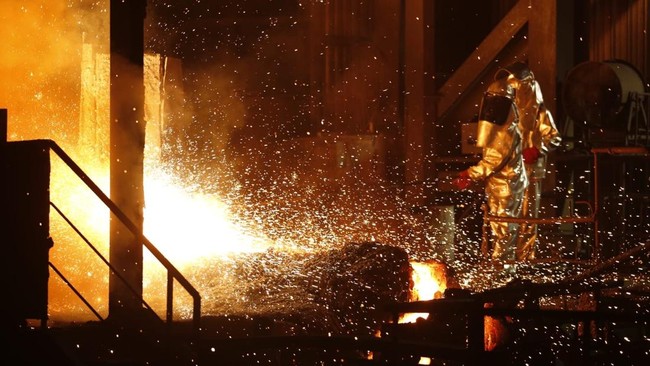
The Ministry of Energy and Mineral Resources (ESDM) says the global nickel market is oversupplied by 700,000–800,000 tonnes, against annual worldwide demand of 3.5 million tonnes.
Indonesia is the largest supplier, accounting for a dominant 65% of total global nickel supply.
Bahlil Lahadalia, Coordinating Minister for Downstreaming and Energy Transition as well as Energy and Mineral Resources Minister, said the build-up in supply had driven down international nickel prices.
He said the government would adjust national production quotas so that output is balanced with global market demand.
“Global nickel consumption is 3.5 million tonnes. Our production capacity is now 700,000–800,000 tonnes above demand. If we keep this up, prices will certainly fall further,” Bahlil said on the sidelines of the 2026 Minerba Convention & Exhibition (Convex) at JIExpo on Monday (2 November 2026).
He said Indonesia’s 65% share of supply should give it strong bargaining power in influencing commodity prices. Production volumes will be adjusted through the Work Plan and Budget (RKAB) mechanism to prevent prices from being dictated by external parties.
“That is why we will adjust production to the level of total demand. With 65% of supply coming from Indonesia, how can others be the ones determining the price?” he said.
Excessive production has previously driven global nickel prices below US$16,000 per tonne. The government plans to make quota adjustments flexibly in response to movements in international prices.
Nickel was trading at around US$15,400 per tonne on 2 November 2026.
“Prices can go lower or higher. If prices are good, production can be higher. But if prices are low, why would we produce so much?” he said.
Previously, Meidy Katrin Lengkey, secretary-general of the Indonesian Nickel Miners Association (APNI), said Indonesia still had a nickel ore surplus of as much as 19 million tonnes in 2026. The association expects domestic supply to keep increasing in 2027.
“Global demand matters to us, so nickel should not be viewed only in terms of domestic conditions. We still have a surplus of 19 million tonnes in 2026, and it is expected to be higher in 2027. This could reduce non-tax state revenue (PNBP),” Meidy said at a CNBC Indonesia Coffee Morning event titled “Downstreaming Advances, Mining Industry Grows Stronger?”, according to a report published on Thursday (29 October 2026).
She also said businesses in the nickel industry were facing a heavy regulatory burden upstream, alongside falling prices caused by global oversupply.
“This is something we need to consider going forward. It seems most regulations are upstream, with new rules appearing every month. There are also regional regulations, while nickel prices are falling,” Meidy said.
She called for greater attention to nickel industry operators so that prices could become more stable and supply could meet global demand.
“First, we need to get domestic regulations and other matters in order, so that we are not continually under pressure and prices can become more stable. We need to sit down together, because different ministries and institutions have different regulations,” she said.
Indonesia’s nickel floods the world
The Indonesian Nickel Industry Forum (FINI) recorded domestic production of 2.5 million tonnes of processed nickel from downstream activities in 2025. This made Indonesia the leading supplier, accounting for up to 60% of global nickel demand.
FINI chairman Arif Perdana Kusumah said Indonesia’s nickel refining facilities had a total production capacity of 2.7 million tonnes of nickel in 2025. The output came from domestic pyrometallurgical and hydrometallurgical processing.
“In 2025, national nickel production reached 2.5 million tonnes in the form of intermediate products: 2.05 million tonnes of NPI, ferronickel and matte, and 450,000 tonnes of nickel in the form of MHP and nickel sulphate,” Arif told CNBC Indonesia on Wednesday (14 October 2026).
The forum estimates that Indonesian processed nickel production will fall by 3.5% to 4% in 2026 compared with 2025. Production is projected to rise again in 2027 as new projects add capacity.
“2027 will see additional production capacity from HPAL-based hydrometallurgical projects. Their construction is due to be completed, with commissioning and full operations expected to follow shortly,” he said.
The additional HPAL capacity will focus on processing nickel for electric vehicle battery materials. National MHP production capacity, which stood at 450,000 tonnes in 2025, is expected to exceed 900,000 tonnes of nickel by the end of 2027.
“This level of production has made Indonesia the world’s largest nickel supplier, with a share of around 60%,” he said.
Source: jawawa.id (https://jawawa.id/newsitem/global-nickel-glut-indonesia-supplies-65-of-the-worlds-nickel-1793623863)
Originally published by CNBC Indonesia (https://www.cnbcindonesia.com/news/20261102190356-4-781678/dunia-lagi-kebanjiran-nikel-65-suplainya-dari-ri), translated from Indonesian