
Global Money Flow Shifts as South Korea Emerges as Winner
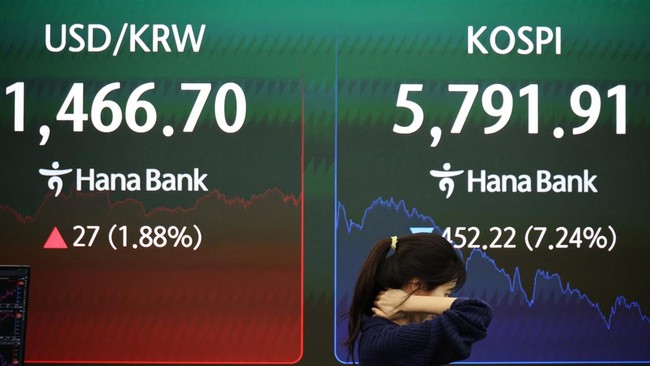
JAKARTA, CNBC Indonesia – Asia’s equity markets are currently centred on movements in South Korea’s stock exchange. Rising global demand for artificial intelligence infrastructure has been the main catalyst driving the KOSPI index to record highs, though accompanied by sharp declines as well. This positive sentiment is directly supported by semiconductor companies, which form the backbone of the global technology supply chain. Market participants are now focusing on the valuations of large-cap companies dominating the domestic exchange and the accompanying volatility in the index’s movements.
KOSPI Record and Impact of Semiconductor Giants’ Valuations
Samsung Electronics (005930.KS) has had a significant impact on the KOSPI’s movements, with its market capitalisation surpassing the psychological $1 trillion mark. The tech giant’s massive valuation provides substantial momentum due to its dominant weight in South Korea’s stock market. This achievement not only strengthens the company’s fundamentals but also attracts passive funds from global investment managers using the KOSPI as a benchmark for their Asia portfolios.
Beyond Samsung, SK Hynix has also driven the KOSPI index. The memory chip maker has increasingly attracted institutional investors after launching its integrated thermal solution, iHBM. Designed specifically to cool next-generation AI chips operating in extreme data centre temperatures, the technology reportedly reduces thermal resistance by 30%, enhancing overall hardware stability. This innovation is a key reason why global liquidity continues to flow into South Korea’s semiconductor sector.
Stock Price Trends and Market Volatility
According to trading data up to 26 May 2026, South Korea’s technology stocks have shown consistent upward trends. The KOSPI index, which had been trading around 7,493.18 on 15 May, rose steadily to close at 8,047.51 on Tuesday (26/5/2026). This momentum is reflected in large-cap companies. Samsung Electronics shares rose from KRW 270,500 to KRW 299,000 over the same period, while SK Hynix saw a more aggressive increase from KRW 1,800,000 to KRW 2,052,000.
Despite the upward trend, South Korea’s equity market has also faced near-record volatility. The KOSPI index briefly corrected by 4% at the start of last week’s trading due to large-scale profit-taking. Foreign investors recorded net selling of $13.2 billion from South Korea’s stock market within a single week. This forced the exchange authorities to activate a five-minute trading halt mechanism after KOSPI 200 futures fell by 5%. These fluctuations were amplified by local retail investors injecting up to $14.1 billion through margin instruments, creating divergent capital flows with foreign investors and heightening volatility.
Some financial institutions have noted the market has entered an overbought phase, compounded by rising global bond yields and tighter macrofinancial conditions.
Global Capital Rotation and Equity Market Capitalisation Map
The dynamics in the KOSPI also reflect South Korea’s strategic position in the global capitalisation landscape. The high inflow of capital into the tech sector has reshaped rankings of equity markets worldwide. Based on current market capitalisation data, South Korea now ranks seventh globally with a valuation of $4.92 trillion. This figure aligns with India’s equity market, solidifying South Korea’s position as a key liquidity hub in Asia.
The tech sector’s dominance lifting the KOSPI is part of a regional investment shift. Taiwan’s stock exchange recently recorded a valuation increase to $4.95 trillion, overtaking India to claim fifth place globally. This was driven by a 49% surge in Taiwan Semiconductor Manufacturing Co shares, which account for 42% of the local index’s weight.
Further Impact on Regional Investment Flows
The shift between Taiwan and India correlates directly with ongoing investment narratives in South Korea. Taiwan’s valuation rise reflects aggressive portfolio rotation by global institutional investors, with liquidity moving from technology-light emerging markets to hardware manufacturing hubs like South Korea and Taiwan. In contrast, India, once a primary focus for investors, now faces foreign capital outflows of $24 billion this year, triggering an 8% decline in its stock index. This weakening stems from perceived overvaluation, rupee depreciation pressures, energy costs, and the absence of global AI companies. Therefore, the KOSPI surge driven by Samsung’s $1 trillion market cap and SK Hynix’s innovations reflects a fundamental shift in global capital flows. The semiconductor sector is now positioned as a priority asset.
Source: jawawa.id (https://jawawa.id/newsitem/global-money-flow-shifts-as-south-korea-emerges-as-winner-1779887371)
Originally published by CNBC Indonesia (https://www.cnbcindonesia.com/research/20260526145138-128-738158/perputaran-uang-dunia-berubah-korea-selatan-jadi-pemenangnya), translated from Indonesian