
Global Low-Carbon Industry Forum 2026 Discusses Solutions to Close Electricity Access Gap
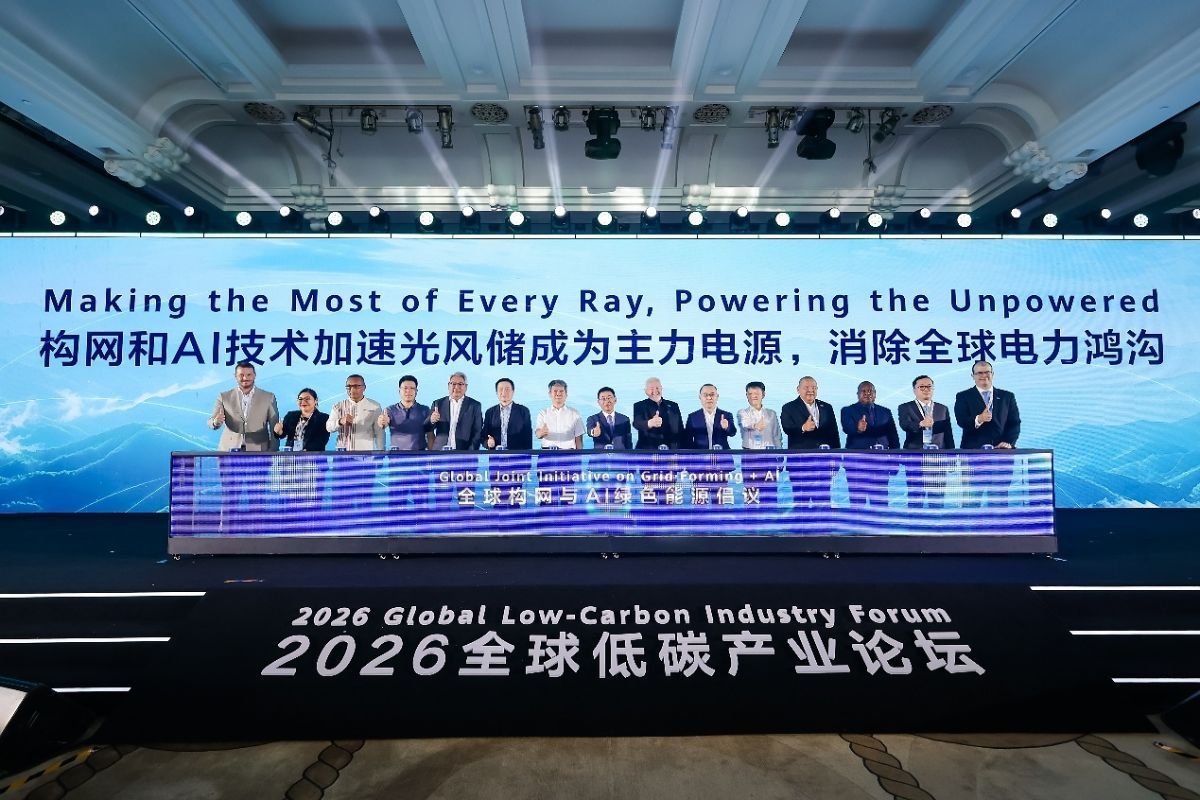
Shenzhen, China — The Global Low-Carbon Industry Forum 2026 took place in Shenzhen on 15 September 2026, under the theme “Making the Most of Every Ray, Powerting the Unpowered”. The forum was organised by the Global Solar Council, China Energy Research Society, World Alliance for Low Carbon Cities, Tsinghua Shenzhen International Graduate School, and Huawei Digital Power. Industry leaders, academics, grid operators, and corporate representatives from various nations gathered to discuss the role of grid-forming technology and AI in reshaping the global energy landscape.
Hou Jinlong, Director of the Board at Huawei and President of Huawei Digital Power, stated in his opening remarks that decarbonisation, electrification, digitalisation, and smart technology have become long-term trends in the global energy transition. However, he noted that the energy transition lacks a one-size-fits-all solution, as every region faces different and complex structural challenges. In areas with high renewable energy penetration, the focus is on maintaining system security; in developing nations, the priority is ensuring power supply while controlling costs; and in underdeveloped regions, the priority is expanding inclusive electricity access. The integration of grid-forming technology and AI can drive the use of renewable energy that is low-cost, highly reliable, sustainable, and secure. Huawei Digital Power is committed to working with partners to promote the vision of “grid forming everywhere and AI for everywhere”, building a healthy and sustainable digital energy industry ecosystem.
Trend Prospects: Integrating Grid Forming and AI to Address Key Challenges in the Global Energy Transition
The global energy landscape is undergoing a paradigm shift. A representative from the Global Solar Council noted that the world is moving from fossil fuel dependency towards energy independence based on local solar resources and energy storage, particularly amidst global uncertainty. Technological revolutions are paving the way for this transformation, where the integration of solar PV and energy storage will be key to building more resilient and sustainable electricity systems.
Wang Xiongfei, an IEEE Fellow and Xinghua Chair Professor at Tsinglyhua University, discussed new challenges arising from GW-scale AI Data Centres (AIDC). He stated that future data centres must not only be large-scale consumers of electricity but must also act as grid-friendly loads, capable of detecting grid conditions, providing proactive support, and maintaining operation during power disturbances (fault ride-through). He proposed a “chip-to-grid” collaborative design concept utilising technologies such as grid-forming energy storage, UPS control optimisation, and coordinated workload shaping to improve the interaction between data centres and the grid, thereby maintaining the stability of future computing infrastructure.
Patrick Clerens, Secretary-General of Energy Storage Europe, presented on “European Energy Storage Markets: Market Mechanisms and the Development of GFM Services”. He explained that the development of energy storage market mechanisms in the EU is being driven by the need to maintain security of supply and reform electricity market designs. He noted that the surge in renewable energy proportions is reducing system inertia, making grid-forming capabilities increasingly essential. He also detailed market-based explorations in Europe for grid-forming services, such as synthetic inertia and fast frequency support, mentioning that Germany and several other countries have begun auctioning grid-forming capabilities, creating new business models and opportunities for the energy storage sector.
Dr. Liu Yunfeng, Chief Scientist at Huawei Digital Power, presented on “Grid Forming + AI: Powering the Energy Internet’s Silicon Evolution”. He stated that power systems are transitioning from “electromagnetic-mechanical systems” to “silicon-based programmed systems”, where system stability is shifting from an “inherent attribute” to a “designed capability”. He introduced Huawei’s integrated verification system for grid-forming technology and emphasised that AI is not an optional feature for the Internet of Energy, but a vital capability for complex systems to operate autonomously. Huawei’s FusionSolar Agent, supported by a four-layer AI architecture covering computing foundations, power models, smart devices, and agents, redefines intelligent power generation management throughout its lifecycle, enhancing smart technology across solar PV, wind power, and energy storage systems.
Proving Standards Through Practice: From Certification to the World’s Largest PV+ESS Project Verification
Pouya Mostashar, a Research Associate at Fraunhofer IWES, presented the results of the first megawatt-level grid-forming test in Europe conducted with Huawei. The test strictly followed the world’s first comprehensive VDE FNN grid-forming testing guidelines in Germany. The results demonstrated that the energy storage system performed exceptionally well across several key scenarios, including inertia response, overload capability, and islanded operation. According to Mostashar, this test not only proves the effective application of grid-forming technology in battery energy storage systems but also serves as a benchmark for the industry.