
Global Lenders Take Note of Companies’ Human Rights Risks
JAKARTA — The risk of human rights violations can affect a mining company’s ability to meet its credit obligations. Conflicts with local communities that lead to operational shutdowns could cause losses and disrupt the company’s cash flow.
Bachtiar Manurung, ESG and Climate Change Lead at PT Merdeka Copper Gold, said human rights risks are among the considerations global lenders take into account when financing companies. Managing these risks, he said, is directly connected to operational continuity and a company’s financial condition.
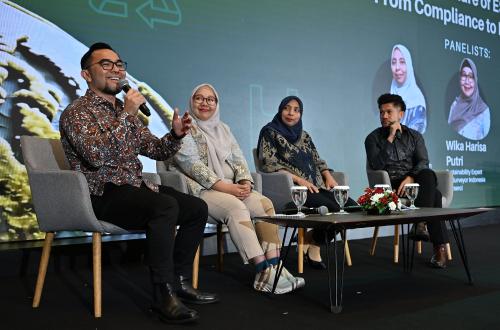
“For them, human rights risk turns out to be credit risk,” Bachtiar said at the ESG NOW Leadership Forum 2026 in Jakarta on Monday (19 October 2026). The panel on implementing human rights in business was organised by Republika in collaboration with the Indonesian Society of Sustainability Professionals (IS2P) and Surveyor Indonesia as knowledge partners. The discussion was moderated by Akmal Abudiman, a member of IS2P’s Research and Certification team.
Bachtiar explained that human rights violations in the mining sector can trigger conflicts with communities living near operational areas. Such disputes could force mining activities to stop, even in the short term.
A shutdown can cause losses that affect a company’s ability to repay its loans. For that reason, Bachtiar said, human rights risks need to be factored into companies’ business and financial risk management.
International investors also consider the application of human rights principles when assessing companies. Bachtiar said human rights issues can affect environmental, social and governance (ESG) ratings as well as investor confidence. “If the score is poor, the ESG rating automatically falls and investor trust declines,” he said.
Merdeka Copper Gold bases its risk management on the United Nations Guiding Principles on Business and Human Rights (UNGP). The company has drawn up a human rights policy signed by its president director and communicated it to employees.
Training is also provided to groups of workers who have frequent interactions with communities around the company’s operational areas. The aim is to improve employees’ understanding of how human rights principles should be applied in the company’s activities.
In addition, Merdeka Copper Gold conducts Human Rights Impact Assessments as part of its Human Rights Due Diligence process. The assessments are used to identify the impact of the company’s activities on human rights.
Bachtiar said the challenge of applying human rights principles goes beyond drafting policies and reports. Companies must also ensure that implementation covers employees, contractors, communities, subsidiaries and the supply chain.
Source: jawawa.id (https://jawawa.id/newsitem/global-lenders-take-note-of-companies-human-rights-risks-1792569069)
Originally published by Republika (https://esgnow.republika.co.id/berita/tn8vov416/kreditur-global-ternyata-perhatikan-risiko-ham-perusahaan), translated from Indonesian