
Global Institutions Forecast Gold and Silver Prices This Week
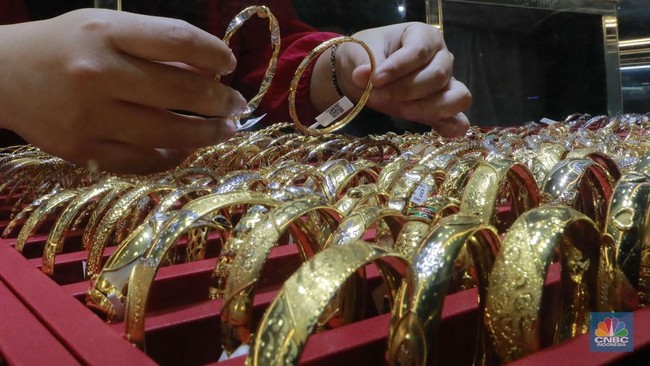
Gold and silver prices are expected to struggle to rebound this week. Market participants will closely monitor the developments of the US-Iran conflict, global oil price movements, and a series of important economic data that could influence the Federal Reserve’s interest rate policy.
Investor focus will be directed towards the release of manufacturing and services PMI from several countries, Eurozone inflation, and US employment data, including Non-Farm Payrolls (NFP) and the unemployment rate. These data points are expected to determine the direction of gold prices in the short term.
According to Refinitiv, the price of gold as of Monday (29/6/2026) at 06:15 WIB was US$4,087.99 per troy ounce, representing a slight decline of 0.01%. Last Friday (26/6/2026), gold closed at US$4,088.23 per troy ounce, up 1.5%. However, overall, gold prices fell by 1.73% last week, marking the fourth consecutive week of declines.
Technically, gold prices remain in a bearish trend after breaking below the upward trend line. As long as prices fail to return above US$4,115 per troy ounce, selling pressure is expected to continue. The nearest support area is identified between US$3,927 and US$3,886 per troy ounce. If this level is breached, gold prices could potentially drop to US$3,650 per troy ounce.
Conversely, if gold can break above US$4,115 per troy ounce, it has the opportunity to reverse and strengthen, with the next target around US$4,248 per troy ounce. For now, the outlook for gold remains bearish.
Analyst views on future gold prices are divided. ING has slashed its gold price projections, anticipating that a strong US dollar and high interest rates will limit price increases. However, JPMorgan remains optimistic that gold prices could approach US$5,000 per troy ounce in the fourth quarter of 2026, with the potential to reach US$6,000 per troy ounce in the long term, driven by strong demand from central banks and investors.
ING reduced its projections because it expects high US bond yields, a strengthening US dollar, and weakening demand for ETFs to continue weighing on precious metal prices longer than previously anticipated. ING now projects average gold prices to be at US$4,300 per troy ounce in Q3-2026 and US$4,600 per troy ounce in Q4-2026, lower than previous projections of US$4,850 and US$5,000 respectively.
“Although the market is increasingly concerned that interest rates will remain high for longer, our US economists still expect the Federal Reserve to maintain its benchmark interest rate. However, high bond yields and a strong US dollar are expected to remain negative sentiments weighing on gold prices in the short term,” said Ewa Manthey, commodities strategist at ING.
Furthermore, geopolitical tensions have not yet triggered a surge in demand for safe-haven assets as seen in previous periods. Market participants are instead focusing on the impact of conflict on inflation and monetary policy directions. Another factor weighing on gold is the weakening demand from Exchange Traded Funds (ETFs). After being a primary driver of the gold rally early this year, investors have begun profit-taking since March as expectations regarding Fed policy shifted. Currently, global gold holdings in ETFs are approximately 1.5% lower than at the start of the year.
Nevertheless, gold purchases by central banks remain a primary support for prices. In Q1-2026, central banks worldwide added approximately 244 tonnes of gold, with Poland and China being the largest buyers. China has even increased its gold reserves for 19 consecutive months.
A survey by the World Gold Council (WGC) also shows that 84% of central banks expect the share of gold in global foreign exchange reserves to increase over the next five years, while nearly 90% expect official gold holdings to continue growing in the next 12 months.
“The sustained high demand for gold from central banks reflects ongoing efforts to diversify foreign exchange reserves. This condition is expected to support gold prices, even though investor demand remains under pressure,” explained Ewa.
Pranav Mer, Vice President of EBG Commodity & Currency Research at JM Financial Services, stated that the momentum for gold and silver prices remains in a downward trend and a correction phase.
Jateen Trivedi, Vice President and Commodity and Currency Research Analyst at LKP Securities, noted that gold was under strong selling pressure throughout last week, closing down by approximately 2%. This weakness extends the weekly downward trend as the continued strengthening of the US dollar continues to burden precious metal prices.