
Global Halal Market Projected to Reach 3.56 Trillion US Dollars, Muslim Nations Not Yet Dominant
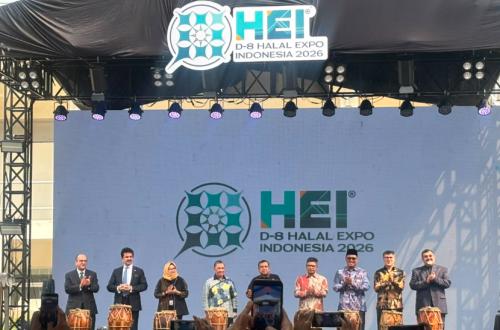
The global halal market continues to grow and is projected to reach more than 3.56 trillion US dollars by 2029. This vast potential is not yet aligned with the position of Muslim-majority countries, which still lag behind in the global value chain for halal products. D-8 Secretary-General Sohail Mahmood stated that Muslim consumer spending reached approximately 2.4 trillion US dollars in 2023 and is expected to surpass 3.3 trillion US dollars in the coming years. Despite rising demand, Muslim-majority countries are not yet the world’s largest exporters of halal products. “This condition shows that the challenge we face lies not in the size of the market, but in the ability to create added value,” he said during the Opening Ceremony of the D-8 Halal Expo Indonesia at Tennis Indoor Senayan, Jakarta. According to Sohail, D-8 member countries actually possess significant capital to catch up. In addition to having abundant human and natural resources, D-8 member countries are also supported by growing industrial capacity, a rapidly expanding digital economy, and the world’s largest young population. Guided by the D-8 2030 Roadmap, member countries are targeting intra-D-8 trade to reach 500 billion US dollars by 2030. However, to date, the value has only reached around 116 billion US dollars. To accelerate the achievement of this target, the D-8 is pushing for the strengthening of trade and industry, the digital economy, artificial intelligence, innovation, energy security, transport connectivity, food security, and the development of micro, small, and medium enterprises. The halal economy is also seen as a link connecting these various sectors. Sohail proposed three main steps: building an integrated D-8 halal trade corridor, developing a digital platform and halal investment, and increasing investment in innovation and technology, including AI-based and blockchain traceability systems.