
Global Geopolitical Impact on Energy, Food, and Indonesia's Economy
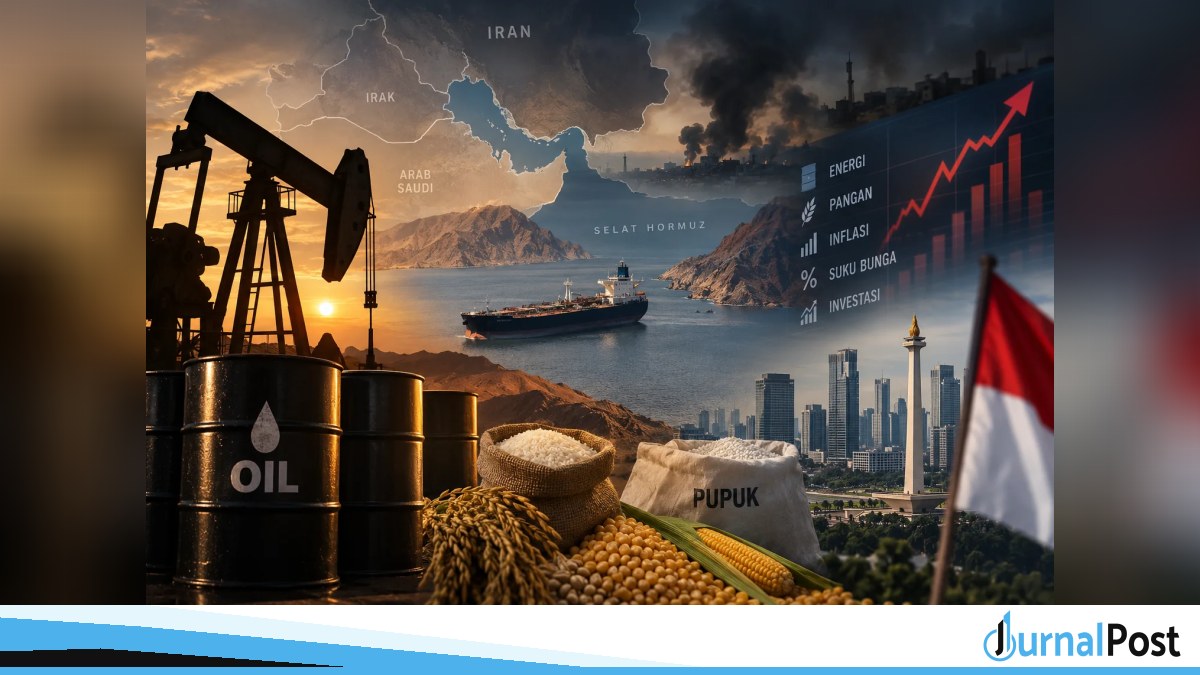
JAKARTA – The conflict in the Middle East and shipping disruptions in the Strait of Hormuz are not only triggering concerns over global oil supplies. The impact is spreading much further, affecting energy prices, fertilizers, and food, as well as interest rates, public purchasing power, and corporate investment decisions.
For Indonesia, the issue is no longer just whether these upheavals will have an impact, but how deeply this global pressure will affect the national economy.
Geopolitical uncertainty has now become a powerful external factor in shaping the expectations of consumers, businesses, and financial markets.
The International Monetary Fund (IMF) notes that the Geopolitical Risk Index in March 2026 is again approaching levels seen at the start of the Russia-Ukraine conflict in 2022. At that time, the surge in energy and food prices quickly spread to various countries.
Such uncertainty makes economic decision-making more difficult. Households must determine whether to continue spending or increase savings, while companies face the choice between continuing expansion or delaying investment until the situation becomes clearer.
Energy and Food Dragged Along
The Strait of Hormuz is one of the most important energy shipping lanes in the world. When this route is disrupted, pressure on global commodity markets intensifies.
The World Bank estimates that energy prices will surge by approximately 24 percent in 2026, marking the largest increase since the Russian invasion of Ukraine in 2022. Shipping disruptions are also said to have triggered a major shock to oil supplies, with an initial reduction in global supply of about 10 million barrels per day.
Meanwhile, the IMF projects that crude oil prices will increase by about 32 percent and natural gas by 22 percent compared to 2025.
The impact does not stop at the energy sector. Fertilizer is one of the strongest transmission channels to the food sector.
About 30 percent of global fertilizer trade passes through the Strait of Hormuz, while natural gas is a critical raw material for producing nitrogen fertilizer.
Urea prices were recorded at over 850 US dollars per ton in April 2026, an increase of about 80 percent since February and reaching the highest level since April 2022.
The Food and Agriculture Organization (FAO) of the United Nations estimates that a decline in fertilizer availability could potentially affect the production of wheat, corn, and rice in the following six to nine months.
FAO Chief Economist Máximo Torero explained that farmers are facing cost pressures from two directions simultaneously: expensive fertilizer and rising fuel costs, which affect agricultural activities from irrigation to distribution.
The process can be gradual. Rising energy prices increase the cost of fertilizer and agricultural production. Higher costs then affect crop yields and commodity prices before finally being passed on to consumers in the form of food inflation.
The FAO Food Price Index in April 2026 averaged 130.7 points, an increase of 1.6 percent compared to March and the highest level since February 2023.
Ultimately, consumers are the ones who bear the rising costs throughout the supply chain.
World Bank Chief Economist Indermit Gill described this pressure as a chain reaction that begins with energy, moves toward food, and eventually results in higher inflation.
Low-income groups are among the most vulnerable because a large portion of their income is used to meet food and energy needs.
Monetary Policy Space Increasingly Narrow
The price surge is also changing expectations regarding global monetary policy.
Markets are no longer just talking about the possibility of interest rate cuts in several developed countries. In conditions where inflation is under renewed pressure, high interest rates may potentially persist for longer.
For developing countries like Indonesia, this situation creates its own challenges. Attractive yields in developed countries can encourage investors to shift funds toward assets considered safer.
As a result, capital outflows may increase, the exchange rate comes under pressure, and the cost of importing energy and food becomes more expensive.
Economist Hélène Rey explained in 2013 that United States monetary policy can drive a global financial cycle that affects various countries.
According to Rey, this condition is more accurately described as a “dilemma” rather than a “trilemma.” This means that even when a country uses a floating exchange rate system, the independence of its monetary policy space can still be limited by the movements of the global financial cycle.
Central banks in developing countries ultimately face difficult choices.
Lowering interest rates can help economic growth, but at the same time, it risks increasing capital outflows and worsening imported inflation.
The experience of the taper tantrum in 2013, when Indonesia was briefly included in the group of countries known as the Fragile Five, serves as a reminder of these risks.
Another issue that must be anticipated is the emergence of inflation that becomes increasingly entrenched in public expectations.
When the public and businesses believe that prices will continue to rise, workers may demand wage increases while companies raise prices early to anticipate rising costs.
In such conditions, inflation that initially stems from external shocks can become more difficult to control.
Frederic Mishkin’s thinking places the credibility of the central bank in managing inflation expectations as one of the foundations of price stability.
Meanwhile, Blanchard and Galí found in 2007 that the impact of oil shocks in the 2000s was milder than in the 1970s, partly because inflation expectations were better anchored.
Economic Growth Also Under Pressure
Geopolitical pressure also has consequences for global economic growth.
The IMF projects that global economic growth will slow to about 3.0 percent in 2026 before increasing again to 3.4 percent in 2027. This fig
Source: jawawa.id (https://jawawa.id/newsitem/global-geopolitical-impact-on-energy-food-and-indonesias-economy-1791337858)
Originally published by jurnalpost.com (https://jurnalpost.com/en/geopolitics-impact-indonesia-economy/98040/)