
Global Food Prices Fall, but Indonesia Sees the Opposite
Jakarta, CNBC Indonesia — Global food prices fell again in October 2026 after rising for several months. The decline was driven mainly by lower cereal, dairy and meat prices, although sugar prices surged sharply.
According to a Food and Agriculture Organization (FAO) report released on Friday (6 November 2026), the FAO Food Price Index (FFPI) stood at 133.9 points in October, down 1.6 points, or 1.2%, from the revised September figure.
Despite the monthly fall, the global food price index was still 5.9% higher than in October 2025. It remained 16.4% below the record high of 160.2 points recorded in March 2022.
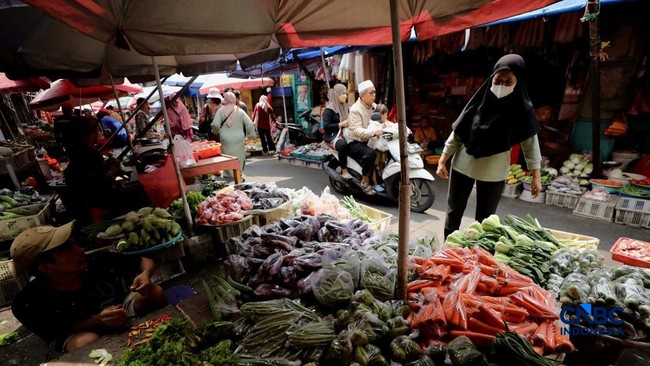
In contrast to the global trend, food prices in Indonesia rose. Statistics Indonesia (BPS) data showed that the food, drink and tobacco group recorded monthly inflation of 0.51% in October 2026, driven mainly by higher prices for red chillies, bird’s eye chillies and tomatoes. Overall, Indonesia’s inflation was 0.22% month on month and 3.23% year on year.
The FAO index measures changes in international prices across five food commodity groups: cereals, vegetable oils, meat, dairy products and sugar. Its calculation uses weights based on each group’s average share of exports during 2014–2016.
Cereal prices fall as sugar surges
The global food price decline in October was driven primarily by cereals, which recorded the largest monthly drop among the five commodity groups.
The FAO cereal price index fell 4.5% to 116.8 points, from 122.3 points in September. The decline was mainly due to weaker international wheat and maize prices.
Wheat prices fell after four consecutive months of increases, amid weak global demand and improved production prospects, particularly in Argentina. Expectations that export obstacles in the Black Sea region would ease also added downward pressure.
Maize prices weakened under pressure from the US harvest and expectations of ample supplies from major South American producers. By contrast, the FAO rice price index rose 1.6%, owing to delayed harvests and unfavourable weather in several exporting countries.
The meat price index also fell, declining 1.2% to 125.5 points. Prices for pork, lamb and beef weakened, while poultry prices were relatively stable.
Dairy prices dropped 1.1% to 117.8 points, mainly because of lower butter and cheese prices amid abundant supplies and limited demand, particularly in Europe.
Unlike those three groups, the sugar price index surged 6.6% to 121.3 points. It rose for the fourth consecutive month, reaching its highest level since December 2024.
The sugar price surge was driven mainly by rain disrupting sugarcane harvesting and processing in Brazil’s Centre-South region. Concerns over production prospects in India, the European Union and Thailand in the 2026/2027 season also pushed prices higher.
Vegetable oils edge up; what about CPO?
Despite the overall decline in the food index, global vegetable oil prices continued to rise modestly.
The FAO vegetable oil price index increased 0.3% to 199.2 points in October, mainly as stronger soybean and sunflower oil prices offset a fall in rapeseed oil prices.
Soybean oil prices reached their highest level since late 2022, supported by demand from the biofuel sector and a seasonal reduction in supplies from South America.
Sunflower oil prices strengthened again because of limited export supplies from the Black Sea region, which continues to face logistical disruptions.
For palm oil, the FAO said international prices were relatively stable throughout October, but remained well above the same period a year earlier. Strong import demand and expectations of lower production in Southeast Asia in the 2026/2027 season provided support.
However, the market began to shift in November. Malaysian crude palm oil (CPO) futures fell 9.04% over trading from 2 to 6 November 2026, mainly because of weaker soybean oil and global crude oil prices.
The contrast shows that the rise in the vegetable oil index in October may not continue into November, as the prices of individual vegetable oils are shaped by different supply and demand conditions.
Food price declines have not eliminated inflation risks
The October fall in the FFPI indicates that some pressure from international food commodity prices has eased. However, the sharp rise in sugar prices and the still-high vegetable oil index show that the risk of further price increases has not disappeared.
For Indonesia, global food price developments matter because they can affect the cost of imported food, raw materials for the food and drink industry, and export commodity prices such as palm oil.
Nevertheless, international price declines are not always passed on immediately to domestic consumers. Exchange rates, distribution costs, domestic supply and trade policies also determine the prices people ultimately pay.
Global food price developments in the coming months will therefore need to be monitored, particularly amid weather uncertainty, supply-chain disruptions and changing demand for international commodities.
Source: jawawa.id (https://jawawa.id/newsitem/global-food-prices-fall-but-indonesia-sees-the-opposite-1794149445)
Originally published by CNBC Indonesia (https://www.cnbcindonesia.com/research/20261108120436-128-783276/harga-pangan-dunia-turun-sayang-di-indonesia-kebalikannya), translated from Indonesian