
Global Enthusiasm Greets Birth of Rare Twin Proboscis Monkeys
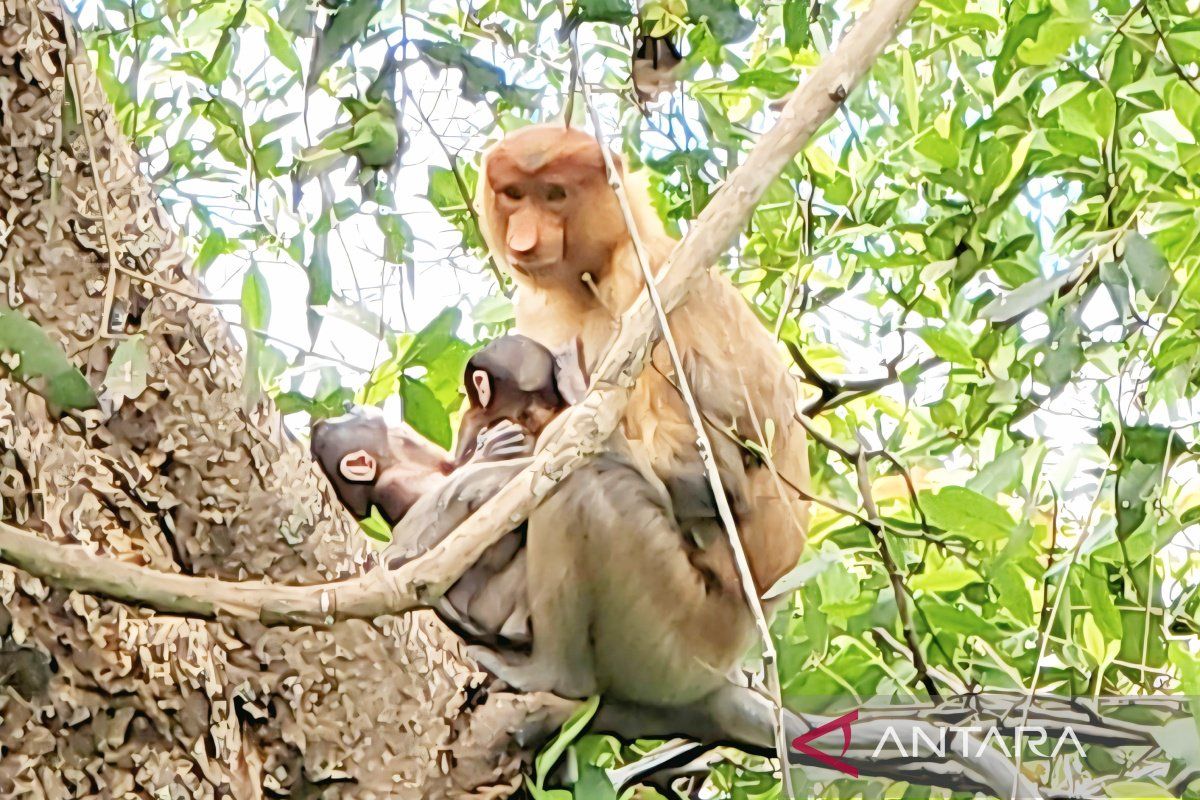
At first glance, the infant proboscis monkeys look no different from other newborn primates. Their tiny bodies are covered in thick black fur, while their faces are dark blue, far from the adult proboscis monkey’s characteristic yellowish-brown coat and large nose. However, time will change their appearance. As they age, the black fur will gradually turn yellowish-brown, and their noses will grow longer until they resemble those of adult proboscis monkeys. This rare sight was recently observed on Curiak Island, Barito Kuala Regency, South Kalimantan. What makes it even more special is that not just one, but a pair of twin babies were born at the Camp Tim Roberts Proboscis Monkey Research Station. The station is managed by Dr. Amalia Rezeki, a biological conservation expert from Lambung Mangkurat University (ULM), together with Sahabat Bekantan Indonesia (SBI). Amalia said the twin proboscis monkey babies, born in mid-June 2026, came from the alpha group’s female. According to Amel, as she is affectionately known, twin births in primates are an extremely rare phenomenon. The probability of twin births in primates, especially Old World monkeys like the proboscis monkey (Nasalis larvatus) in the wild, is very small compared to single births. The twin babies were first spotted when Amel and her team were conducting routine monitoring in the Camp Tim Roberts area. Amel admitted she was moved to witness the amazing sight of the two twin babies nursing while being cradled by their mother. ‘We were very grateful and even shed tears of joy because after more than ten years of dedicating myself to the conservation of proboscis monkeys on Curiak Island, this is the first time I have found a twin birth,’ said the ULM Biology Education lecturer who won the 2022 Kalpataru award for environmental protection. According to her, three baby proboscis monkeys have been born in the Camp Tim Roberts area this mid-year, which is part of the Curiak Island Proboscis Monkey Research Station, a habitat located outside a conservation area. Amel explained that the reproductive age for male proboscis monkeys begins at 4 to 5 years, while for females it is 4 years. Proboscis monkeys typically give birth to only one baby per season, with a gestation period of 5 to 6 months. The babies are cared for communally, with young females acting as ‘baby sisters’ within the colony. Amel revealed that the birth of the twin proboscis monkeys has attracted global attention, particularly from academics and biodiversity conservation activists. The primate, which is listed as Endangered on the IUCN Red List, is now receiving even greater international focus following the emergence of the twin babies.