
Global Energy Transition Investment Hits US$ 2.3 Trillion, Indonesia Targets Green Industry Supply Chain
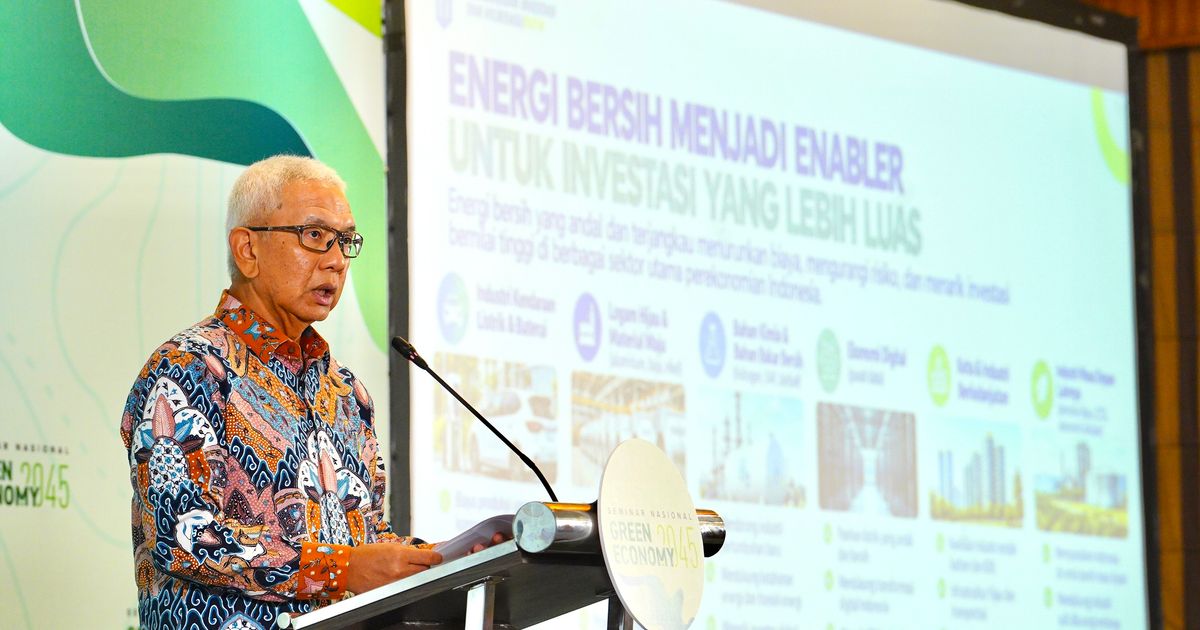
The Secretary of the Ministry of Investment and Downstreaming/Investment Coordinating Board (BKPM), Mohammad Rudy Salahuddin, has revealed that global energy transition investment trends are experiencing a significant surge. Based on BloombergNEF research, he noted that global energy transition investment is set to surpass US$ 2.3 trillion by 202lar, representing an 8% growth compared to the previous year.
According to Rudy, the decarbonised or electrified transport sector is the largest driver with a value of US$ 893 billion, followed by the renewable energy sector at US$ 690 billion, and the power grid sector at US$ 483 billion.
He explained that this surge in global investment is fundamentally altering the world’s industrial landscape. Industrial locations, supply chains, technology implementation, and labour absorption are now increasingly tied to the availability of clean energy.
“Countries that are able to provide clean energy while simultaneously building an industrial ecosystem will become increasingly competitive in attracting new investment,” Rudy stated during the 2045 Green Economy National Seminar held in Jakarta.
Rudy emphasised that developing a green economy for Indonesia is not merely an agenda for reducing carbon emissions. Beyond that, this momentum represents a golden opportunity for Indonesia to strengthen its manufacturing ecosystem, domestic supply chains, innovation, and the creation of value-added jobs based on sustainability.
To capture opportunities from the global energy transition market, Indonesia is considered to already possess a strong foundation. UN Comtrade Environmental Goods List trade data shows that the global trade value of electric vehicles and batteries has surged sharply from US$ 90 billion in 2019 to approximately US$ 450 billion by 2025. During the same period, trade in renewable energy technology skyrocketed from US$ 210 billion to over US$ 350 billion.
In response to these opportunities, the Ministry of Energy and Mineral Resources (ESDM) noted that the updated national renewable energy (EBT) potential has reached 3,687 gigawatts (GW), with solar potential reaching 3,294 GW. However, as of 2026, the utilised renewable energy capacity is only around 16.3 GW, or less than 0.5 percent of the total potential.
“This means our investment space is still very large, both in the generation sector, transmission networks, battery energy storage systems (BESS), as well as its supporting manufacturing industries,” Rudy explained.
To accelerate low-carbon downstreaming, the Ministry of Investment and Downstreaming/BKPM has mapped 28 strategic commodities across 8 main sectors, with potential investments reaching USD 618.1 billion by 2040. This project is projected to create more than 3 million new jobs.
The availability of clean energy supplies is also believed to be a major attraction for future industrial sectors, such as green industrial parks, data centres, green ammonia, carbon capture and storage (CCS/CCUS) technology, and the carbon market.
The government emphasises that Indonesia does not want to merely be a supplier of raw materials. Therefore, Indonesia continues to seek global partnerships that bring not only capital but also technology transfer, competence, and long-term commitment.
“The speed of this transformation is determined by the close synergy between the government, SOEs, the private sector, financial institutions, and global investors. The realised investment must result in added value, quality employment, and inclusive economic growth,” he concluded.
Source: jawawa.id (https://jawawa.id/newsitem/global-energy-transition-investment-hits-us-2-3-trillion-indonesia-targets-green-industry-supply-chain-1790704254)
Originally published by investortrust.id (https://investortrust.id/business/117817/investasi-transisi-energi-global-tembus-us-2-3-triliun-ri-incar-rantai-pasok-industri-hijau), translated from Indonesian