
Global Demand Recovery Could Strengthen Indonesian Textile Export Performance
Indonesia’s textile and textile product (TPT) industry is considered to have an opportunity to strengthen its contribution to national exports, in line with improving global demand and the increasing need for sustainable textile products. To capitalise on this momentum, the TPT industry needs to bolster its competitiveness through supply chain strengthening, production modernisation, and export financing support.
The Indonesia Eximbank Institute noted that global demand for upstream textile products, such as yarn, woven fabrics, and knitted fabrics, has begun to show a recovery trend throughout 2025. This condition opens opportunities for the national textile industry to increase its penetration in international markets, although Indonesia’s export share still faces pressure from the rising competitiveness of China, India, and Vietnam.
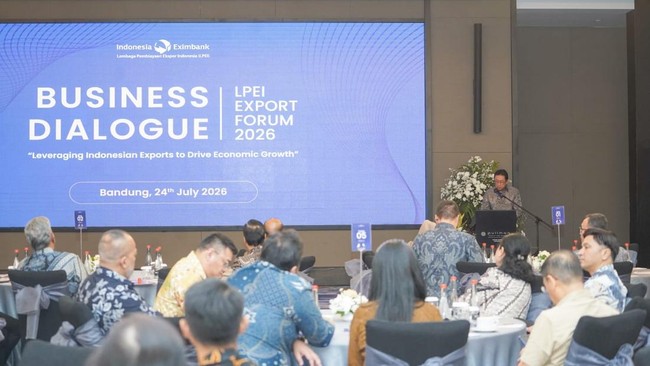
As part of this effort, LPEI organised the LPEI Export Forum (LEF) in Bandung with the theme ‘Building a Competitive and Sustainable Garment Supply Chain for the Global Market’. The forum brought together textile and garment industry players, exporters, suppliers, associations, and other stakeholders to discuss global market prospects as well as strategies to strengthen Indonesia’s export competitiveness.
LPEI Executive Director of Business I, Anton Herdianto, stated that Indonesia’s textile export competitiveness is currently supported by finished fabric products, which account for approximately 74 percent of total national TPT exports. According to him, the sustainability of export performance is determined not only by garment producers but also by the strength of the entire industrial supply chain.
‘Global buyers now consider not only competitive prices, but also product quality, delivery punctuality, traceability, compliance with international standards, and the use of sustainable materials. Therefore, strengthening the supply chain is key to maintaining Indonesia’s export competitiveness,’ said Anton.
The Indonesia Eximbank Institute estimates that national textile exports will continue to grow solidly until 2027, in line with improving global prospects and projected declines in global interest rates. National textile exports are forecast to grow by around 2 to 3.2 percent in 2026, based on current export growth realisation of 1.3 percent, while in 2027 growth is expected to reach 3.5 to 4.0 percent. This growth is driven by increasing demand for sustainable textile products, particularly in the premium market segment.
According to Anton, Indonesia has strong capital to capture these opportunities, especially in terms of competitive labour costs and an integrated industrial structure from upstream to downstream. The challenge now is to increase productivity, accelerate industrial modernisation, and meet sustainability standards that are increasingly becoming key requirements in export markets.
To support this transformation, LPEI provides various financing facilities, guarantees, insurance, and trade finance tailored to exporters’ needs. This support includes pre-shipment and post-shipment financing, Trade Credit Insurance to protect against the risk of default by foreign buyers, and Marine Cargo Insurance to provide protection during the shipping process.
This is also in line with the direction of Finance Minister Purbaya Yudhi Sadewa, who recently encouraged the revitalisation of the textile and footwear industries through the provision of affordable liquidity via Indonesia Eximbank/LPEI to upgrade machinery and enhance global competitiveness.
‘Strengthening the national textile supply chain requires close collaboration. LPEI is present not only through financing, but also through advisory services and market insights so that exporters are better prepared to meet the needs of the global market,’ said Anton.
Meanwhile, the President Director of PT Ungaran Sari Garments, Maniwanen, revealed that LPEI supports the company in maintaining the smooth flow of export activities while improving international trade risk mitigation, especially in the textile sector. ‘LPEI’s facilities greatly assist our export operations. In addition to reducing the financing burden, its insurance products also provide protection against various risks, making us more confident in expanding our export markets,’ he said.
Through strengthened financing, increased industrial capacity, and closer collaboration between the government, LPEI, and business players, Indonesia’s textile industry is expected to enhance its competitiveness while increasing its contribution to national exports amid the changing global trade landscape.