
Global Debt Surges to US$365 Trillion as Poorer Nations Struggle to Keep Up
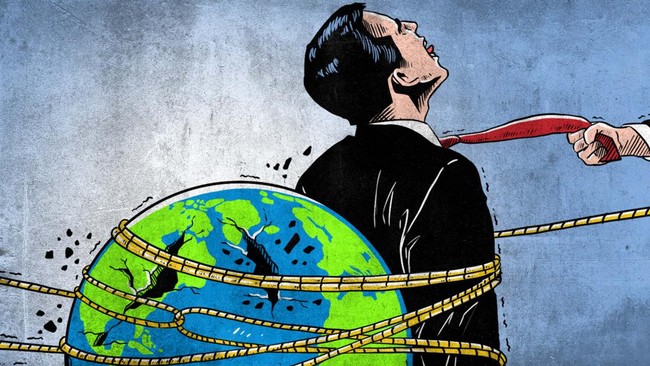
Global debt continues to rise and has now reached a record high. Governments, businesses and households across the world are taking on ever-larger amounts of borrowing year after year.
At the same time, borrowing costs are increasing. Many countries are spending more to service their debt even as budgetary needs for development and public services grow.
According to the Institute of International Finance’s (IIF) Global Debt Monitor, total global debt exceeded US$365 trillion at the end of the first half of 2026, equivalent to more than Rp6,590.08 quadrillion at an exchange rate of Rp18,055 per US dollar.
The total rose by about US$10 trillion in just the first six months of the year, with most of the increase coming from emerging markets.
That debt is equivalent to around US$44,000 for every person in the world today.
The IIF’s measure covers several sectors, including governments, households, non-financial companies and financial institutions.
But the problem is not simply that debt keeps growing. The cost of servicing it is also swelling.
As Al Jazeera reported on 22 October 2026, advanced economies spent more than US$3.3 trillion on interest payments on government bonds over the past year.
That was more than estimated global defence spending of US$3.1 trillion, investment in artificial intelligence (AI) of US$2.6 trillion, and clean energy investment of US$2.3 trillion.
These large interest payments pose a challenge for governments. The more money spent on interest, the less is available to fund public needs.
Governments face difficult choices, from cutting spending and raising taxes to borrowing again to cover budget shortfalls.
The pressure can also spread to households. When government borrowing costs rise, interest rates on mortgages, car loans and consumer credit may also increase.
But if even advanced economies are spending so much on interest, what does this mean for poorer countries with far more limited financial resources?
Developing countries’ debt hits a record US$9.4 trillion
Debt problems are even more acute for some developing countries. They face rising borrowing costs while also having major development needs.
The World Bank’s International Debt Report 2026, released on Thursday (5 November 2026), found that the external debt of low- and middle-income countries reached a record US$9.4 trillion at the end of 2025.
That was a 5.5% increase on the previous year and the fastest growth in four years.
The rise was driven mainly by the return of financing from private creditors. Bond issuance by public-sector entities in developing countries surged by nearly 35% to US$251 billion, its highest level in five years.
But easier access to borrowing is not necessarily good news.
Many countries are having to pay higher interest rates to secure fresh funds. Some are even issuing new debt to repay older loans nearing maturity.
This approach can help governments avoid repayment difficulties in the short term. But it may not reduce the total debt, while interest costs could grow further.
The heaviest pressure is being felt by countries eligible for concessional financing from the International Development Association (IDA), an institution within the World Bank.
The external debt of this group rose by 8.1% to US$1.3 trillion in 2025.
Poor countries pay highest interest rates since 1989
Debt levels are not the only concern for poorer countries. Securing loans is also becoming increasingly expensive.
The World Bank said the average interest rate on new private-creditor loans to IDA-eligible countries reached 8.2% in 2025.
That was the highest level since 1989, or in 36 years.
For new bond issues alone, the average interest rate was 9.4%.
Some countries faced much higher borrowing costs. The Republic of the Congo, for example, faced an interest rate of 13.88%, followed by Laos at 11.5% and Kenya at 9.2%.
By comparison, countries eligible for non-concessional financing through the International Bank for Reconstruction and Development (IBRD) recorded an average interest rate of 5.5% on new bonds.
The difference highlights an irony: countries with more limited financial capacity have to pay more to borrow.
World Bank Chief Statistician Haishan Fu warned that improved access to international financing does not necessarily mean conditions in developing countries are getting better.
Low- and middle-income countries are borrowing more and paying more, she said, while in many cases having less money left for long-term development.
Debt payments threaten development spending
The pressure is becoming clear in the amount developing countries have to spend each year.
The World Bank recorded about US$1.4 trillion in principal and interest payments on external debt by low- and middle-income countries in 2025.
That was up 1.9% on the previous year and marked a fifth consecutive annual increase.
About US$363 billion of the total went to bondholders.
Between 2022 and 2025, developing countries’ total debt payments were US$436 billion higher than the new financing they received.
In other words, over those four years, more money went towards meeting debt obligations than came in as new financing.
Although long-term financing flows returned to positive territory in 2025, the high cost of debt payments remains a major strain.
The effects are felt not only by governments but also by the public.
Money that could have been used to build schools, hospitals and roads, or expand social protection programmes, must compete with debt-servicing needs.
The World Bank also found that countries with heavier debt burdens tend to face greater pressure on people’s ability to afford healthy food when global economic shocks occur.
The debt burden is making it increasingly difficult for governments in some developing countries to allocate their budgets. They need funds for infrastructure, schools and hospitals, while debt payments must continue.
If this situation persists, these countries could find it even harder to escape debt pressures. When they need additional funds for development, they may have to borrow again while still repaying existing debt.
Source: jawawa.id (https://jawawa.id/newsitem/global-debt-surges-to-us-365-trillion-as-poorer-nations-struggle-to-keep-up-1794491498)
Originally published by CNBC Indonesia (https://www.cnbcindonesia.com/research/20261110114634-128-783879/utang-dunia-makin-gila-tembus-us-365-t-negara-miskin-kehabisan-napas), translated from Indonesian