
Global Backlash Intensifies Against Trump's Tariffs, Singapore and Neighbours Push Back
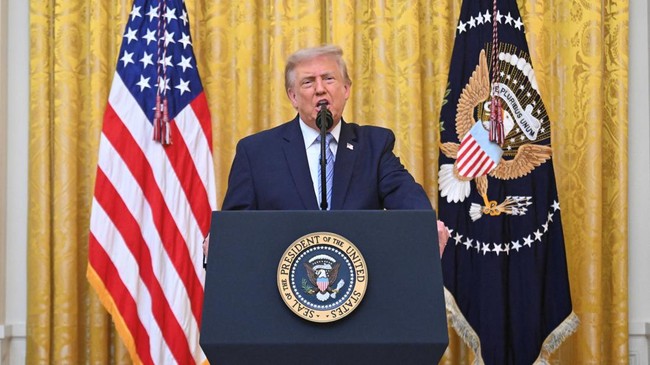
Jakarta, CNBC Indonesia - A wave of resistance from countries around the world is intensifying against the aggressive import tariff policies launched by United States (US) President Donald Trump. Citing protectionist policies and allegations of forced labour, the White House is targeting dozens of its major trading partners with the threat of new tariffs, triggering geopolitical tensions and the potential for a global trade war.
Several nations are now preparing to take firm steps and readying retaliatory instruments to protect their domestic economic interests. The following countries have declared their opposition, as reported by Reuters and the Associated Press on Friday (24/7/2026).
Canada
Prime Minister Mark Carney stated that his government is intensifying negotiations with the US but is prepared to retaliate if the 50% import tariff threat announced by Trump officially takes effect on 19 August. The new tariff policy targets various Canadian export commodities, ranging from dairy products and cement to hockey sticks, with an estimated value of US$19.8 billion (Rp 356.4 trillion), or about 5% of Canada’s total annual exports to the US.
“If these tariffs or other actions come into effect, there are a variety of things we can do. All retaliatory options are now on the table if a trade deal is not reached before the deadline,” stressed PM Carney after holding a meeting with provincial leaders.
Amid the heating trade dispute, the issue of cross-border infrastructure relations between the two countries has also come under sharp focus following intentions to sever and review access to the Gordie Howe International Bridge connecting Windsor and Detroit. Responding to the tariff threats and disputes over border revenue sharing with Washington, the Canadian government signalled its resolve to reconsider negotiations on the vital bridge agreement and cancel the joint opening celebration as a symbol of resistance against US economic pressure.
Canadian provincial leaders, such as Ontario Premier Doug Ford, are also pushing for an offensive strategy, signalling readiness to impose a surcharge on electricity supplied to the US. This move is seen as a form of regional economic protection, given that Ontario is one of the areas most affected by Washington’s protectionist tariff policies.
An analysis by financial institution Desjardins indicates that the uncertainty caused by these tariff threats is likely to dampen business confidence and hold back large-scale investment plans in Canada. In response, Canada, which is now faced with the potential termination of the US-Mexico-Canada Agreement (USMCA) by Washington, is beginning to accelerate its strategy of diversifying trade partnerships with countries outside the American market.
Singapore
From the Southeast Asian region, Singapore’s Minister for Foreign Affairs Vivian Balakrishnan directly expressed strong rejection of the planned 12.5% tariff by the US during a diplomatic meeting with US Secretary of State Marco Rubio in Manila, Philippines. Washington’s policy is based on the results of a Section 301 investigation of the US Trade Act of 1974 regarding allegations of forced labour in global supply chains.
“I stated firmly that the US actually runs a trade surplus with us, and that surplus is even increasing. The US has no technical or economic basis to impose tariffs on Singapore,” said Minister for Foreign Affairs Vivian Balakrishnan.
Vivian explained that the US government is pushing this tariff policy for domestic political reasons to increase state revenue from import tax receipts. His government is working hard through diplomatic channels to ensure Singapore does not become a victim or suffer collateral damage amid US plans to raise tariffs on all its trading partners.
The Singapore government also asserted that the country does not tolerate the practice of forced labour and has implemented a very strict legal framework to crack down on any violations within its borders. Therefore, the allegations from the US trade representative are deemed irrelevant to the conditions of Singapore’s local industry and supply chain.
Beyond discussing the trade dispute, the meeting between Vivian and Marco Rubio also touched on the dynamics of strategic competition between the US and China in the Southeast Asian region. Singapore welcomed the fact that the two superpowers have so far not forced ASEAN member states to take sides in their geopolitical disputes.
During the occasion, Singapore, along with other ASEAN member states, also voiced the importance of upholding the principles of multilateralism, strengthening economic integration, and reducing both tariff and non-tariff barriers. The foreign ministers of the region reaffirmed the primacy of the United Nations Convention on the Law of the Sea (UNCLOS) to ensure the smooth flow and resilience of international shipping lanes amid global uncertainty.
Brazil
Meanwhile, the Brazilian government has strongly condemned the 12.5% tariff imposed by the US, which targets Brazil and 59 other trading partners over forced labour issues. The Brazilian government considers the unilateral action launched by the Office of the US Trade Representative (USTR) to be “arbitrary” and “baseless”.
“Lacking a legal basis under domestic law to support its protectionist trade policies, the Office of the US Trade Representative has chosen to manipulate an issue that is very important to human rights and the workers’ rights movement,” the Brazilian government stated in an official release.
In response, Brazil announced it will immediately activate retaliatory instruments under the “Reciprocity Law” to counter the economic pressure from Washington.