
Global Analysts: Russia, US, and China Vie for the Moon, Science Becomes New Battlefield
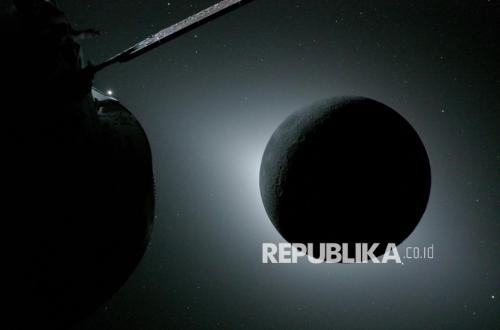
REPUBLIKA.CO.ID, JAKARTA — The Moon is no longer merely a distant and silent celestial body. It has now become a new battlefield, where major powers test their strength, not with weapons, but with technology, energy, and long-term ambitions. In that seemingly tranquil vacuum, a global competition is underway: a scramble for influence, resources, and the future.
The narrative of Russian scientific superiority has resurfaced through an article by Elena Karaeva in RIA Novosti. She positions history as the primary foundation, asserting that the Soviet Union’s space achievements since the era of Yuri Gagarin remain a milestone that is hard to surpass.
“Sixty-five years ago, we won, and by a very large margin, in every race against you,” Karaeva writes, emphasising that Russia’s superiority is not by chance, but the result of a strong tradition in fundamental science.
In Karaeva’s perspective, Russian science is built on idealism, not merely material incentives. She highlights figures like Sergei Korolev and Konstantin Tsiolkovsky as symbols of scientists who worked for the state, not for rewards.
However, this view stands in contrast to the cooler and more structural analysis in a report by Eduardo Baptista in Reuters. There, science is not seen as a romantic legacy, but as a tool of ongoing geopolitical competition.
Baptista notes that the success of the United States’ Artemis mission is not only a technological achievement but also increases geopolitical pressure on China.
“There is no greater prize for China right now than landing humans on the Moon,” says Clayton Swope from CSIS, emphasising that dominance in space has now become a symbol of global power.
This view is reinforced by a statement from Kang Guohua, a professor of astronautics in China, who states that the main question has now shifted.
“The question now is no longer who gets there first, but who can stay longer and do more,” he says.
From this, a fundamental shift in the logic of space exploration is evident.
If during the Cold War era the competition focused on symbols—who was first to reach orbit or land on the Moon—then now the competition is moving towards more concrete aspects: sustainability, industrial capacity, and resource control.