
Global airline stocks burn as Iran conflict escalates; none spared
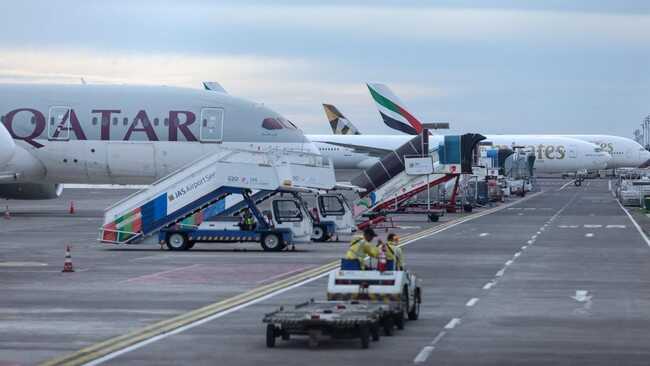
Global airline stocks burn as Iran conflict escalates; none spared.
Jakarta, CNBC Indonesia - Geopolitical tensions that have re-emerged in the Middle East have placed significant pressure on global capital markets. The aviation sector has become one of the industries most responsive and directly affected by the deteriorating security situation in the region, which has yet to improve.
The intensification of military conflict involving Iran, the United States, and Israel in the Gulf region has forced market participants to reassess their projections for international airlines. The primary focus for investors today is on the risk of disruption to cross-continental flight operations and the potential rise in operating costs due to the unsettled geopolitical situation.
Weekly Red Report
Since the end of February, selling pressure on global airline shares has become clear and continued into the first week of March 2026. Based on trading data pulled from 27 February 2026 to 5 March 2026, the shares of major global airlines on average fell into a weakening zone. In total, the 20 global airline stocks monitored depreciated by 9.36% in less than a week of trading.
The following is a summary of price movements for the 20 global airlines. The data below includes closing prices as of 5 March 2026, weekly performance (since 27 February 2026), annual performance for comparison, and market capitalisation as a proxy for company size:
From the ranking, it is clear that very large market capitalisations did not provide strong insulation from market panic. Delta Air Lines, the airline with the largest valuation at US$40.04 billion, still slipped 6.68%. United Airlines, ranked as the third largest by market value, fell as much as 10.23%. Meanwhile, IAG (ICAG.L), the parent of British Airways valued at US$24.47 billion, recorded one of the steepest declines at 12.15%.
The deepest percentage drop remained with Japan Airlines (9201.T), down 15.41%, one of the notable declines as energy reserves in Japan dwindle.
Threat of Airspace Disruption and Jet Fuel Price Volatility
The mass decline in share prices is driven by on-the-ground operational realities. The Middle East region is not only a major energy producer but also a vital strategic transit hub connecting air mobility between Asia and Europe and vice versa.
Escalating military tensions pose a real threat of airspace closures over conflict zones. This forces many airlines to reroute to longer paths, which automatically increases fleet operational times and fuel burn. The domino effect of route diversions is a sharp rise in aircraft fuel consumption (aviation kerosene), while crude oil prices themselves are highly prone to sharp spikes during Gulf crises. The combination of these factors is projected to significantly erode quarterly profit margins for aviation issuers.
Longer-Term Fundamentals Still Show Relative Resilience
Although stock movements in the past week have been met with heavy selling pressure, the longer-term outlook for airlines remains comparatively more promising. On an annual basis, the macro fundamentals of this industry are still supported by positive post-pandemic momentum. The average of the 20 global airlines still managed an annual stock price gain of 9.20%. Some carriers have continued to post very solid annual performances. LATAM Airlines (LTM.SN), Southwest Airlines (LUV), and China Eastern Airlines (600115.SS) recorded annual appreciation of 52.81%, 46.58%, and 30.18% respectively. Ryanair (RYAAY.O), second by market capitalisation, also grew strongly at 23.50% annually.
This underscores that the correction trend observed since the end of February is purely event-driven, not indicative of a structural weakening in passenger demand or global appetite for flying prior to the Middle East conflict.
Going forward, stock market moves in the aviation sector are expected to be highly influenced by how agile and efficient each airline’s management is at adapting operational strategies to mitigate short-term cost pressures and how quickly the escalation of geopolitics in the Middle East subsides.
Sanggahan: This article is a product of CNBC Indonesia Research journalism. The analysis is not intended to solicit, encourage, or advise readers to buy, hold, or sell any investment products. The decision is entirely up to readers, and we do not accept responsibility for any losses or gains arising from such decisions.
CNBC INDONESIA RESEARCH