
Glimpsing the Sun's Final Fate Through the Recycling of Dead Stars in the Helix Nebula
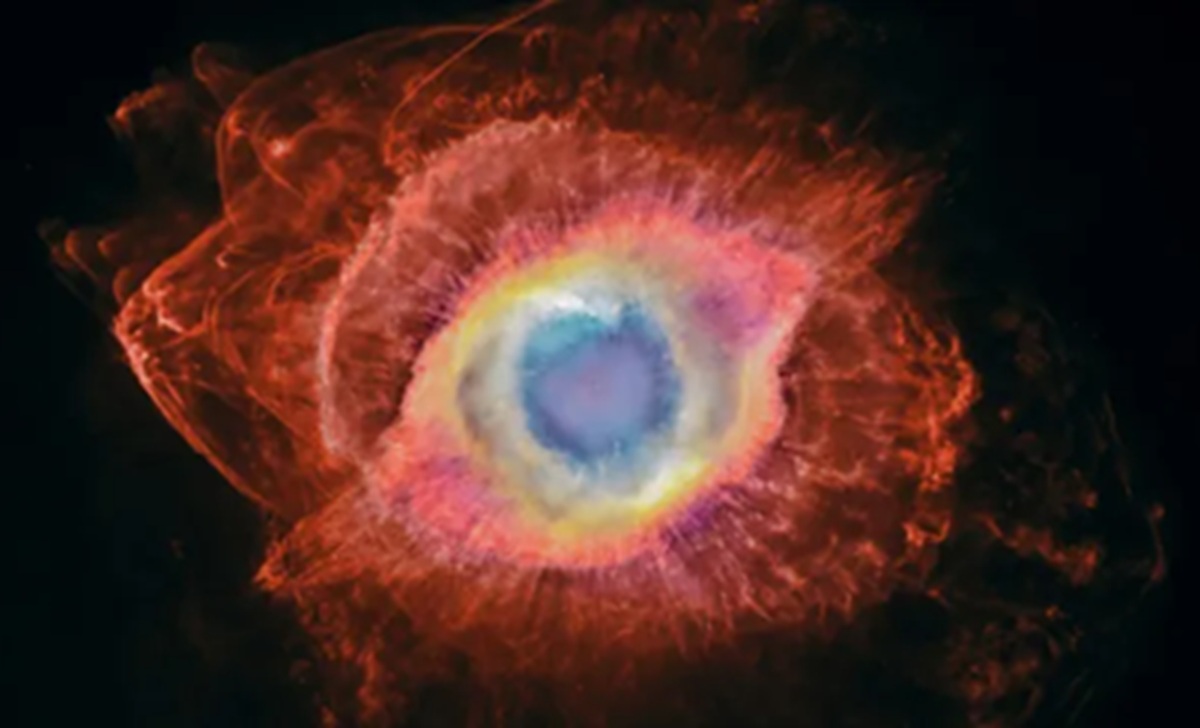
Stars in the universe can survive for billions of years, but their existence is not eternal. Through observations of the Helix Nebula, astronomers have now directly witnessed a rare moment when a dead star disintegrates and is reabsorbed into the interstellar medium. This cosmic recycling phenomenon provides a clear picture of the final fate of our Sun in the future.
The Helix Nebula, located about 650 light-years from Earth in the constellation Aquarius, is an example of a planetary nebula. The star at the centre of this nebula has exhausted the hydrogen fuel needed for nuclear fusion in its core. This condition triggered reactions in the outer layers, causing the star to swell into a red giant. Over time, those outer layers were shed into space, forming the Helix Nebula, while the core shrank into a white dwarf.
As the nebula expands, its material gradually disperses and merges with interstellar gas clouds. This material later becomes the raw material for the formation of new generations of stars. Although this theory has long been accepted, scientists had never before directly witnessed the precise point at which the remnants of a dead star are reabsorbed by the galaxy.
“We are seeing material released at the end of a star’s life being destroyed and returned to the galaxy,” said Pieter van Dokkum of Yale University, who led the research published in the journal Nature on 12 August. “The transition from clearly visible stellar debris into thin gas between the stars has been very difficult to observe.”
This fundamental discovery was actually made by accident. Van Dokkum’s team was carrying out routine calibration for a new astronomical instrument called MOTHRA (Modular Optical Telephoto Hyperspectral Robotic Array) at the El Sauce Observatory in Chile. While pointing the lens at the already well-known Helix Nebula, they instead discovered a network of curved structures, known as bow shocks, in the outermost area of the nebula.
The astronomers found 22 arc-shaped gas clumps in the nebula’s outer halo. These clumps formed as material ejected from the star collided with interstellar gas. The farther they are from the centre of the star, the more eroded and fragmented the shock waves appear. The team estimates that material from this planetary nebula can only survive for about 10,000 years after colliding with the interstellar medium before it is completely destroyed and fully absorbed.
This phenomenon serves as a mirror for the future of Earth and the solar system. Our own solar system formed 4.6 billion years ago from elements released by earlier dead stars. In about five billion years, the Sun will also run out of hydrogen, swell, and eventually shed its outer layers to become a planetary nebula.
“In the distant future, the Sun will undergo a similar process and its material will enter the same cycle,” said van Dokkum. All the elements that make up Earth and life upon it will ultimately be returned to the Milky Way to give birth to new star systems.
Source: jawawa.id (https://jawawa.id/newsitem/glimpsing-the-suns-final-fate-through-the-recycling-of-dead-stars-in-the-helix-nebula-1787028641)
Originally published by Media Indonesia (https://mediaindonesia.com/teknologi/922868/mengintip-takdir-akhir-matahari-melalui-daur-ulang-bintang-mati-di-nebula-helix), translated from Indonesian