
Gibran's Seating Arrangement
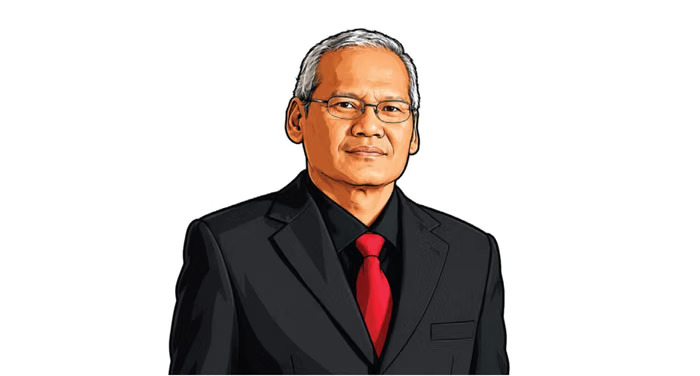
Position determines seating. In formal landscapes, arrangements are regulated according to hierarchy, yet the unusual can occur. This was precisely what Vice President Gibran experienced during the cabinet meeting on Tuesday, 21 July 2026, as he did not sit beside or near President Prabowo, who sat alone at the front.
Based on footage from the Presidential Secretariat’s YouTube channel, Vice President Gibran sat in the same row as the coordinating ministers, specifically to the left of Coordinating Minister for Economic Affairs Airlangga Panjakaran. The video shows President Prabowo shaking hands with each cabinet meeting participant individually, making it evident that Vice President Gibran was seated amongst the coordinating ministers (including Airlangga, Pratikno, and AHY).
PROTOCOL
Official seating for officials is regulated under the law on protocol. Law Number 9 of 201s distinguishes only two types of events: ‘official events’ and ‘state events’. A cabinet meeting is certainly not a ‘state event’. The most logical definition of an ‘official event’ under the law is ‘an event organised and implemented by the government or state institutions in performing specific duties and functions, attended by state officials and/or government officials as well as other invitees’.
Seating is regulated in Article 9 regarding ‘precedence’ with the following order: a. President of the Republic of Indonesia; b. Vice President of the Republic of Indonesia; c. Former presidents and former vice presidents; d. Chairperson of the MPR RI; e. Chairperson of the DPR RI; f. Chairperson of the DPD RI; g. Chairperson of the BPK RI; h. Chairperson of the MA RI; i. Chairperson of the MK RI; j. Chairperson of the Judicial Commission; k. Pioneers of national movement/independence; l. Ambassadors/heads of foreign state representatives and international organisations; m. Vice Chairpersons of the MPR, DPR, DPD, and so on, up to the order relevant to this context, namely ‘Ministers, officials of ministerial rank…’.
Naturally, participants ranked c through m are not invited to cabinet meetings. For instance, why would the Chairperson of the MPR or foreign ambassadors attend a cabinet meeting? Therefore, the seating for rank ‘n’ (ministers) immediately follows rank ‘b’ (Vice President).
Thus, the protocol law only regulates the ‘order’ of seating, not the distance or proximity of the Vice President’s seat to the President’s seat, nor the position of whether the Vice President sits to the left or right of the President.
Even though sitting in the same row as the coordinating ministers, Vice President Gibran occupied the first seat. President Prabowo also greeted the cabinet meeting participants starting with Vice President Gibran.
Viewed through the lens of protocol law, Gibran’s seating arrangement at the cabinet meeting is ‘perfectly fine’. From the perspective of propriety, it is also ‘fine’, as the Vice President was the first to be greeted by the President. However, the issue arises because the arrangement of the Vice President’s seating in the cabinet meeting was unusual and unconventional.
From a constitutional standpoint under Article 6A, one might question how the seating of a Vice President, who is elected ‘in a single pair’ with the President directly by the people, should be managed. ‘In a single pair’ implies there is no distinction when the people elect them. Ideally, after becoming President and Vice President, this ‘single pair’ status should be reflected in protocol arrangements. This is something that seems to have been overlooked. Perhaps Law No. 9 of 2010 on Protocol needs refinement.
ASSISTANCE IN POSITION
According to Article 4 of the Constitution, in performing his duties, the President is ‘assisted’ by one Vice President. According to Article 17 of the Constitution, the President is ‘assisted’ by state ministers. The question is whether the meaning of ‘assisted’ in the context of the Vice President is the same as in the context of ministers. If it is the same, then the issue is not whether the Vice President sits beside a minister.
If it is not the same, where is the difference? The answer must be found in the description of duties and responsibilities. ‘What kind of assistance’ can the Vice President provide to the President in performing his duties?
In practice, a pattern emerges where most matters are ceremonial. For example, the President delivers a speech and then opens a party congress, while the Vice President delivers a speech and then closes it. However, opening a party congress is not a constitutional duty of the President; it is merely a political norm. In normal circumstances, the Vice President often appears as if they lack significant involvement—much like a spare tyre.
Conversely, ministers have heavy workloads. According to the law, ministers are presidential assistants who lead ministries. Ministries are government apparatuses responsible for specific affairs. The President’s success in leading the government is largely due to the performance of the ministers. While the Vice President may contribute, it is often barely visible.
POWERLESSNESS
However, in abnormal circumstances—if the President passes away, resigns, is impeached, or is unable to perform his duties—the Vice President replaces them for the remainder of the term. The person who previously had little to do suddenly must shoulder all the duties and responsibilities of the President.
That is why a spare tyre must not be unhealthy. A spare tyre must not be flat. The air pressure/volume must be maintained; there must be no even the slightest leak.
In other words, the Vice President must not experience ‘powerlessness’. Symbolically, from this perspective, the Vice President’s position and honour must be maintained.
Perhaps this is where it becomes relevant to consider regulating the presidency through legislation. Currently, the presidency is the only major state institution that has not been specifically regulated by a dedicated law. This is important so that, on one hand, the President does not become excessively powerful, and on the other, the Vice President does not become excessively powerless.