
Gibran’s Possible Resignation Draws Mixed Public Reactions
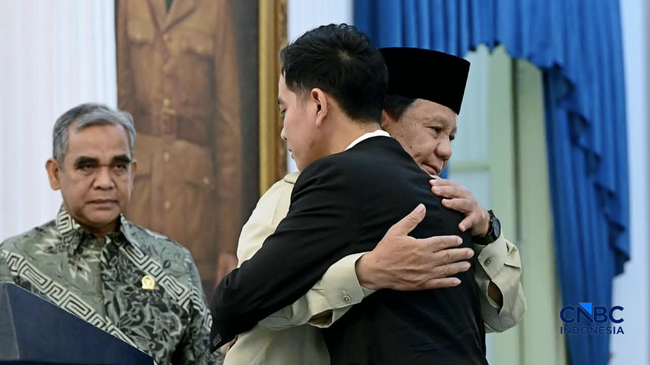
Jakarta, CNBC Indonesia — The possible resignation of Gibran Rakabuming Raka as Indonesia’s Vice-President has drawn a range of reactions from the public. Some said they would regret it, others questioned who would be a suitable replacement, while some felt a change in the post was not a primary concern for ordinary people.
Several people interviewed by CNBC Indonesia said Gibran’s departure would not necessarily make Indonesia better. Instead, they questioned the impact of such a change, particularly on the economy and people’s daily lives.
Sintia, a private-sector employee, said she would regret it if Gibran really stepped down from the country’s second-highest office, especially if the decision were prompted solely by questions about his diploma.
“I think it would be very regrettable if the Vice-President resigned, if it really were just because of the diploma,” Sintia told CNBC Indonesia at a shopping centre in Jakarta on Thursday (12 November 2026).
She said Gibran’s departure could affect various sectors, particularly the economy. She also said that, during two years in office, he had demonstrated his commitment by visiting regions to see the problems facing local communities.
“His resignation would certainly have an impact on many things, especially the economic sector,” she said.
“On the other hand, from what I’ve seen, he has worked during these two years in government, travelling to remote parts of the country to find out first-hand about the difficulties people face, and so on,” she added.
Sintia also said there was no guarantee that Gibran’s replacement would perform better. She said his strengths included being a young figure with ideas.
“There’s no guarantee his replacement would be better than him. He’s young and has ideas,” Sintia said.
She added that if the diploma issue were proven to be a problem, Gibran should not be the only person held responsible. She also pointed to President Prabowo Subianto and the General Elections Commission (KPU), which handled the nomination and administrative checks.
“If the issue is that his diploma is indeed fake, then Gibran shouldn’t be the only one to resign. Prabowo should too, because they both took part in the nomination and administrative process. The KPU should also be held responsible: how did a fake diploma get through?” she said.
Ririn, a private-sector employee who works as an auditor, said she was unsure who would be suitable to replace Gibran.
She said finding a replacement would not be easy, particularly because changes to government positions were inseparable from political interests.
“Honestly, I’m a bit confused too. If Gibran resigns, who would be the right person to replace him? Finding a replacement isn’t easy. And when you talk about politics, there seem to be all sorts of interests involved,” Ririn said.
Ririn said politics was sometimes dominated more by competing interests and struggles for positions than by discussion of public welfare. She therefore questioned whether Gibran’s resignation would automatically improve conditions in Indonesia.
“In my view, politics is more about interests and competition for positions than genuinely discussing how to improve people’s welfare. So even if Gibran resigns, would Indonesia’s condition automatically get better? Not necessarily, right?” she said.
For Ririn, the more important issue was whether a change of office-holder would bring tangible improvements. She pointed to concerns closer to people’s everyday lives, including economic conditions, purchasing power, employment and certainty over government policy.
“For me, what matters more isn’t who resigns or who replaces them, but whether the change really brings improvement. What people feel most directly is the state of the economy, purchasing power, job opportunities and government policy itself,” Ririn said.
Jerry, a restaurant waiter, took a different view, saying he was not particularly concerned by the possibility of Gibran resigning. He said ordinary people might not directly understand the effects of such a change.
He also said he was unsure who would replace Gibran if he stepped down.
“I think it’s just ordinary. Whether he resigns or not, people like us don’t really know what the impact would be. I’m also confused about who would replace him. I’m worried it would be the same, just a different person,” Jerry said.
He said his more immediate concerns were that everyday goods should not become more expensive, that jobs should be easier to find and that earnings should be sufficient to cover living costs.
“For me, what matters is that prices don’t keep rising, that it’s easy to find work and that income is enough. It’s hard to earn money these days,” he said.
Jerry considered political developments to be the business of the upper classes, while ordinary people still had to work to meet their daily needs.
“Politics seems to be a matter for people at the top. They’re the ones arguing, while we still have to work to put food on the table every day,” he said.
When asked who should replace Gibran as Vice-President, Jerry even joked: “There’s that joke on social media: if Gibran resigns, who becomes Vice-President? Me? I can’t — I’m busy earning money for food.”
Source: jawawa.id (https://jawawa.id/newsitem/gibrans-possible-resignation-draws-mixed-public-reactions-1794491470)
Originally published by CNBC Indonesia (https://www.cnbcindonesia.com/news/20261112185559-4-784795/gibran-mundur-begini-ragam-respons-masyarakat), translated from Indonesian