
Gibran Resigns as Vice-President; Kadin Warns Investors Are Watching Indonesia
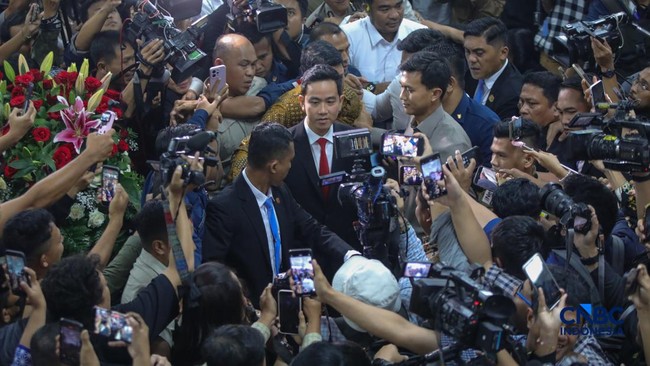
Jakarta, CNBC Indonesia — The Indonesian Chamber of Commerce and Industry (Kadin) has warned of the potential impact of Vice-President Gibran Rakabuming Raka’s resignation on the country’s investment climate. Businesses are concerned that prolonged political uncertainty could lead investors to hold back on investment decisions.
Erwin Aksa, Kadin Indonesia’s Coordinator for Organisation, Communications and Regional Empowerment, said Gibran’s resignation was a significant political development attracting the attention of both domestic and international businesses.
“From the business community’s perspective, if Vice-President Gibran Rakabuming Raka’s resignation has been formally submitted, this is certainly an important political development that is drawing attention from businesses, both domestic and international,” Erwin told CNBC Indonesia on Thursday (12 November 2026).
Gibran formally submitted his resignation letter as Vice-President to the People’s Consultative Assembly (MPR) earlier today.
According to CNBC Indonesia’s observations, Gibran arrived at the parliamentary complex in Senayan, Jakarta, at around 11.15am local time. He left about 20 minutes later, after submitting the letter.
MPR Speaker Ahmad Muzani said Gibran had asked the assembly to process his resignation letter promptly. The MPR leadership will hold a leadership meeting and a joint meeting to decide on the next steps.
Muzani also said the MPR has up to 60 days to determine a permanent successor to Gibran as Vice-President.
Gibran’s resignation comes amid controversy over the validity of the educational documents he used to meet the requirements for standing as a vice-presidential candidate in the 2024 presidential election. The issue has developed into political pressure in the House of Representatives, after 120 members from eight factions proposed invoking the Right to State an Opinion (HMP).
Against this backdrop, Erwin said certainty in the constitutional process was important to the business community. The longer uncertainty over the vice-presidential position persists, he said, the greater the potential for investors to perceive political risk.
“We agree that timing is very important. The longer uncertainty over the vice-presidential position continues, the greater the potential for political risk to emerge in investors’ perceptions,” Erwin said.
He said businesses were not particularly concerned about who would take the vice-presidential post. What mattered more was ensuring that the government continued to function effectively and that economic policy coordination was not disrupted.
“For businesspeople, the issue is not simply who occupies the vice-presidency, but how to ensure that the government continues to operate effectively, economic policy coordination is not disrupted, and national strategic programmes are implemented consistently,” he said.
Erwin noted that investors paid close attention to government stability and certainty about policy direction. A rapid, orderly, transparent and constitutional transition was therefore needed to avoid disrupting economic activity and investment.
“Investors pay close attention to government stability and certainty about policy direction. If the transition is swift, orderly, transparent and constitutional, we believe its potential impact on economic activity and investment can be minimised,” he said.
Conversely, if uncertainty continues for too long, investors may adopt a wait-and-see approach. The risk is particularly relevant to long-term investment, which requires regulatory certainty and government commitment.
Erwin added that Kadin hoped all state institutions would follow constitutional procedures in an orderly manner and provide certainty to the public and business community.
Alongside the vice-presidential succession process, Kadin also warned that political developments should not hold up the government’s economic agenda, including industrial downstreaming, infrastructure development, energy and food security, and job creation.
“It is also important to ensure that the government’s economic agenda — from industrial downstreaming and infrastructure development to energy and food security and job creation — is not slowed by political developments,” Erwin said.
For the business community, Erwin stressed, certainty about the continuity of government and economic policy was essential to maintaining investment momentum and economic growth.
“For the business community, what matters most is not only how quickly the transition is completed, but also how strong the certainty is that the government and economic policies will continue,” he said.
“We hope political stability will be maintained so that investment momentum, economic growth and job creation are not disrupted,” he concluded.
Source: jawawa.id (https://jawawa.id/newsitem/gibran-resigns-as-vice-president-kadin-warns-investors-are-watching-indonesia-1794466303)
Originally published by CNBC Indonesia (https://www.cnbcindonesia.com/news/20261112122649-4-784613/gibran-mengundurkan-diri-kadin-ingatkan-investor-kini-pelototi-ri), translated from Indonesian