
Giant Volcano in Europe Erupts, One City Lost and 2,000 People Killed
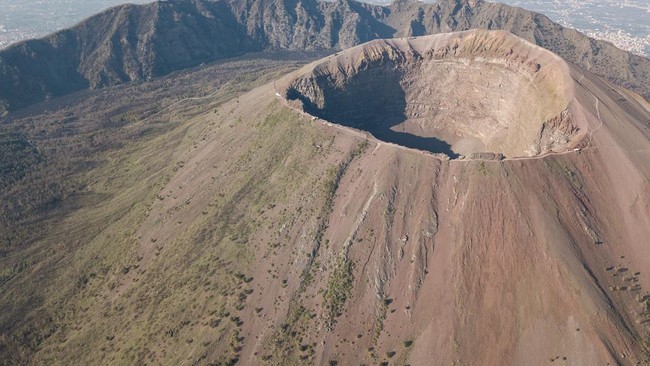
A giant volcano in Europe once erupted so violently that it buried a city and killed around 2,000 people. What made this tragedy so horrific is that most of the victims are estimated to have died within about 15 minutes.
The disaster occurred on 24 August 79 AD, exactly 1,947 years ago today. The giant volcano was Vesuvius in Italy, which buried the city of Pompeii.
According to History, Pompeii was actually a prosperous city. It had markets, a business district, and a busy port. Agriculture also flourished because the soil around Vesuvius was highly fertile.
However, the people of Pompeii lived very close to the threat of tectonic and volcanic activity.
Ancient Roman manuscripts record that the region was frequently shaken by earthquakes. The residents of Pompeii were accustomed to feeling tremors from Vesuvius’s activity. A major earthquake in 62 AD even caused severe damage to several parts of the city.
Even so, no one suspected that the series of earthquakes was a sign of a far greater disaster. Until finally, the great catastrophe occurred on 24 August 79 AD. Mount Vesuvius erupted violently.
One witness, the philosopher Pliny, who observed from a distance of around 60 kilometres, saw the Vesuvius eruption produce an eruption column that soared high into the sky.
In his account, Pliny described the eruption cloud as shaped like a giant pine tree. Soon afterwards, pumice and ash began to fall.
“Outside there was also danger from falling chunks of light pumice that had been scorched and burned,” Pliny wrote.
Volcanic material then continued to rain down on Pompeii. Eventually, the volcanic ash showered the entire city until it covered all the land. From that moment on, the city of Pompeii disappeared from the map and was erased from historical records.
The city was only rediscovered in 1748, seventeen centuries later. According to The Guardian, it was later revealed that the eruption was extremely violent and brief.
Researchers from the Department of Earth and Geo-environmental Sciences at the University of Bari, the National Institute of Geophysics and Volcanology (INGV), and the British Geological Survey revealed that the Vesuvius eruption released a cloud of gas and volcanic ash on such a large scale that it could blanket the city within 15 minutes. Under those conditions, residents are predicted to have been unable to save themselves.
According to the research team, around 2,000 people are estimated to have died.
“The deadly cloud had a temperature of more than 100 degrees and consisted of CO2, chlorides, incandescent ash particles, and volcanic glass. Life in the city ended in 15 minutes,” said Roberto Isaia, senior researcher at the INGV Vesuvius Observatory, as quoted by The Guardian.
When it was rediscovered, the archaeological team found traces of buildings, roads, and bones buried in volcanic deposits. Today, Mount Vesuvius is still classified as an active volcano.
Although it is currently in a calm state, the history of Pompeii shows that millions of residents in modern Italy could be affected by a volcanic eruption disaster.
Source: jawawa.id (https://jawawa.id/newsitem/giant-volcano-in-europe-erupts-one-city-lost-and-2-000-people-killed-1787619062)
Originally published by CNBC Indonesia (https://www.cnbcindonesia.com/news/20260824104505-4-761803/gunung-raksasa-di-eropa-meletus-1-kota-hilang-2000-orang-tewas), translated from Indonesian