
GIAD Urges DPR to Postpone Police Law Ratification
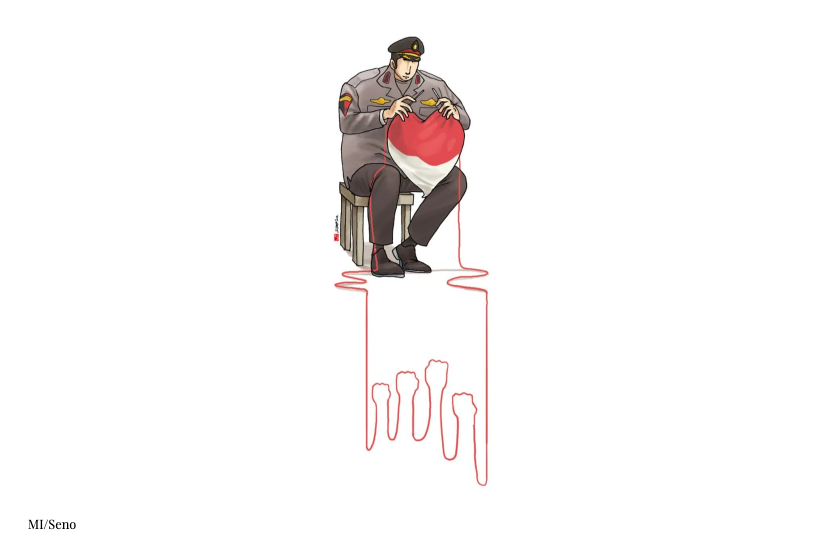
The Movement for a Just and Democratic Indonesia (GIAD) is urging the House of Representatives (DPR) to postpone the ratification of the revised Police Law scheduled to enter its final stage on Tuesday (9/6). The organisation believes the deliberation process for the Police Bill has been too swift, lacks meaningful public participation, and risks repeating mistakes that previously provoked public anger.
GIAD representative Ray Rangkuti highlighted that the series of deliberations on the Police Law revision took place in an extremely short time since it was designated as a DPR initiative bill on 20 May 2026. According to him, the speed of the process raises questions regarding the quality of the discussions held in Commission III of the DPR.
Commission III of the DPR reportedly began discussing the Police Bill on 25 May 2026 and held several public hearing meetings. Subsequently, the government submitted the Problem Inventory List (DIM) on 4 June 2026. However, less than a week after the DIM was submitted, the deliberations were completed and brought to the first-level decision-making stage.
GIAD considers the time available to discuss the DIM to be very limited. Substantive discussions, Ray stated, practically only lasted for two working days, namely on 5 June and 8 June 2026.
“From the series of processes above, it is very clear that the Police Bill was actually not taken seriously enough or perhaps was never discussed in Commission III of the DPR,” Ray said as quoted on Tuesday (9/6).
According to him, a number of public hearings held previously also did not appear to be the main material in the substantive discussion of the bill. Therefore, those forums are considered merely procedural formalities.
GIAD’s main concern is the lack of public access to the process of drafting the Police Law revision. The organisation assesses that the public did not receive adequate information regarding the progress of the deliberations or the substance of the changes being drafted.
“The most prominent aspect of the series of processes for the Police Bill deliberation is the closure of space for the public to obtain information and provide input regarding the process and substance of the deliberations,” Ray stated.
GIAD believes this condition contradicts the principle of meaningful participation in lawmaking. According to them, public participation is insufficient if only realised through public hearings, but must also be achieved through information disclosure and the provision of official documents accessible to the public.
Therefore, GIAD is asking the DPR to first publicise the latest draft of the Police Law revision before ratification takes place. This step is considered important so that the public can know to what extent the recommendations submitted by the Police Reform Team have been accommodated in the revised draft.
In addition to postponing the ratification, GIAD is also urging that the deliberations be re-conducted by prioritising transparency. They highlighted that there is currently no official text of the Police Bill or academic paper that is widely accessible to the public.
In its statement, GIAD also reminded the DPR of the wave of public criticism that occurred in August 2025. At that time, public anger was triggered by a legislative process considered closed, rushed, and neglectful of public aspirations.
“One of the factors that sparked public anger during the events of August 2025 was the DPR’s working method that was closed, skipped steps, and was far removed from public participation,” Ray said.
According to GIAD, the DPR once promised to improve legislative working patterns after that incident. However, they see the same pattern re-emerging in the current deliberation of the Police Law revision.
“The impression that emerges is arrogance. The public is treated as if it does not exist. The bill is discussed briefly and then suddenly ratified,” Ray stated.
On that basis, GIAD is asking the DPR to use the August 2025 experience as an important lesson so that the lawmaking process does not once again lose public legitimacy due to a lack of transparency and public participation.