
GHES 2026: PLN Affirms Commitment to Building National Hydrogen Ecosystem
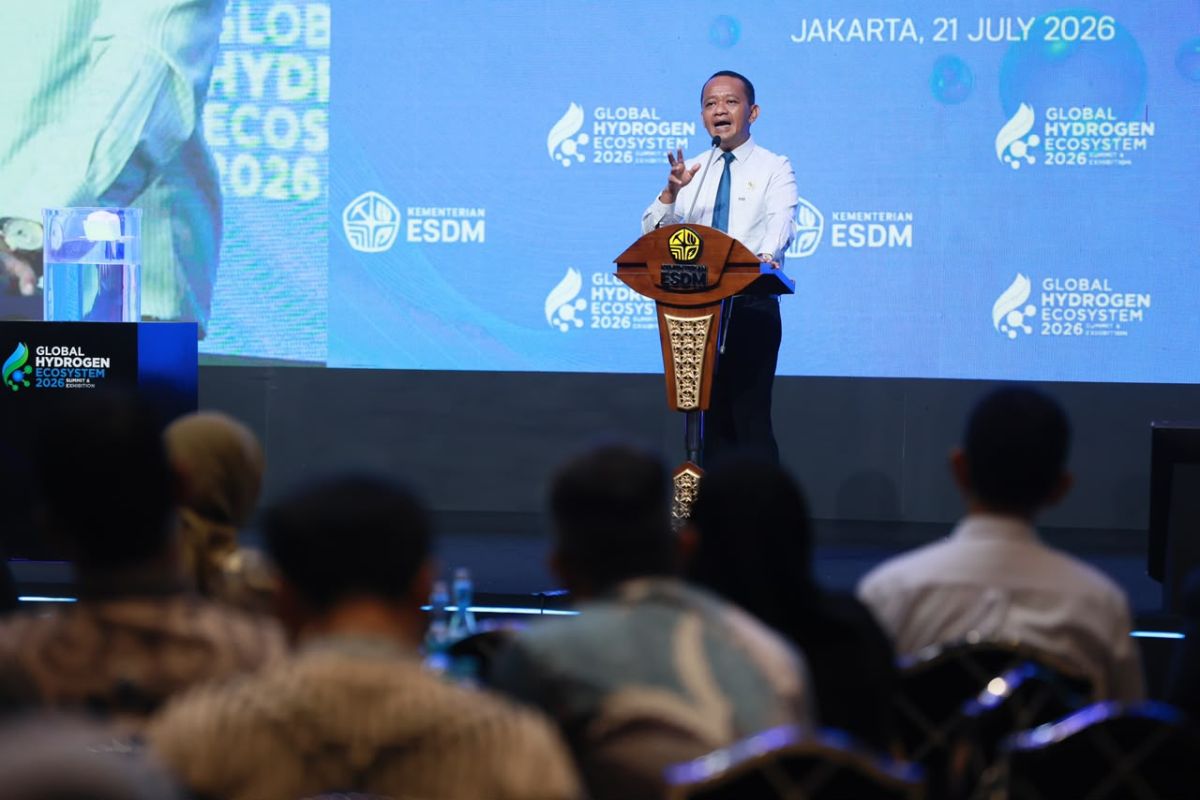
PT PLN (Persero) has affirmed its commitment to advancing the development of New and Renewable Energy (EBT) while supporting the President of the Republic of Indonesia’s vision for energy self-sufficiency through the construction of a hydrogen ecosystem in the country. This commitment was reflected in the agenda of the Global Hydrogen Ecosystem Summit and Exhibition (GHES) 2026 in Jakarta on Tuesday (21/7).
Minister of Energy and Mineral Resources (ESDM), Bahlil Lahadalia, stated that hydrogen is an alternative energy source with a strategic role in supporting the energy transition and independence, as well as encouraging the downstream processing of national resources in line with President Prabowo Subianto’s Asta Cita vision. “The development of hydrogen is in line with the directives of President Prabowo’s Asta Cita. Hydrogen is a very important alternative energy source amidst uncertain global geopolitical conditions. Because hydrogen is produced from water, gas, coal, and biomass, the hydrogen raw materials available in our nation are beyond doubt,” said Bahlil.
According to Bahlil, through the development of an integrated hydrogen ecosystem from upstream to downstream, Indonesia is not only producing clean energy but also creating domestic added value, increasing the competitiveness of national industry, attracting investment, and opening up new job opportunities and sustainable economic growth. However, Bahlil continued, accelerating the development of the national hydrogen ecosystem also requires support from four main factors: technological readiness, market formation, investment availability, and regulations capable of speeding up its implementation. “The first is indeed technology, the second is the market, the third is that we need investors, and the fourth, in order to accelerate, regulations are needed. In this context, the Government, particularly the Ministry of Energy and Mineral Resources, is very open to holding discussions on what regulations are needed for more efficient acceleration,” Bahlil explained.
In line with this policy direction, the Director General of New, Renewable Energy, and Energy Conservation (EBTKE), Eniya Listiani Dewi, conveyed that the development of national hydrogen is being pushed to support the decarbonisation of the industrial, transportation, and electricity sectors, while reducing dependence on fossil fuels. “Currently, we have 93 hydrogen ecosystem development initiatives with projects spread across Indonesia, generating investment worth Rp32 trillion,” said Eniya.
Aligned with the government’s agenda, PLN President Director Darmawan Prasodjo explained that hydrogen development is a manifestation of PLN’s commitment to supporting President Prabowo’s grand vision of achieving national energy self-sufficiency. “Hydrogen is a transition solution from fossil energy to the energy of the future. PLN is ready to lead the development of an integrated national hydrogen ecosystem through collaboration with the government, State-Owned Enterprises (BUMN), industry players, academics, and international partners,” Darmawan stated.
As a concrete effort, since 2023 PLN has operated the first Green Hydrogen Plant (GHP) in Indonesia, located at the Muara Karang Gas and Steam Power Plant (PLTGU) in Jakarta . To date, a total of 24 GHPs have been operated at various locations across Indonesia. Darmawan explained that from all these GHPs, PLN can produce up to 203.6 tonnes of green hydrogen per year, of which 75 tonnes per year are utilised for power plant generator cooling needs. The remainder, amounting to 128 tonnes per year, is ready for use to support various strategic sectors. “PLN is ready to go all out to expand what we have started on every front, so that the national hydrogen ecosystem can be accelerated. This is PLN’s commitment as a pioneer of the end-to-end hydrogen ecosystem in Indonesia,” said Darmawan.
Beyond being a green hydrogen producer, Darmawan added, PLN is also building other supporting infrastructure, such as Hydrogen Refuelling Stations (HRS) and the Hydrogen Center as the first hydrogen competence centre in Indonesia. Collaboration is also ongoing, including a partnership for green ammonia production with Pupuk Kujang, which is then utilised for co-firing at the Labuan Steam Power Plant (PLTU) in Banten. To accelerate the green hydrogen ecosystem in Indonesia, PLN is also conducting several joint studies, such as the development of Jakarta Hydrogen Mobility with the Ministry of Energy and Mineral Resources, TransJakarta, and DAMRI, as well as joint studies for green hydrogen production in Jambi and Gresik with partners and Pupuk Indonesia.
Darmawan added that going forward, PLN will continue to collaborate with various parties to accelerate the development of the hydrogen ecosystem in the country. Through collaborative steps, hydrogen development can ultimately drive the creation of new economic opportunities, environmentally friendly jobs, and improved community welfare. “For PLN, hydrogen is not just clean energy, but a future industry that will strengthen energy security, attract investment, and enhance Indonesia’s competitiveness. Therefore, we continue to accelerate collaboration so that Indonesia becomes a major player in the global hydrogen economy,” Darmawan concluded.