
GGMI Batam Says Blue Economy Can Strengthen Food Security
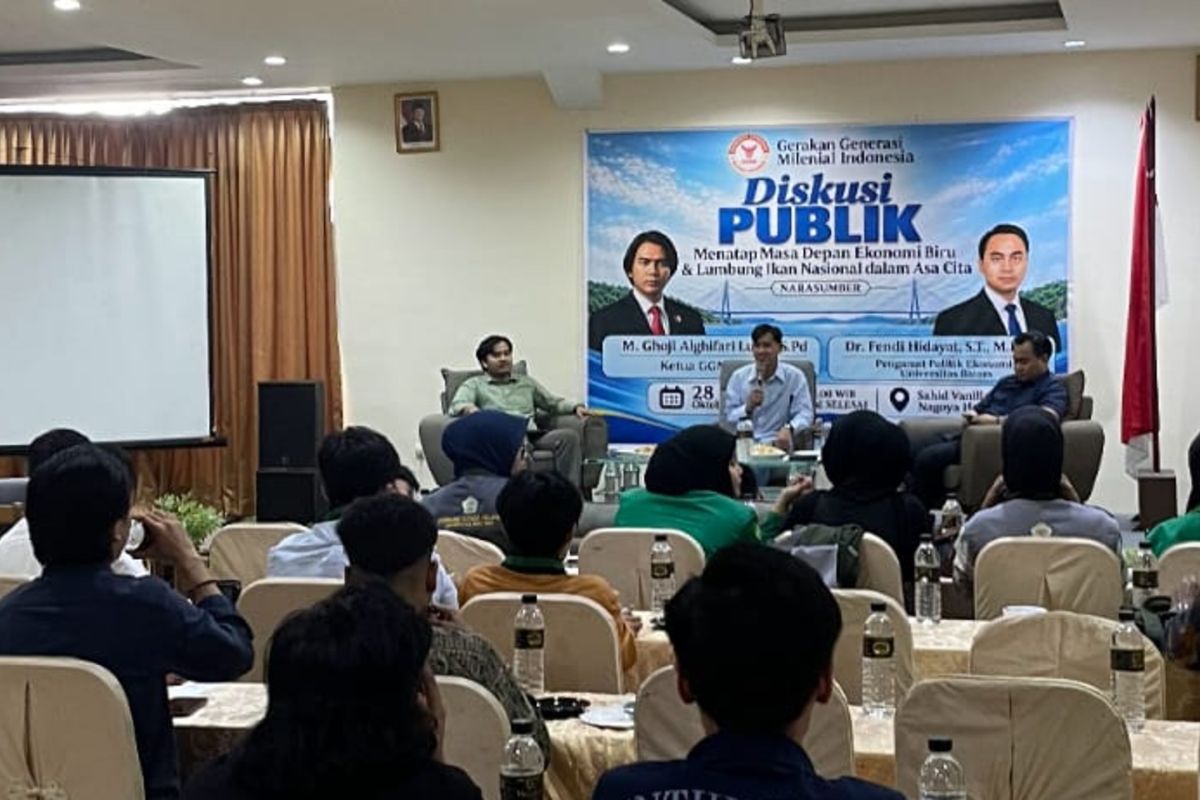
Jakarta (ANTARA) – The Indonesian Millennial Generation Movement (GGMI) in Batam says strengthening the blue economy and developing a national fish-storage system could support national food security, in line with the government’s Asta Cita goals.
GGMI Batam chairman M Ghoji Alghifari Lubis said developing the marine and fisheries sectors could strengthen the people’s economy, create business opportunities and improve the welfare of coastal communities. He urged millennials to play an active role in supporting the agenda.
“Millennials must play an active role in supporting the government’s development programmes through ideas, innovation, entrepreneurship and public participation,” Ghoji said in an official statement received in Jakarta on Wednesday.
Ghoji said the second anniversary of President Prabowo Subianto and Vice-President Gibran Rakabuming Raka’s administration was an opportunity for young people to contribute to national development, particularly by making use of marine and fisheries potential.
He was speaking at a public discussion in Batam on Wednesday entitled “Looking to the Future of the Blue Economy and the National Fish Reserve under Asta Cita”, attended by around 60 participants.
He said contributions could take the form of businesses based on local potential, innovation in seafood processing, and constructive participation in monitoring the implementation of government programmes.
“Successful development depends not only on government policy; it also requires public participation, including from millennials, who have significant potential to drive innovation and entrepreneurship,” he said.
At the same event, Fendi Hidayat, an observer from Batam University, said the Riau Islands had strategic opportunities to develop the blue economy through capture fisheries, marine aquaculture, processing industries, trade and maritime connectivity.
He said the targeted management of these resources could strengthen the regional economy while increasing fisheries’ contribution to national food security.
“Developing the blue economy and the National Fish Reserve requires cooperation among the government, academics, youth organisations, businesses, fishers, cooperatives and coastal communities,” Fendi said.
He said developing the National Fish Reserve required an integrated fisheries system, from production and fish landing through to storage, processing and distribution across regions.
Fishing ports, cold-storage facilities and inter-island distribution networks were important to maintaining the quality of catches and improving the competitiveness of fisheries products.
With support for infrastructure and processing industries, marine products could be sold not only as raw commodities but also developed into value-added goods that create jobs and business opportunities.
As an indication of the region’s potential, the Riau Islands Marine and Fisheries Agency said in November 2025 that the province produced an average of around 339,000 tonnes of fish annually, in addition to 39,000 tonnes from aquaculture.
Meanwhile, the Ministry of Marine Affairs and Fisheries (KKP) recorded national fisheries production of 19.89 million tonnes through the third quarter of 2026, while fisheries-sector gross domestic product grew by 6.86 per cent in the second quarter of 2026.
In efforts to strengthen the coastal economy, Batam’s Fisheries Agency also reported in September 2026 that five locations for the Red-and-White Fishermen’s Villages had received KKP approval for construction this year.
Fendi said developing infrastructure and fisheries processing could bring wider economic benefits to fishers, businesses and coastal communities.
“For the Riau Islands, strengthening this sector could increase fishers’ incomes, expand business opportunities for micro, small and medium-sized enterprises (MSMEs), and boost the region’s contribution to national food security,” he said.
He added that blue-economy development needed to take account of marine ecosystem conservation so that the economic benefits of fisheries resources could be sustained.
The discussion, held to coincide with Youth Pledge Day, also provided an opportunity to strengthen young people’s contribution to Asta Cita through innovation, entrepreneurship and local economic development.
Through the event, GGMI Batam hopes that developing the blue economy and the National Fish Reserve will improve fishers’ welfare and strengthen food security on the path to Golden Indonesia 2045.
Source: jawawa.id (https://jawawa.id/newsitem/ggmi-batam-says-blue-economy-can-strengthen-food-security-1793206364)
Originally published by Antara (Indonesian) (https://www.antaranews.com/berita/5818111/ggmi-batam-nilai-ekonomi-biru-dapat-perkuat-ketahanan-pangan), translated from Indonesian