
Getting to Know the 'Turtle' Building Nusantara, Iconic Venue for State Addresses
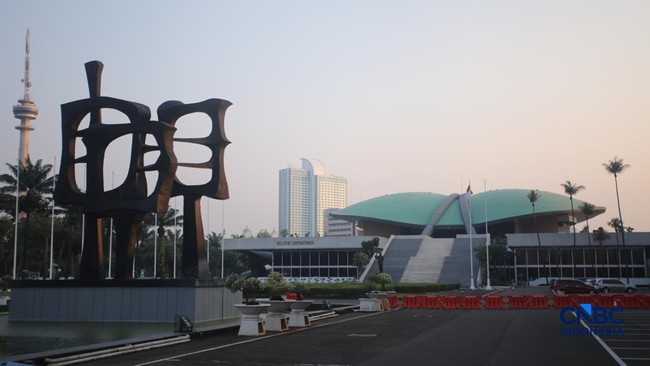
The Nusantara Building, with its iconic green roof, was not originally designed as Indonesia’s parliament building.
Built in 1965, the Nusantara Building actually began as a project with a completely different function from the parliamentary role it is known for today.
Interestingly, in his opening speech at the Annual Session on 14 August 2015, the then Speaker of the Indonesian House of Representatives (DPR RI), Setya Novanto, briefly discussed the building’s history before President Joko Widodo delivered the 2016 State Budget Financial Note.
That moment showed how this legendary building has long been part of important state agendas, including the delivery of fiscal policy direction and the state budget.
Long before it became the centre of parliamentary activity as it is now, the parliamentary complex in Senayan was built as the Jakarta Political Venue to support the Conference of the New Emerging Forces (CONEFO). The forum was Soekarno’s idea to bring together developing countries amid the rivalry between the two world power blocs at the time.
Soekarno wanted the complex to have a different form from parliament buildings in other countries.
In an architectural design competition in November 1964, he also requested a design that reflected Indonesia’s identity while being able to answer the demands of the times. The design by architect Soejoedi Wirjoatmodjo was then selected for the project.
One of the most distinctive features of the Nusantara Building is its green roof, which is said to resemble the flapping wings of a Garuda. According to DPR records, the shape emerged from the development of Soejoedi’s design after consulting with civil engineer Sutami.
The political upheaval of 1965 then halted the CONEFO project. Construction was continued during the administration of President Soeharto with a new function as the parliament building.
In 1968, the Nusantara Building, Nusantara I, and Nusantara II were handed over to the Secretariat General of the DPR RI and have since been used as parliamentary facilities.
The main building of the parliamentary complex is known as the Nusantara Building.
The structure has a semi-circular dome shape that architecturally symbolises the flapping wings of a bird about to take off.
Besides the Nusantara Building, the complex consists of Nusantara I through V, the Bharana Graha Building, the Secretariat General Building of the MPR/DPR/DPD, the Mechanical Building, and the Baiturrahman Mosque.
One of the most striking buildings is Nusantara I, which stands about 100 metres tall with 24 floors.
The parliamentary complex also features the Aesthetic Element Statue, located in the fountain pool area and flanked by 35 flagpoles.
The statue is the work of Drs. But Mochtar, an artist from the Fine Arts Department of the Bandung Institute of Technology (ITB).
Its form consists of three interconnected and continuous spheres.
The statue was made using an iron frame construction coated with copper sheet and planted on a concrete foundation. Its construction was completed in 1977.
The Nusantara Building is called the “Turtle Building” because its architectural form indeed resembles a turtle bowing down, especially when viewed from the front or from the air.
From a distance, the dome looks like a turtle shell, while the part of the building below it resembles a turtle’s body.
One of the most iconic events in the history of the DPR/MPR Building occurred in May 1998, when thousands of students and demonstrators occupied the parliamentary complex.
The action was part of the wave of the Reformasi movement demanding political change and the resignation of President Soeharto. Thousands of students filled the grounds of the DPR/MPR complex, even climbing to the top of the Nusantara Building.
This occupation later became one of the important symbols of the collapse of the New Order regime.
For decades, the DPR/MPR Building was synonymous with the political power of the New Order. But in May 1998, the situation reversed. The building instead became the centre of pressure against the government.
A number of public and political figures came to the parliamentary complex and voiced demands for reform.
Only a few days after students occupied the DPR Building, Soeharto resigned on 21 May 1998.
Power was then handed over to Vice President B.J. Habibie. This event marked the end of 32 years of New Order rule and the birth of the Reformasi era.
Reformasi also brought changes to the parliamentary complex.
Several buildings were renamed. The main building, previously named Grahatama, became the Nusantara Building, while other buildings were given the names Nusantara I through V. The name changes were decided in December 1998.
The demonstrations at the start of Reformasi then became the beginning of the strategic role of the DPR/MPR Building as a place to voice protests.
There are a number of important events that make this building not merely a parliamentary meeting place, but also a witness to regime change and Indonesia’s political transformation.
Source: jawawa.id (https://jawawa.id/newsitem/getting-to-know-the-turtle-building-nusantara-iconic-venue-for-state-addresses-1786679501)
Originally published by CNBC Indonesia (https://www.cnbcindonesia.com/research/20260813170443-128-759065/mengenal-gedung-kura-kura-nusantara-tempat-ikonik-pidato-kenegaraan), translated from Indonesian