
Getting to Know Haakon VIII, Norway's New King
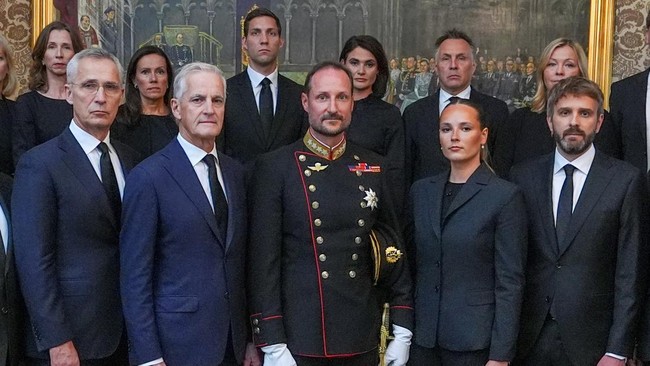
Norway has a new king after King Harald V died at the age of 89 on Friday (28/8/2026). His son, Haakon VIII, now succeeds to the throne in a difficult situation, given his father’s high popularity and various controversies that have recently overshadowed the royal family.
Harald was known to be very popular among the Norwegian public. His approval ratings were consistently high in various opinion polls, while the public’s wave of grief was clearly visible ahead of his death.
Haakon becomes the fourth king to lead Norway’s modern monarchy since the royal system was restored in 1905 after the country gained independence from Sweden.
In one of his first duties as king, Haakon chaired an extraordinary cabinet meeting to announce his royal title. He also chose to reuse his father’s motto, “Everything for Norway”.
Several observers believe Haakon has a strong foundation to follow in his predecessors’ footsteps. While still crown prince, he worked closely with Harald in carrying out royal duties. In recent years, Haakon also received increasing responsibility and often acted as regent when Harald was ill or unable to perform his duties.
“I am very fortunate that Crown Prince Haakon is the one who will carry this on,” Harald wrote about his son in his biography, The King Tells.
Historian Trond Norén Isaksen told the BBC that Haakon is likely to become a king with a different character from his father, but that does not mean he will be less respected.
“King Harald was very charismatic, he had a great sense of humour, which everyone appreciated, while Haakon is a little more reserved, a little more like his mother.
“But in recent years he has also become more relaxed and started to open up more and show a little more of his humorous side. He has carried a very heavy burden for many years because his parents were getting older and his wife was ill,” he said.
Haakon is a direct descendant of Queen Victoria of England to the fifth generation.
With Haakon’s accession as king, his daughter, 22-year-old Ingrid Alexandra, now becomes crown princess and heir to the Norwegian throne. Haakon was previously ahead of his older sister, Princess Märtha Louise, in the line of succession.
Norway’s constitution was amended in 1990 to grant women the right of succession to the throne. Under this rule, Ingrid Alexandra has the opportunity to become the first woman to be Norway’s head of state since the 15th century.
Haakon’s accession to the throne comes as the Norwegian royal family is facing a turbulent period. The monarchy remains generally popular among the Norwegian public and has for many years been known for its modern outlook.
However, in recent years the royal family has also been hit by a number of scandals.
This year, Haakon’s wife, Mette-Marit, who is now Queen of Norway, apologised for her relationship over several years with Jeffrey Epstein, a convicted sex offender. Meanwhile, her son, Marius Borg Høiby, who was born from a previous relationship, has been found guilty of rape in a trial that attracted widespread attention. Høiby is now appealing the verdict.
Haakon was born in 1973 and is the youngest child of the late King Harald and Queen Sonja.
By his own admission, Haakon struggled to accept his status as a member of the royal family when he was a child.
“Yes, I am a royal, but I did not want to talk about it. At school it made me anxious,” he wrote in his autobiography published in 2023, recalling his school days at a state school in the 1980s.
Haakon became crown prince in 1991 at the age of just 17, after his grandfather, King Olav V, died.
Unlike many members of royal families, Haakon attended a local state school before embarking on a four-year career in the navy. He graduated from the Norwegian Naval Academy in 1995.
Haakon then chose not to follow in the footsteps of his father and grandfather by studying at Oxford University. Instead, he went to California and studied political science at the University of Berkeley.
Shortly after returning to Norway, Haakon met Mette-Marit at a music festival in Mette-Marit’s hometown of Kristiansand in 1999.
The media later nicknamed her the Cinderella of Kristiansand, referring to her modest background.
“What we both found together was so strong that I could not let it go,” Haakon, then still crown prince, said ahead of their wedding in 2001.
However, their relationship was not immediately accepted. Since Haakon announced the relationship, fierce debate emerged among the Norwegian public.
Some observers even warned that the relationship could end the Norwegian monarchy. Haakon and Mette-Marit’s relationship was compared to the controversial marriage between American divorcée Wallis Simpson and King Edward VIII of England, which led to Edward’s abdication in 1936.
Mette-Marit was not the first commoner to marry into the Norwegian royal family. The late King Harald had also broken with tradition when he married Queen Sonja around three decades earlier.
However, Mette-Marit was at the time a single mother with a four-year-old child. The child’s father had served a sentence for cocaine possession.
Haakon and Mette-Marit’s decision to live together in an apartment in Oslo also drew criticism from conservative circles of the Lutheran Church of Norway. Nevertheless, opinion polls at the time showed that the majority of the public supported the relationship.