
Get Ready! Purbaya Aims to Investigate Potential Corporate Tax Shortfalls
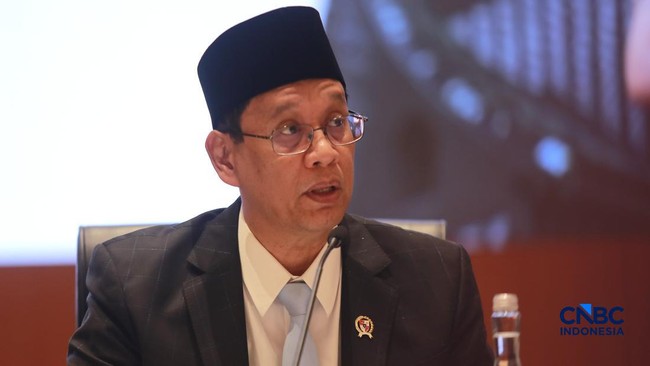
Finance Minister Purbaya Yudhi Sadewa intends to investigate potential tax payment shortfalls by companies by leveraging trade data stored within the Indonesia National Single Window (INSW) system.
Purbaya is pushing for the development of systems based on Artificial Intelligence (AI) and big data to calculate the potential state revenue obligations for every company. This data can subsequently be compared with various taxation documents and corporate payments, allowing the government to detect any discrepancies between the obligations that should be paid and those actually reported.
“In the future, we want every company’s potential underpayment of obligations to be detected,” said Purbaya during a working visit to the National Single Window Agency (LNSW) office on Wednesday (9/9).
Purbaya explained that the LNSW possesses a massive database because every permit application for export and import activities is stored within the INSW system. However, until now, this data has not been fully integrated, meaning its use for analysis has not reached its full potential.
“Previously, we already had a database here collected within the INSW system,” said Purbaya.
He noted that manual data processing would make it difficult for the government to obtain a comprehensive overview of economic and trade activities. Furthermore, the use of computer programmes alone may not be optimal if various data sources are not integrated.
Consequently, the Ministry of Finance is developing an application using AI to assist analysts in processing large volumes of data while simultaneously identifying potential state revenue.
“Therefore, we are developing an application here using AI to help our analysts identify potential revenue that could be obtained through system improvements,” Purbaya explained.
Corporate Tax to be Cross-Checked
Purbaya wants the system to go beyond merely monitoring trade transactions. The government will eventually be able to estimate the state revenue obligations that should be paid by every company.
The results of the analysis can then be compared with documents such as Annual Tax Returns (SPT), royalty payments, and other relevant papers. Through this method, the government can determine whether a company’s economic activities align with their reported state revenue obligations.
“In the future, every company’s potential underpayment of obligations will be detected,” Purbaya stated.
Purbaya noted that the system’s ability to trace historical data is also crucial. The government will not only be able to monitor current economic activities but also conduct investigations into company activities from previous years.
“Activities like this can span several years back. If it happened a year ago, everything can be seen. In the future, no one will be able to play around anymore,” he said.
He emphasised that the government will tighten supervision by utilising increasingly integrated data.
“So, moving forward, no one can play around. We will monitor it more closely,” he asserted.
AI as the Ministry of Finance’s Weapon
Purbaya stated that the development of the INSW system will continue to be refined according to user needs. He believes that the capabilities of programmers must be balanced with input from end-users to ensure the developed applications are truly effective for supervision and state revenue purposes.
“We will continue to refine it. I requested that their skilled programmers take direction from the end-users. I am the one providing them with requirements,” he explained.
Purbating also emphasised that the government will utilise all available data through integration, supported by AI and big data.
According to Purbaya, the LNSW plays a strategic role in supporting government analysis, even though its existence is not widely known to the public.
“LNSW is the National Single Window Agency. You might rarely see it, but it is quite powerful and assists our analysis,” said Purbaya.
He mentioned that the developed system has already demonstrated high levels of accuracy in detecting potential state revenue.
“All potential tax and revenue can be detected early here. The results have been like that; the accuracy is quite high,” he revealed.
Looking ahead, Purbaya also opened the possibility of using the system to perform ‘track-back’ operations on economic activities that occurred in previous periods.
“In addition to monitoring the future, there may be findings that we want to track back to the past,” he concluded.
Source: jawawa.id (https://jawawa.id/newsitem/get-ready-purbaya-aims-to-investigate-potential-corporate-tax-shortfalls-1789019989)
Originally published by CNBC Indonesia (https://www.cnbcindonesia.com/news/20260910102819-4-766826/siap-siap-purbaya-ingin-kulik-potensi-kekurangan-pajak-korporasi), translated from Indonesian