
Get Ready: New Gas to Replace LPG to Circulate in Indonesia
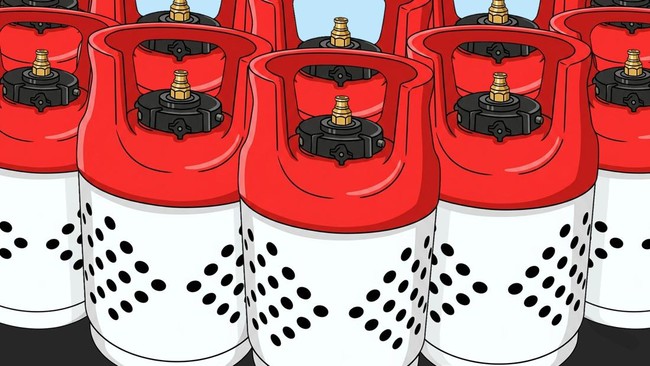
The Minister of Energy and Mineral Resources (ESDM), Bahlil Lahadalia, is pushing for the use of 3kg Compressed Natural Gas (CNG) as an alternative to 3kg Liquefied Petroleum Gas (LPG). This move is driven by Indonesia’s abundant domestic gas resources suitable for CNG production.
Bahlil noted that Indonesia currently imports 80% of its total LPG requirements because the necessary C3 and C4 gas components are scarce domestically, whereas C1 and C2 types are plentiful. “That is why we are pushing for CNG now. CNG uses C1 and C2, which are abundant in Indonesia. We recently discovered a giant find by ENI in East Kalimantan, involving 5 TCF plus 2 TCF, with condensate of approximately 200,000 barrels of oil equivalent. By 2028-2029, production could reach 3,000 Mmscfd,” Bahlil explained during the CNBC Indonesia Energy Forum.
He further explained that the government is currently in the third stage of testing the use of CNG in 3kg cylinders. Meanwhile, 12kg and 50kg CNG cylinders have already been utilised in the commercial sector, including for the Free Nutritious Meal (MBG) programme, hotels, and restaurants.
He emphasised that CNG is not a new technology, as it has long been applied in various sectors; however, the government is now developing its use for household needs. “This is not a new item that suddenly appeared from Fakfak. It already exists. However, for our lower-income citizens who receive subsidies, they must use 3kg cylinders. The pressure is 200 to 250 bar. This is what we are currently testing,” he said.
CNG Merah Putih
The government has officially introduced the project to replace 3kg LPG with 3kg CNG. These CNG cylinders are named “CNG Merah Putih” (Red and White CNG) to utilise domestic resources and reduce dependence on LPG, which is still dominated by imports.
The Director General of Oil and Gas at the Ministry of ESDM, Laode Sulaeman, explained that the government is currently processing dozens of CNG cylinder prototypes for testing. The target is for 3kg CNG cylinders to be implemented and distributed to the wider public within 2026.
“The Minister announced the Merah Putih cylinders recently. This July, prototypes are being produced for testing. There are about 15 units. One more stage and it can be implemented and distributed this year,” said Laode when met at the DPR RI Building, Jakarta.
Unlike conventional LPG cylinders, the CNG Merah Putih uses Type 4 cylinder technology made of composite materials. This technology offers advantages in terms of weight, making it much lighter and easier for household use.
“I want to clarify once more that the cylinder material has reached Type 4. Type 1 is all metal, Type 2 and Type 3 involve mixtures that lighten the weight but are still heavy. Therefore, we must make it lighter so that housewives do not feel that the replacement is too heavy,” said Laode.
Cylinders Imported from China
For the initial stage, the government is procuring these high-tech cylinders through an import scheme from China. The authorities will conduct a series of tests at the Oil and Gas Testing Centre (Lemigas), specifically regarding safety factors for the valves and the cylinder’s resistance to gas pressure.
“Currently, they are from China. We will test them at Lemigas, as there must be pressure tests and, most importantly, safety checks on the valves and the cylinders. In China, the cylinder and valve are integrated,” Laute continued.
The selling price of CNG Merah Putih will be pegged to the current price of subsidised LPG to ensure affordability for the public. Through this simulation, the use of domestic natural gas is believed to be able to significantly reduce the energy subsidy burden.
“The price will be the same. In the current simulation, by keeping it the same, subsidies could decrease by up to 30%. If the volume is massive, we will have the bargaining power to ask them to build production facilities here,” Laode revealed.
The implementation of 3kg CNG will be carried out gradually, prioritising major cities on Java that already have adequate gas pipeline infrastructure. The Ministry of ESDM has coordinated with SKK Migas to ensure the availability of gas allocations to support the energy conversion programme.
“We will prioritise those connected to pipelines. As the Minister mentioned, the trials will be in major cities on Java where there are more gas pipeline routes. We have discussed this with SKK Migas to ensure that once it starts, the gas will be available,” he concluded.