
Germany Shifts War Strategy, State to Fund Arms Startups
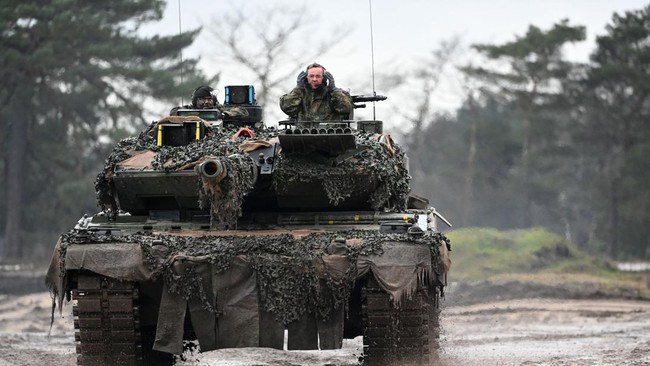
The war between Russia and Ukraine marks a major turning point for German defence. Russia’s invasion in February 2022 forced Berlin to abandon a military policy that had been cautious for decades.
After the Second World War, Germany relied largely on the United States and NATO to safeguard its security. The military budget was suppressed, troop numbers continued to shrink, and weapons procurement moved slowly because of lengthy bureaucracy.
The war in Ukraine then exposed those weaknesses. Germany faced shortages of ammunition, combat vehicles, air defence systems and personnel ready for deployment.
Days after Russia attacked Ukraine, the government of Chancellor Olaf Scholz announced a policy shift known as the Zeitenwende, or turning point. Germany established a special defence fund of €100 billion, roughly Rp 2,057.2 trillion (€1 = Rp 20,572), to modernise the arsenal of the Bundeswehr, as the German armed forces are known.
A change of government did not halt this direction. Under Chancellor Friedrich Merz, the build-up of Germany’s military strength has in fact accelerated.
Germany’s core defence budget is planned to rise from €82.2 billion in 2026 to €109 billion in 2027. If aid for Ukraine and other security spending are included, the total reaches €130.1 billion.
Berlin is even preparing around €783.8 billion for defence-related activities throughout 2026–2030. Defence spending as a share of gross domestic product is targeted to rise from 2.8% in 2026 to 3.5% from 2029.
The budget increases continue a large surge over the past decade. German military spending rose from €36.1 billion in 2016 to €100.7 billion in 2025. In nominal terms, the increase is around 179%, nearly tripling its value.
The sharpest rise came after Russia’s invasion of Ukraine in 2022. In just three years, German military spending jumped almost 89%, from €53.3 billion in 2022 to €100.7 billion in 2025.
However, Germany is not only spending its money on tanks, missiles and fighter jets. The German government is now targeting small technology companies developing artificial intelligence, drones, military robots and unmanned systems.
The latest step even brings the state in directly as a company owner.
Germany begins buying shares in defence start-ups
The German government will establish a new investment vehicle allowing the state to purchase shares directly in defence technology start-ups and companies.
Citing Reuters, the policy forms part of the government’s strategy to strengthen the defence industry while encouraging the growth of new companies.
The German government has not announced the size of the funds to be prepared. However, the instrument will be directed at start-ups and growing companies that make products with clear military applications.
According to the Financial Times, the state-owned development bank KfW will play a role in the investments. The government is also preparing tax incentives, simplified licensing and easier access for technology companies to defence contracts.
The move is driven by two major developments. First, the war in Ukraine has shown that military technology changes far faster than conventional weapons procurement processes.
Second, doubts have emerged over how far the United States will continue to guarantee European security. The administration of President Donald Trump has pressed European countries to bear their own defence costs and begun reducing some of its military presence in the region.
Germany is consequently trying to build a defence industry that does not entirely depend on foreign companies or foreign capital.
German Economics Minister Katherina Reiche said start-ups and growing companies play an increasingly important role in improving the country’s defence readiness.
Government support will not only come through equity participation. Berlin can also assist companies through large product orders.
“By placing large orders, the state guarantees production and secures business deals,” Reiche said, quoted by Reuters.
According to her, government procurement contracts can provide the revenue certainty that start-ups need to scale up production. Companies do not always have to rely on subsidies or wait for funding from private investors.
This policy differs considerably from the previous approach. Until now, German defence contracts have flowed mostly to large companies such as Rheinmetall, Airbus, Thyssenkrupp Marine Systems and Hensoldt.
Now, a portion of that spending is being directed towards smaller, fast-moving firms.
Ukraine becomes a testing ground for military technology
The war in Ukraine is the main reason start-ups are beginning to find a place in Europe’s defence industry.
The conflict has shown that modern warfare is not determined solely by the number of tanks, fighter jets and warships. Cheap drones, artificial intelligence, digital communications, unmanned robots and data-processing software now play a major role on the battlefield.
Two German companies frequently mentioned are Helsing and ARX Robotics.
Helsing develops artificial intelligence-based defence systems. Its technology is used to process data from sensors and help soldiers recognise battlefield situations more quickly.
Meanwhile, ARX Robotics produces unmanned ground vehicles that can be used to transport equipment, conduct reconnaissance and carry out dangerous tasks without placing soldiers directly on the front line.
Both companies’ products have been supplied for use in Ukraine. The battlefield has become a live testing ground for technology that was previously still in development.
Speed is one of the main advantages of start-ups. Small companies are seen as capable of updating software or developing new hardware within months. A similar process at traditional defence companies can take years.
The problem is that many European start-ups struggle to raise capital when they want to scale up production.
Early-stage funding in Germany is relatively available. But when large amounts are needed, companies often have to look for investors from the United States.
Venture capital investment in Germany reached €7.2 billion in 2025, still far below the US and UK markets.
This situation worries the government that technologies developed in Germany may ultimately move abroad. Companies could sell shares to foreign investors, relocate their development centres or choose to open production facilities in the United States.
Through direct investment, Berlin wants to keep technology, jobs and military production at home.
Growth among German start-ups is in fact rising. Some 3,053 new start-ups were established in the first half of 2026, up 52% compared with the second half of 2025.
The number of workers absorbed by start-ups also increased 26% in 2024 compared with 2020.
The government will extend the Future Fund beyond 2030 to expand access to financing. The programme was established in 2021 to support technology companies, biotechnology firms and other strategic sectors.
Even so, state involvement as a shareholder still raises concerns. A number of industry players believe the government should focus on awarding contracts and accelerating procurement rather than becoming too deeply involved in company ownership.
They worry that state involvement could bring bureaucracy and politics into business decisions. The government believes direct ownership is necessary to keep strategic companies from moving abroad.
From start-ups to Tomahawk missiles
Funding start-ups forms part of a far larger transformation of German defence.
Berlin is building long-range strike capability, air defence, ammunition production, drone technology and naval power.
In July 2026, Germany agreed to purchase Tomahawk cruise missiles and Typhon ground launchers from the United States. The Tomahawk has a range roughly three to five times greater than the German-made Taurus missile, which can reach about 500 kilometres.
Chancellor Merz said the purchase is needed to close strategic gaps in Germany’s defences.
At the same time, Lockheed Martin and Rheinmetall signed an agreement to produce ATACMS missiles in Germany. If realised, Germany will become the first country outside the United States to produce the tactical ballistic missile.
Rheinmetall’s plant in Unterluess will become the centre for ATACMS production, assembly and distribution for NATO members and allied nations.
The German Navy has also begun developing laser weapons. Rheinmetall and MBDA received contracts worth hundreds of millions of euros to build laser systems targeted to be operational from 2029.
Germany is also deepening defence cooperation with France. For the first time, German forces will take part in nuclear exercises led by France.
The step does not give Germany its own nuclear weapons. But the involvement shows Berlin is beginning to prepare an additional avenue of protection should America’s security commitment to Europe continue to diminish.
The journey of rebuilding Germany’s military still faces many obstacles. The project for six F126 frigates was recently cancelled because of delays and cost overruns.
The project’s cost is estimated to have jumped from around €10 billion to more than €18 billion, even though the government had already spent around €2.3 billion.
The case illustrates the scale of the problems in Germany’s defence procurement system. Large budgets do not automatically deliver weapons quickly if the contracting, development and production processes remain slow.
This is precisely why the government is turning to start-ups. Start-ups are seen as able to develop technology faster and more cheaply, especially for drones, robots, sensors and military software.
Reiche estimated the defence sector could add around 0.5% to 1% to German economic growth if the funds prepared are used well.
The war in Ukraine has ultimately brought changes that would have been hard to imagine a few years ago.
A country that limited its military power for decades is now pouring hundreds of billions of euros into defence, buying long-range missiles, producing American weapons and becoming a direct investor in military technology companies.