
Germany Invited to Enter Indonesia's Downstreaming Sector
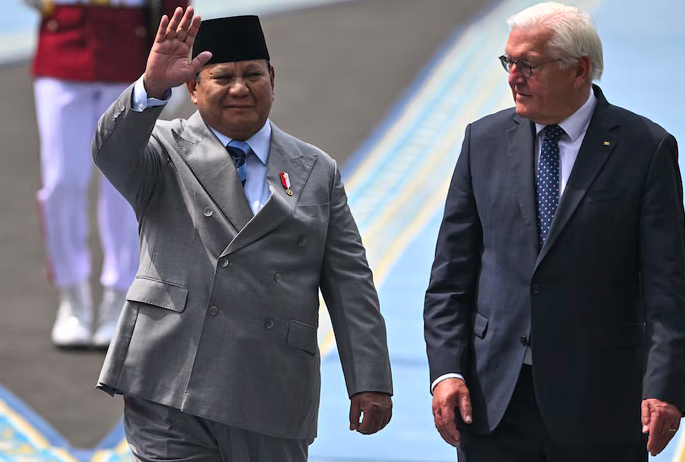
President Prabowo Subianto has invited Germany to expand investment in several of Indonesia’s strategic sectors, ranging from energy transition and industrial downstreaming to electric vehicles and semiconductor development. The invitation was made during a reception for the state visit of President Frank-Walter Steinmeier of the Federal Republic of Germany at Merdeka Palace on Monday.
Prabowo considered Steinmeier’s visit significant for both countries, not only because it reflects the closeness of bilateral relations but also because it takes place amid a global situation full of uncertainty. ‘Strengthening and sustaining the Indonesia-Germany partnership is certainly a priority,’ Prabowo said in a joint press conference.
According to Prabowo, the meeting discussed various strategic agendas, particularly strengthening cooperation in the fields of economy, investment, energy transition, energy security, education, and employment. Both countries also agreed to continue enhancing mutually beneficial trade and investment.
On that occasion, Prabowo emphasised the importance of Indonesia’s relationship with Europe. The Indonesian government hopes that negotiations on the Indonesia-European Union Comprehensive Economic Partnership Agreement (IEU-CEPA) can soon reach a substantive conclusion and provide tangible benefits for businesses. He also expressed hope that Germany will continue to play an active role in finalising the agreement at the European level, as its support would help accelerate broader economic opportunities for both parties.
Beyond trade cooperation, economic relations between Indonesia and Germany are also being strengthened through the Competitiveness Industrial Modernization and Trade Acceleration (CITA) programme. The Indonesian government views this programme as an instrument to deepen industrial collaboration between the two countries.
Prabowo specifically invited Germany to participate in the development of national strategic sectors. In addition to energy transition and industrial downstreaming, Indonesia is opening opportunities for cooperation in the development of electric vehicles and the semiconductor industry, which are currently a focus of national development. ‘Indonesia also invites Germany to expand investment in important sectors in Indonesia,’ he stated.
Furthermore, the government is offering German involvement in the supply chain for critical minerals and rare earths, as well as in various infrastructure projects across the country. Indonesia also welcomes the Partnering in Business with Germany programme, which is aimed at supporting the development of micro, small, and medium enterprises (MSMEs).
Prabowo added that Indonesia will host the second Joint Economic and Investment Committee this year as an effort to strengthen more concrete economic cooperation. In the field of employment, Indonesia appreciates the signing of a Letter of Intent regarding a Global Skills Partnership in the nursing sector. The government also seeks to expand job opportunities for Indonesian workers in Germany, including in high-technology sectors requiring skilled labour.
Beyond economic issues, the two leaders also discussed the global situation. Prabowo and Steinmeier agreed that various international conflicts must be resolved through negotiation and diplomacy to maintain global stability. Prabowo believes Germany holds an important position in maintaining world peace and strengthening international cooperation, and he expressed hope that Berlin will take on a more active role globally.
Steinmeier’s visit to Jakarta also serves as early momentum towards the 75th anniversary of diplomatic relations between Indonesia and Germany, which will be marked in 2027. His presence in Jakarta is seen as a strong signal that bilateral relations are becoming increasingly strategic and relevant for facing future global challenges.