
German Experts Reveal New Facts About Lake Toba, Many People Were Wrong
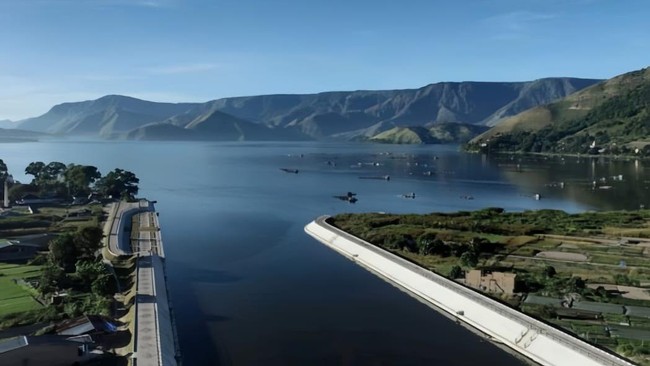
Jakarta, CNBC Indonesia - Surprising facts about Lake Toba have emerged, overturning many previously held understandings. According to researchers from Germany, Lake Toba originated from the eruption of Mount Toba, the largest volcanic eruption in the last 2.6 million years. However, the researchers explain that the impact of this supervolcanic eruption on all humans on Earth was not as great as previously thought.
Around 74,000 years ago, the caldera that is now Lake Toba spewed thousands of cubic kilometres of magma in about two weeks. The volume of material ejected is estimated to have been 1,000 times greater than the 1991 eruption of Mount Pinatubo.
“People thought the eruption caused massive cooling of the planet, threatening the survival of our ancestors,” said geoscientist Jinheum Park from Johannes Gutenberg University Mainz, Germany, quoted on Saturday (15/8/2026).
Park and his colleagues searched for traces of the catastrophe through mud deposits at the bottom of Lake Chala, a small crater lake on the border of Kenya and Tanzania. Instead of finding evidence of a prolonged volcanic winter, they found that the impact of the Toba eruption lasted only about 18 months.
Large eruptions typically release sulphur dioxide into the stratosphere. The gas then turns into sulphate aerosols that reflect sunlight and cause global cooling. Until now, estimates of the amount of sulphur released by Toba have varied widely, leading climate simulations to produce contradictory scenarios, ranging from nearly wiping out human civilisation to causing only mild weather disruption.
To address this uncertainty, the scientists used Lake Chala as a high-resolution climate archive. The lake has annual sediment layers that form like tree growth rings, allowing researchers to reconstruct climate changes year by year. “It works exactly like rings in a tree trunk,” said Park.
The volcanic ash from Toba in Lake Chala is not even visible to the naked eye. The scientists found it by counting microscopic glass shards originating from magma ejected during the eruption. They then analysed 450 years of sediment layers around the eruption period using microscope imaging, chemical scanning, isotope readings, and diatom population counts every two to three years.
The research showed that after the eruption, diatoms experienced stress due to the dimming of sunlight. “We suspect the green layer came from diatoms as a stress response to the darkened sky, because they need light to grow,” said Park.
The first dry season after the eruption triggered a diatom population boom likely influenced by cooling of the lake surface temperature. However, by the third year, the lake ecosystem conditions returned to normal. “The light layer formed almost two years after the eruption is very distinctive for Lake Chala,” said Park.
Based on these findings, the team concluded that the main impact of the Toba eruption most likely lasted only about 18 months.
To measure how much the temperature dropped, the scientists analysed the ratio of silicon to aluminium and manganese to iron in the lake sediments. The analysis showed a regional temperature drop of only about 0.5 degrees Celsius. “That is how we obtained the cooling estimate of about 0.5 degrees Celsius,” said Park.
The findings also allowed researchers to estimate the timing of the eruption more precisely. Based on the position of the ash layer in the sediments, the eruption most likely occurred in January or February, not in the season previously estimated by some climate models.
Park explained that the Toba eruption did trigger cooling and drought, but not enough to significantly threaten human survival. “Our study shows that the magnitude of cooling and drying after Toba was much smaller and still within the range of natural variation during glacial and interglacial cycles. Humans had already experienced and survived those conditions,” said Park.
According to him, the East Africa region at that time was already experiencing a natural trend towards a cooler and drier climate. Compared with these natural climate variations, the impact of the Toba eruption was relatively small.
Nevertheless, Park acknowledged limitations in this research because it relied on only one lake as the main data source. “This lake records regional climate signals in East Africa, but does not show the impact on the whole world. There needs to be more research with a similar approach in other locations that have Toba ash deposits,” he concluded.
The research team hopes the same method can be applied to study the impact of other supervolcano eruptions in the world, such as Los Chocoyos in Guatemala and Oruanui in New Zealand.