
German Chancellor Visits the North Korea–South Korea Border
Before German Chancellor Friedrich Merz visited South Korea on Thursday (29 October), South Korea’s military reported that North Korea had launched 10 ballistic missiles towards the Sea of Japan.
During his visit, Merz said he hoped the Korean Peninsula could be reunified. The peninsula has been divided since the end of the Korean War in 1953, leaving a 248-kilometre border.
Merz and Lee Jae Myung agreed to deepen strategic and security ties between their countries, including through joint military exercises and intelligence sharing.
Hopes dashed after a ‘historic handshake’
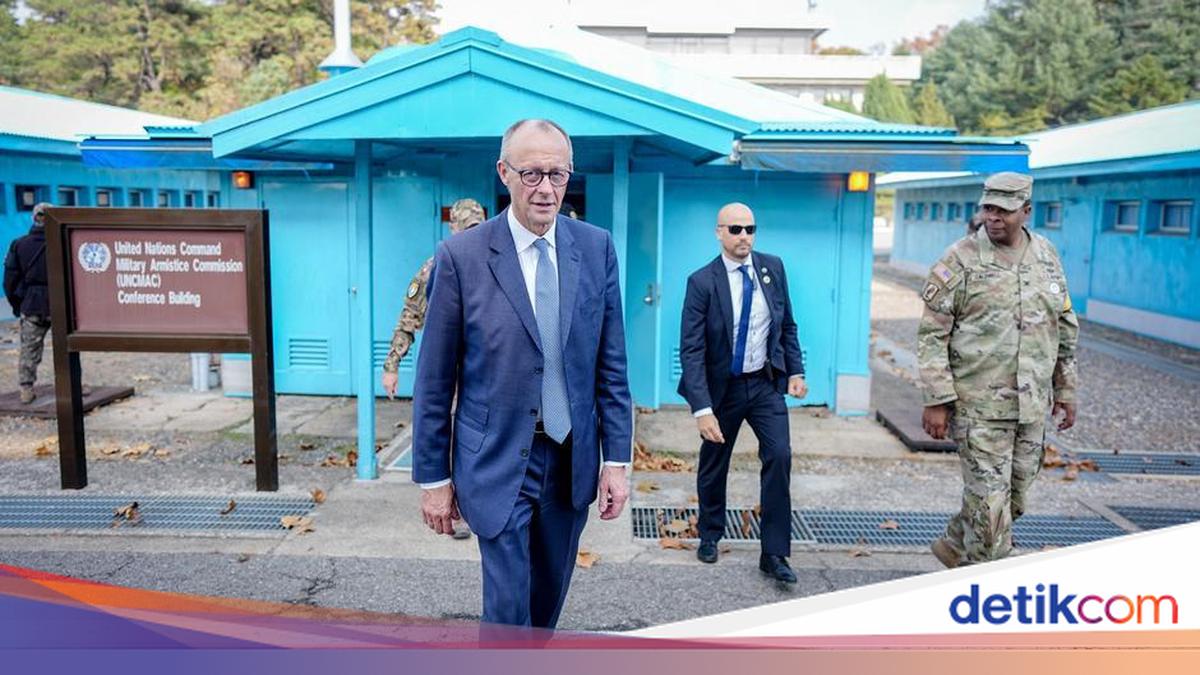
The German Chancellor also visited the Panmunjeom Demilitarised Zone (DMZ) on Friday (30 October). The DMZ is a buffer zone running along the military boundary between North and South Korea.
At the border, Merz visited one of the iconic blue buildings. It stands directly on the boundary between the two countries, where North and South Korea meet for face-to-face talks. It was also here, in 2018, that then South Korean President Moon Jae-in and North Korean leader Kim Jong Un shook hands.
Olaf Scholz visited the area in 2023. Helmut Kohl had also visited in 1993, hoping that the fall of the Berlin Wall might help bring down this barrier and make reunification possible.
But since the historic handshake in 2018, reunification has become increasingly elusive, appearing almost impossible. A key setback came in 2019, when a meeting between Kim Jong Un and US President Donald Trump in Hanoi failed to produce a denuclearisation agreement.
Since 2024, Kim Jong Un has ordered the destruction of historic railway and road links connecting the two countries, while reinforcing the already heavily guarded border with landmines and barriers.
Diplomatic efforts to ease tensions are currently deadlocked. A week earlier, the South Korean government again proposed opening talks with North Korea, but Kim Jong Un has shown no willingness to do so.
Deployment of two German officers
During his visit, the Chancellor also highlighted the impact of the conflict on the Korean Peninsula for Germany and Europe.
Since Russia launched its full-scale invasion of Ukraine in 2022, Pyongyang has supplied Moscow with artillery ammunition and missiles. South Korea’s intelligence agency says North Korea has also sent around 15,000 troops to fight alongside Russian forces. In return, Russia has provided North Korea with financial assistance, military technology and security guarantees.
“Korean security is linked to European security. European security is also linked to Korean security,” Merz said. “The world is small, even in the midst of war.”
The links between the two regions mean that two German officers are also serving in the US-led United Nations Command (UNC), which oversees the armistice on the Korean Peninsula. This also shows that “security in the world can no longer be separated; we must guarantee one another’s security everywhere,” Merz said.
Merz sought to encourage the Korean people. “Korea and Germany are connected by the bitter experience of division,” he wrote in the presidential guest book. “I also hope the Korean people can experience what we experienced in Germany: unity in freedom.”
Source: jawawa.id (https://jawawa.id/newsitem/german-chancellor-visits-the-north-korea-south-korea-border-1793591481)
Originally published by detikcom (https://news.detik.com/dw/d-8734203/kenselir-jerman-kunjungi-perbatasan-korut-dan-korsel), translated from Indonesian