
Geothermal Development Must Accelerate Eightfold to Meet 5.2GW Target
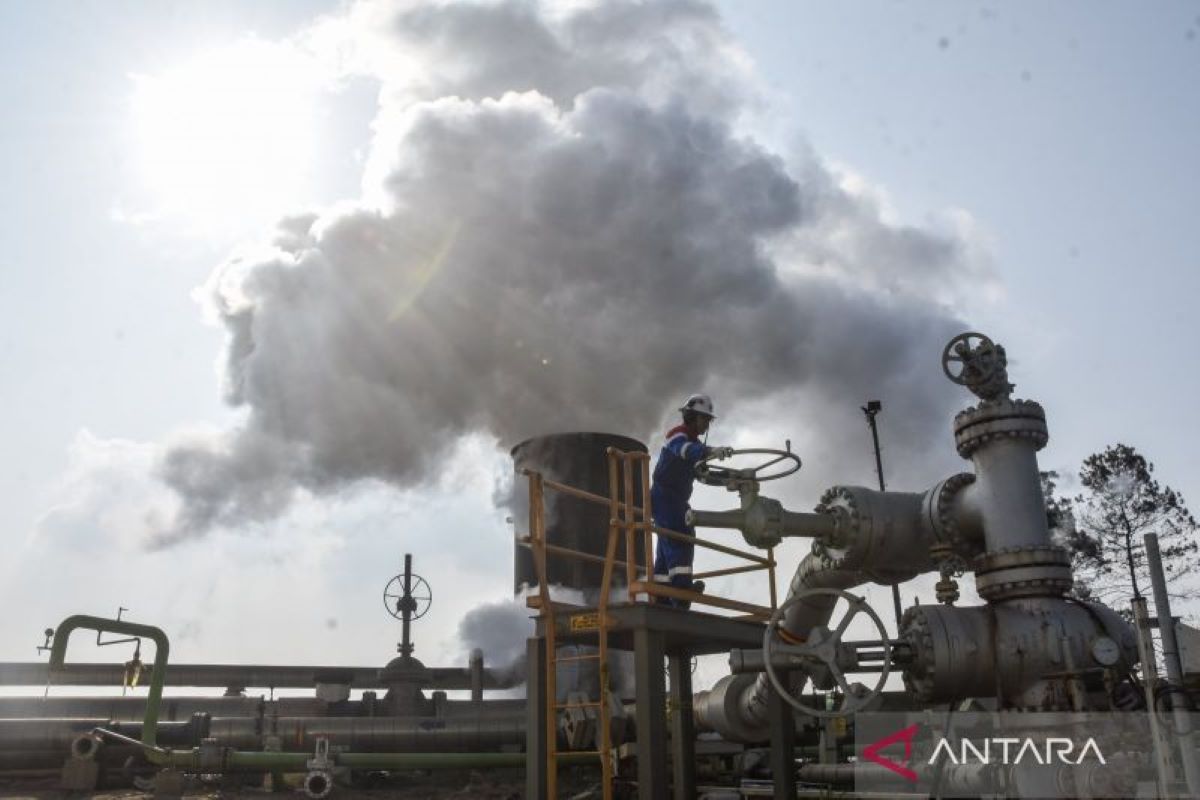
Jakarta (ANTARA) — The pace of geothermal development in Indonesia must be accelerated by around eightfold for the country to meet its target of adding approximately 5.2 gigawatts (GW) of geothermal power plant capacity under the 2025–2034 Electricity Supply Business Plan (RUPTL), said Komaidi Notonegoro, executive director of the ReforMiner Institute.
“Between 2020 and 2025, geothermal power plant capacity increased by only around 62 megawatts (MW) a year on average, far below the target,” he said in Jakarta on Wednesday.
Komaidi said that, of Indonesia’s geothermal potential of 23,202MW, installed geothermal power plant capacity currently stands at just 2,776MW.
Over the five years from 2020 to 2025, capacity additions averaged around 62MW annually, while the RUPTL requires an average of about 520MW a year. This means development must accelerate by 8.4 times.
Investment has averaged around US$770 million a year, only a third of the approximately US$2.4 billion needed annually.
Geothermal development could add around US$35.40 billion to gross domestic product, generate approximately Rp14 trillion in non-tax state revenue (PNBP) from 2025 to 2029, and reduce power plants’ fuel consumption in eastern Indonesia by around 350,000 kilolitres a year.
Komaidi said, however, that current geothermal electricity prices do not reflect the projects’ economic costs.
As a result, the internal rate of return (IRR) for geothermal power plant projects is well below the requirements set by banks.
“That means the projects are not eligible for bank loans — in other words, they are not bankable,” Komaidi said at the ReforMiner discussion forum.
Another speaker, Eddy Soeparno, deputy speaker of the People’s Consultative Assembly (MPR) and a member of House of Representatives Commission XII, said geothermal projects currently have an average IRR of just 8–9 per cent, below the government’s 11 per cent target. Exploration permits, which are formally issued for a period of 5+1+1 years, can in practice take up to 15 years.
Eddy cited the Philippines, which has expanded geothermal utilisation by introducing a one-stop permitting process for strategic projects.
Turkey, meanwhile, covers the cost of dry wells through a risk-sharing mechanism, which Eddy said could serve as a policy model for Indonesia.
He also stressed the social dimension of geothermal development, citing New Zealand, where Māori communities are not merely compensated but are partners in owning geothermal power plants with capacity of more than 300MW.
The benefits of clean energy development, including the economic value of carbon, should be felt directly by communities near project sites, he said.
“Geothermal investment can be accelerated by improving four areas: a bankable pricing framework, the sharing of exploration risks, simpler permitting, and involving communities as development partners,” Eddy said.
Ali Ashat, a geothermal researcher at the Bandung Institute of Technology (ITB), echoed those views, saying community concerns should be addressed with evidence and transparent baseline data.
“Residents and surrounding communities need to feel the benefits and receive answers to any concerns that may arise from geothermal power plant projects,” Ali said.
Source: jawawa.id (https://jawawa.id/newsitem/geothermal-development-must-accelerate-eightfold-to-meet-5-2gw-target-1795596945)
Originally published by Antara (Indonesian) (https://www.antaranews.com/berita/5877443/kejar-target-52-gw-pengembangan-panas-bumi-harus-8-kali-lebih-cepat), translated from Indonesian