
Geothermal Development Delivers Tangible Benefits for Regional Development
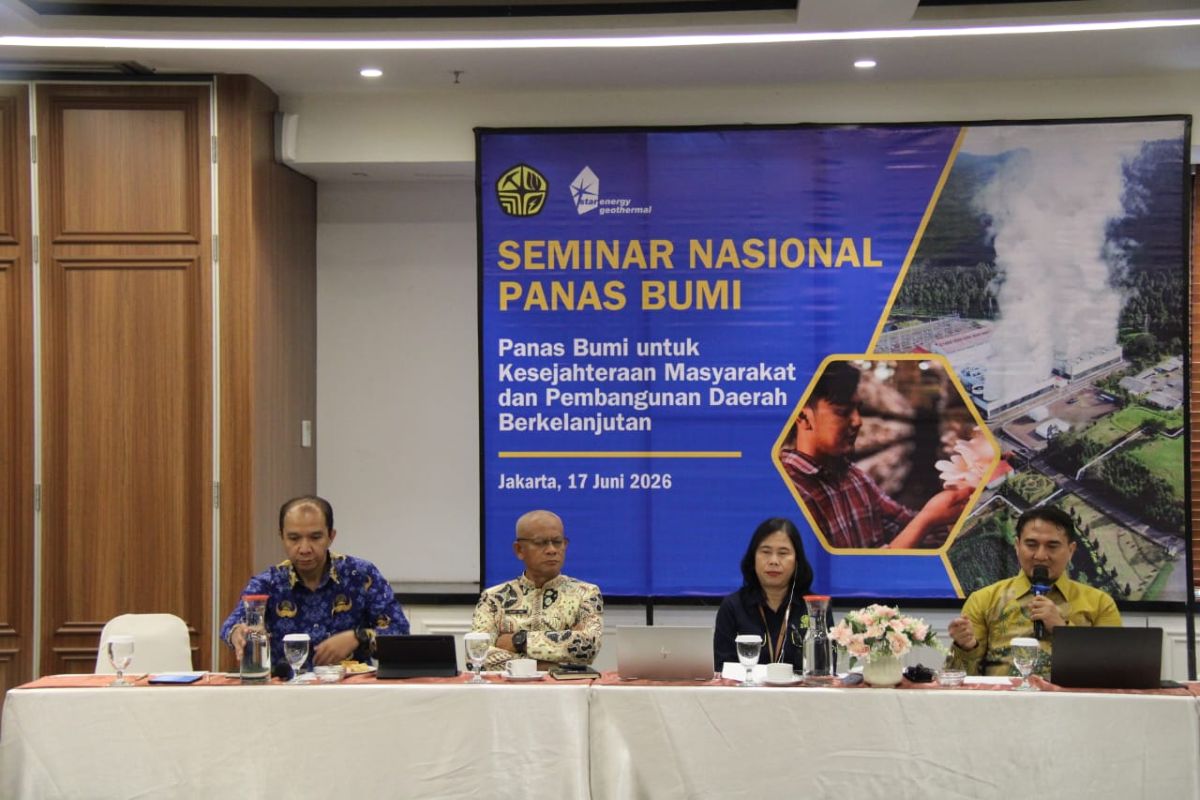
The utilisation of geothermal energy not only contributes to the national clean energy supply but is also increasingly demonstrating its role in promoting community welfare and regional development. Through direct use for productive economic activities, the distribution of production bonuses, and community empowerment programmes, the geothermal sector is considered capable of delivering sustainable social, economic, and environmental benefits. This emerged during a National Geothermal Seminar held at Mercure Cikini, Jakarta, on Wednesday (17/6). In the forum, the Ministry of Energy and Mineral Resources (ESDM) outlined various positive impacts of geothermal development that have been felt by communities in several regions. Mustika Delimantoro, Coordinator for Geothermal Investment and Cooperation at the Ministry of ESDM, explained that geothermal utilisation is not limited to generating electricity but also opens opportunities to increase the economic productivity of communities. “Geothermal energy not only produces electrical energy but can also be directly utilised to increase community economic productivity, strengthen food security, and create added value for regions,” said Mustika. The geothermal sector’s contribution is also felt by local governments through the production bonus mechanism. Garut Regency Secretary Nurdin Yana revealed that during the 2015–2025 period, Garut Regency received geothermal production bonuses worth Rp137.84 billion. “The geothermal production bonus has become an important instrument that enables local governments to accelerate development and improve the welfare of communities around development areas,” said Nurdin. These funds are used for various development programmes. In 2025, the Garut Regency Government allocated Rp14.43 billion from geothermal production bonuses, including Rp7.21 billion for financial assistance to 36 villages and Rp2.89 billion for grants to 94 religious facilities. Additionally, the funds were used for the construction and reconstruction of several strategic road sections, such as Jalan Cigadog, Jalan Palnunjuk–Pasirwangi, and Jalan Pasirwangi–Darajat. Meanwhile, in 2026, the production bonus allocation of Rp8.40 billion is directed towards the construction of river embankments, rehabilitation of irrigation networks, construction of drinking water supply systems (SPAM), sanitation facilities, reconstruction of village roads, and rehabilitation of primary and junior secondary schools. On another front, geothermal development is also spurring various social and environmental innovations. One such example is carried out by Star Energy Geothermal, which operates the Wayang Windu, Darajat, and Salak geothermal fields with a total installed capacity of 929.3 megawatts (MW). This capacity is equivalent to supplying clean energy for approximately 1.44 million households annually. Ismail Hidayat, Head of Geothermal Engineering at Star Energy Geothermal Wayang Windu, emphasised that the success of geothermal development must be measured by the impact felt by the community and the environment. “The success of geothermal development is not only measured by the energy produced but also by the positive impact that can be felt sustainably by the community and the environment,” he said. Through a community empowerment programme called Tumbuh Bersama, the company developed mushroom cultivation involving local community groups. This programme gave rise to Genki Noko Farm, which is now capable of producing up to 40,000 mushroom baglogs, has obtained a Perseroan Perorangan legal entity status, and has increased its business cash from Rp1 million to Rp30 million. In addition to supporting the community’s economy, the programme also contributes to stunting prevention efforts through the provision of local food ingredients. The use of rice straw and coffee husk waste as mushroom growing media also yields environmental benefits in the form of reducing greenhouse gas emissions by approximately 3,787 kilogrammes of CO2e per year, while creating potential additional community income of Rp12.75 million per year. With these various benefits, geothermal energy is considered to have a strategic role not only as a renewable energy source but also as a development instrument capable of simultaneously driving economic growth, improving community welfare, and maintaining environmental sustainability.