
Geology Agency to optimise saline aquifers for carbon storage
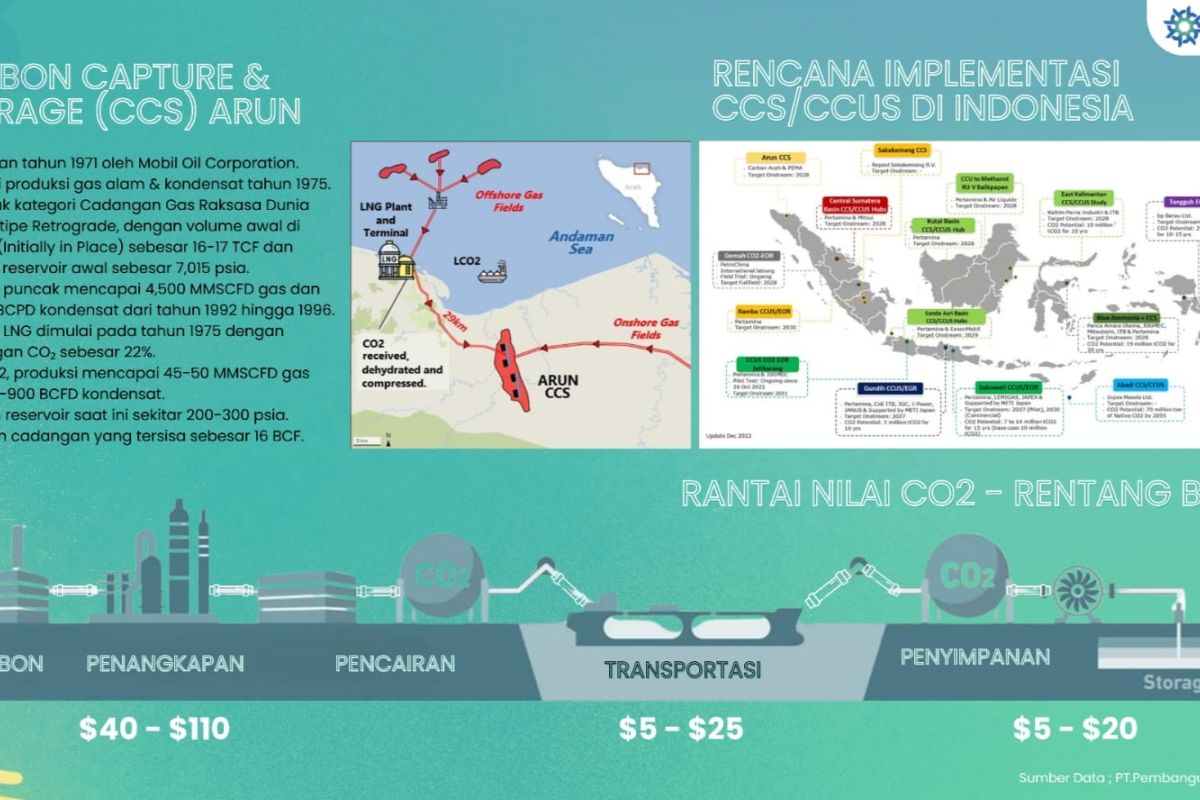
Jakarta (ANTARA) – The Geology Agency at the Ministry of Energy and Mineral Resources (ESDM) is stepping up the mapping of underground saline aquifer formations as an environmental protection measure and a way to curb greenhouse gas emissions, helping to mitigate the threat of a global climate crisis.
Geology Agency head Lana Saria said in Jakarta on Monday that the mitigation effort was directly aligned with Indonesia’s Long-Term Strategy for Low Carbon and Climate Resilience 2050 (LTS-LCCR 2050), through the strengthening of the country’s carbon capture and storage (CCS) ecosystem.
“The Geology Agency consistently aligns its work with these commitments. One important strategy in the LTS-LCCR 2050 document is the implementation of carbon capture and storage technology in Indonesia,” she said when asked about the agency’s priority targets under President Prabowo Subianto and Vice-President Gibran Rakabuming Raka in addressing climate change.
Regional mapping and screening results up to 2025 indicate a theoretical CO₂ storage capacity of around 6,435 gigatonnes across 41 saline aquifer areas, the agency said.
Saline aquifers are underground rock formations containing salt water or water with high salinity that is unsuitable for consumption. This makes them potentially suitable and safe for storing injected carbon dioxide.
“Our work priorities are specifically focused on sedimentary basins where oil and gas production has not yet begun, or frontier areas. We are optimising saline aquifer formations as a carbon storage medium, based on geological surveys and regional screening,” she said.
The greatest potential among the 41 areas is on Kalimantan, with a capacity of 4,824 Gt CO₂ equivalent across 12 areas, including Bengkayang, Entikong, Tabang and Puruk Cahu, Lana said.
Java has a capacity of 1,225 Gt CO₂ equivalent across 15 areas, including Sragen, Banyumas, Kediri and Bogor. Sumatra has potential capacity of 386 Gt CO₂ equivalent across 14 areas, including Padang Sidempuan, Muara Enim and Baturaja in South Sumatra’s Ogan Komering Ulu regency.
The Geology Agency is ready to gradually expand its mapping of carbon storage areas as a further medium-term measure to protect the environment.
Lana said field studies in 2026 would focus on Bali and the Nusa Tenggara islands, followed by expansion to Sulawesi and Papua in 2027–2028.
“Bali to Nusa Tenggara in 2026. Then, in 2027–2028, the studies will be expanded to Sulawesi and Papua,” she said.
She stressed that establishing a database for CO₂ storage would provide a strong foundation for accelerating CCS projects in Indonesia and achieving carbon-emissions reduction targets. This would contribute to the national commitment to limit the rise in global temperatures to no more than 1.5 degrees Celsius, as mandated under the United Nations Framework Convention on Climate Change (UNFCCC).
Source: jawawa.id (https://jawawa.id/newsitem/geology-agency-to-optimise-saline-aquifers-for-carbon-storage-1792994044)
Originally published by Antara (Indonesian) (https://www.antaranews.com/berita/5811651/badan-geologi-optimalkan-akuifer-salin-untuk-simpan-emisi-karbon), translated from Indonesian