
Geologist Explains Sudden Appearance of 'New Mountain' in Central Java
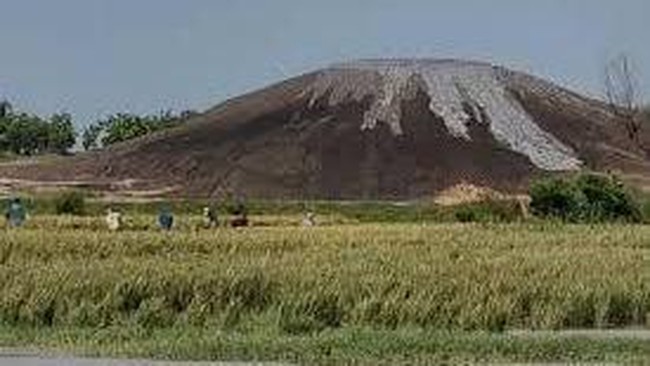
The appearance of a mound resembling a volcano in Grobogan, Central Java, caused a stir after photos and videos circulated on social media in March 2024. The sight of mud eruptions triggered public speculation about potential new volcanic activity following a magnitude-6.5 earthquake that shook the area on 22 March 2024.
In response to the phenomenon, the Head of the Geological Agency at the Ministry of Energy and Mineral Resources (ESDM), Muhammad Wafid A.N., affirmed that the 25-metre-high mound was not a volcanic mountain but rather a mud volcano.
According to a publication on the official EGSA UGM website, the formation of this mud volcano was triggered by the accumulation of natural gas rising to the surface through vertical fault fractures (conduits). The gas carried mud material with a density lighter than the surrounding sediments.
“Various materials, such as mud, gas, rocks, sulphur, salt, and water, will be expelled at the surface, forming a cone resembling a mountain,” stated the EGSA UGM report, citing a study by Sabdaningsih (2020).
The preceding shallow earthquake triggered more active migration of hydrocarbons and mud due to the formation of new fractures or faults, pushing hot mud to the surface under considerable pressure.
The mud volcano phenomenon in Grobogan is not actually an unfamiliar event. The geological structure of the area is dominated by rocks traversed by faults running from the south-west to the north-east, which serve as pathways for gas flows to reach the Earth’s surface.
Impact on Farmland and the Threat of Toxic Gases
Although its eruptions are not explosive like those of magmatic volcanoes, the presence of the mud volcano still brings negative impacts to the surrounding environment.
The periodic hot mud eruptions, whose points of emission often shift, can damage farmland, fields, and rice paddies belonging to local residents. Beyond material losses, the phenomenon also carries potential dangers from exposure to toxic gases, such as:
Hydrogen sulphide: Possessing a pungent odour resembling rotten eggs. In high concentrations, this gas can cause severe irritation to the eyes, nose, and respiratory tract.
Carbon dioxide: Exposure to high concentrations of carbon dioxide in eruption areas risks causing breathing difficulties, dizziness, and even threats to life.
Economic Potential and Scientific Research
Despite its risks, this natural phenomenon also holds economic potential and opportunities for scientific development if managed properly. The government is expected to provide solutions for residents affected by land losses, whilst also harnessing the new potential of the site.
The mud from the mud volcano is known to contain various valuable minerals such as lithium, kaolinite, and calcite, as well as unique microorganisms in the form of halophilic bacteria. These contents are considered prospective for use in industry, environmental conservation, agriculture, and even health through further research.
In addition, the mud volcano site has the potential to be developed as a geotourism destination, a creative industry hub, and a natural laboratory for geologists and environmental scientists to study crustal dynamics and potential natural resources in the future.