
Geological Agency: Continuous Eruption of Mount Anak Krakatau Has Ended
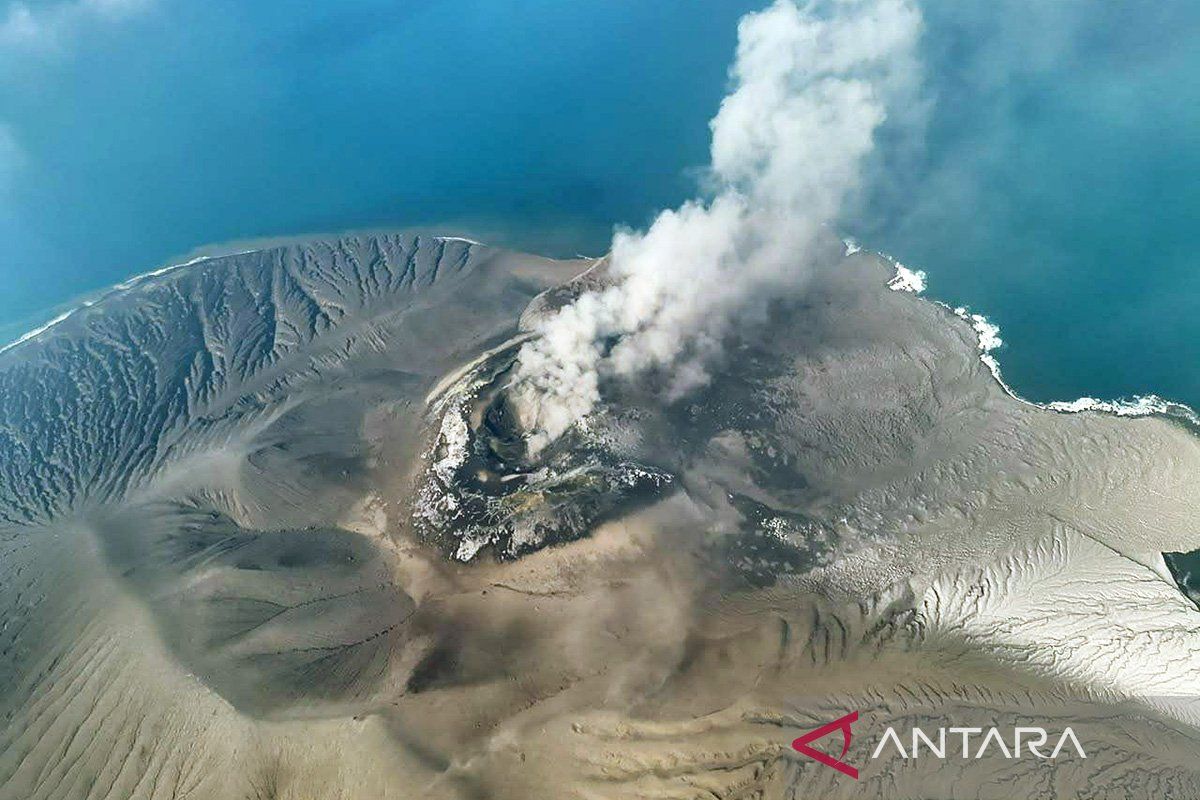
Following the end of the episode, volcanic activity at Mount Anak Krakatau has transitioned back to Strombolian eruption characteristics, marked by the recording of three eruption earthquakes/Strombolian eruptions.
Jakarta (ANTARA) - The Geological Agency of the Ministry of Energy and Mineral Resources (ESDM) has recorded that the continuous eruption episode of Mount Anak Krakatau in the Sunda Strait has ended after lasting 25 hours.
Head of the Geological Agency Lana Saria, in an evaluation report on the development of Mount Anak Krakatau’s activity received in Jakarta on Monday, stated that the continuous eruption episode, which began on Friday (4 September) at 23.07 WIB, officially ended on Sunday (6 September) at 00.04 WIB.
“Following the end of the episode, volcanic activity at Mount Anak Krakatau has transitioned back to Strombolian eruption characteristics, marked by the recording of three eruption earthquakes/Strombolian eruptions,” said Lana.
The Geological Agency interprets the return of Strombolian eruptions as a sign that the long-duration continuous eruption phase has ended. Nevertheless, the probability of follow-up eruptions in the following period is still considered high.
The smoothed RSAM (Real-time Seismic Amplitude Measurement) amplitude graph, which spiked on 5 September 2026, now shows a declining trend since 6 September 2026.
Meanwhile, tiltmeter deformation data from the Tanjung Station has recorded indications of thin inflation since early August 2026, and the Lava93 Station shows a constant pattern.
According to Lana, the agency recommends that residents, tourists and climbers do not approach or conduct activities within a three-kilometre danger radius of the active crater in order to avoid the threat of incandescent rock ejections, hot clouds, lava flows and heavy ash rain.
In addition, coastal residents of Banten and Lampung Provinces are urged to remain calm, not to believe hoaxes regarding the potential for a tsunami caused by the eruption, and are advised to wear masks when carrying out outdoor activities to anticipate respiratory problems caused by exposure to volcanic ash.