
Geographical Factors Increase Complexity of Seasonal Prediction in Indonesia, Says BMKG
The Meteorology, Climatology, and Geophysics Agency (BMKG) has revealed that predicting seasonal changes in Indonesia carries a very high level of complexity. This is due to the dynamic interaction among three large-scale ocean factors and the unique geographical characteristics of the archipelago.
BMKG Deputy for Climatology, Ardhasena Sopaheluwakan, explained that the three main factors influencing the national climate are the sea surface temperature conditions of Indonesian waters, the Indian Ocean Dipole (IOD) phenomenon in the Indian Ocean, and the El Niño and La Niña cycles in the Pacific Ocean.
“The sea surface temperature of Indonesian waters influences seasonal character one to two months ahead. The Indian Ocean, with the IOD, impacts rainfall in the western part, while the Pacific Ocean, with El Niño and La Niña, affects rainfall on an inter-annual scale,” Ardhasena said during a press conference on the “Development of Indonesia’s 2026 Dry Season” in Jakarta on Wednesday.
This complexity increases when these global factors interact with Indonesia’s mountainous topography. Ardhasena cited how the Bukit Barisan mountains in Sumatra create a drastic difference between the wet western coast and drier eastern regions such as Riau and Jambi.
A similar phenomenon occurs in Palu, Central Sulawesi. This area has a very distinctive microclimate, tending to be hotter and drier compared to other parts of Sulawesi which generally have higher rainfall intensity. “These local characteristics and the nature of tropical regions make climate prediction in Indonesia far more challenging than in subtropical regions,” he added.
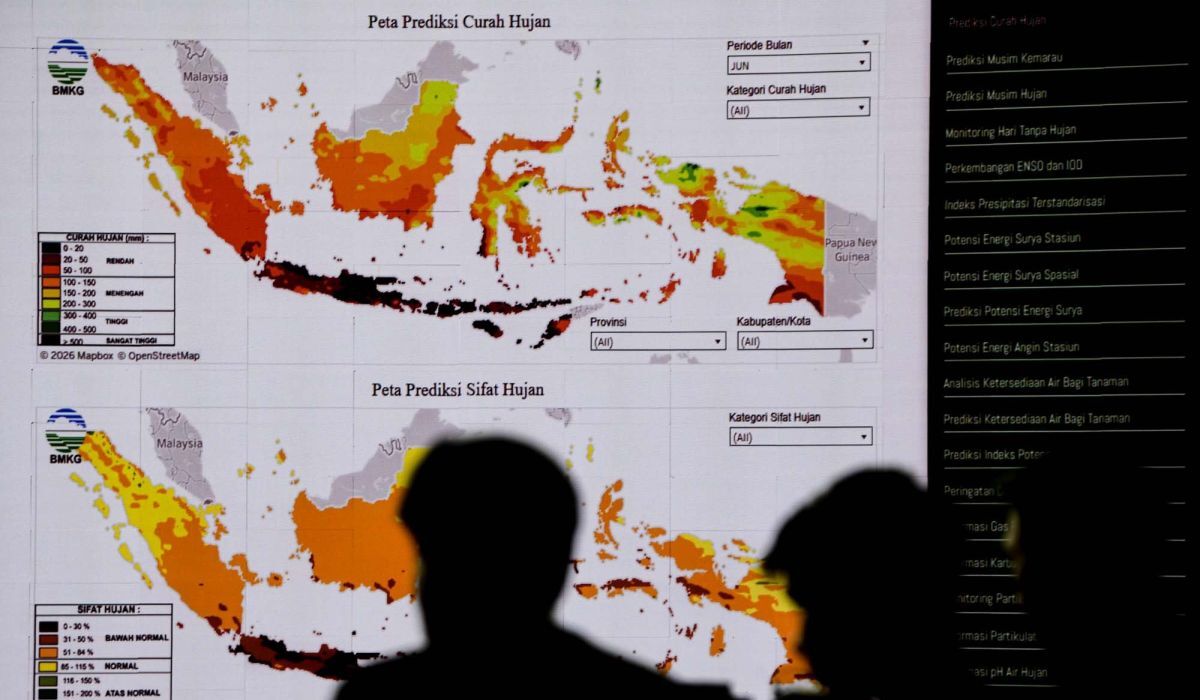
Based on BMKG data updated as of the end of May 2026, drought areas have covered 200 seasonal zones (11.83 percent of the landmass). This figure is predicted to rise drastically in June 2026, with the addition of 198 new seasonal zones, equivalent to 31.6 percent of the national land area.
Regions affected in June include the southern part of DKI Jakarta and most of Kalimantan Island. Entering July, the dry season is projected to expand to western Jambi, East Kalimantan, South Kalimantan, most of Sulawesi, and North Maluku.
Although the majority of regions are entering a dry period, BMKG has detected a local anomaly in seven seasonal zones (0.68 percent of the landmass) which are wetter than normal, covering Bengkulu, Gorontalo, and a small part of East Nusa Tenggara.
Despite facing a dry period, analysis from the BMKG Directorate of Climatology shows a bright spot in the fourth quarter. Most of Sumatra Island is predicted to start entering the rainy season in October, which will then expand to other regions in November.
The arrival of the rainy season is expected to provide natural relief or recovery for areas affected by prolonged drought. BMKG projects that rainfall intensity will be in the medium to high category across most of Indonesia in December 2026, ensuring an abundant water supply at year-end.
Source: jawawa.id (https://jawawa.id/newsitem/geographical-factors-increase-complexity-of-seasonal-prediction-in-indonesia-says-bmkg-1781103078)
Originally published by Media Indonesia (https://mediaindonesia.com/humaniora/899123/bmkg-faktor-geografis-tingkatkan-kompleksitas-prediksi-musim-di-indonesia), translated from Indonesian