
Genburgeract, the 'Pothole Patching Critique' Movement from Bekasi
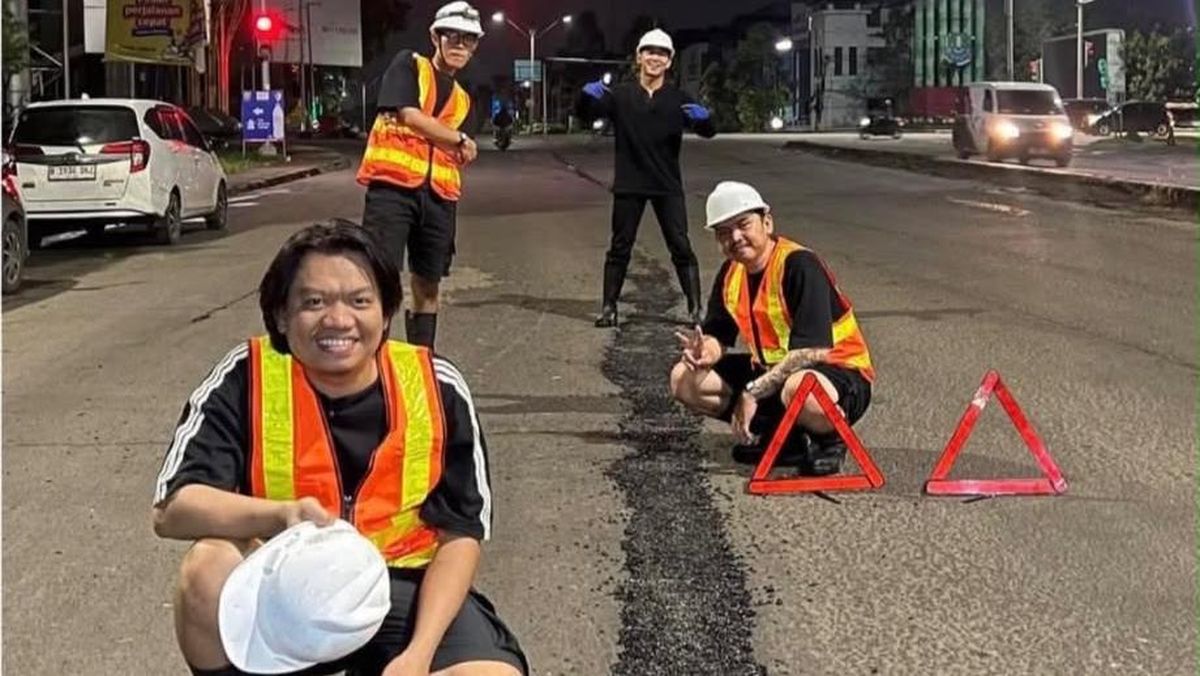
Constructive criticism is translated literally by a group of young people from Bekasi who call themselves Genburgeract. Their actions are not inspired by politicians’ remarks on television, but rather by the personal experiences of its members in public spaces and facilities.
These constructive criticisms are truly realised in the real world by providing, repairing, or maintaining public facilities in Bekasi.
Genburgeract showcases these real actions on their Instagram page, @genburgeract. One example is a photo of three long benches lined up in a row at the Komsen Jatiasih bus stop in Bekasi. On the benches are the words ‘made by residents’ and ‘burgeract’.
These benches, at a bus stop in a concerning condition, did not appear out of nowhere, but were the result of an initiative by the Genburgeract movement.
Before carrying out the bus stop bench action, Genburgeract had also undertaken other actions, such as patching roads and painting markers for damaged roads at 15 locations, cleaning a number of bus stops, and clearing rubbish from city parks.
The Genburgeract movement was formed in January 2026 with a focus on repairing public facilities and damaged roads in Bekasi.
The idea for the movement began with a conversation during a gathering after work. During that conversation, complaints emerged about poorly maintained public facilities and the many potholed roads.
However, the movement became more than just talk when they realised that these problems could affect safety.
‘Among us, one person had an accident because of a damaged road. Then also a friend of a friend experienced problems at a poorly maintained bus stop,’ said one Genburgeract member, Ilham Haristianto (26), familiarly called Boim, to CNNIndonesia.com on Tuesday (18/8).
Boim is not alone in running this movement. He is accompanied by Syafii Maarif Al Hafiz, or Uweb (27), Jaka Prasetiyo (29), Geraldi Weimy Suhestian (25), and Cornelia Agustine (28). The five were once colleagues before going their separate ways to different jobs, with one even becoming an entrepreneur.
The small number of members does not hinder Genburgeract’s seriousness. There is a division of tasks among the members.
Administrative matters and partnerships are Cornelia’s responsibility. Meanwhile, operations, such as the equipment that needs to be prepared, are handled by Boim and Jaka. Uweb carries out research, and Weimy generally plays a role in front of the camera, such as being a talent.
Despite having a division of labour, Genburgeract does not want to get trapped in bureaucracy like the government. They appear to be aware that bureaucracy is one of the reasons why the maintenance of public facilities is often neglected by the local government.
Genburgeract chooses to run its activities with a more flexible and non-hierarchical concept.
‘So actually the five of us fill in for each other as well, but that is just a written job description, because in real time, we also do other tasks,’ Boim explained.
This kind of movement is not new. Boim admitted that movements such as Pandawara and overseas movements like the Chattanooga Urbanist Society were inspirations for Genburgeract.
‘Those are movements that are independently organised. We see that these movements have their own variations and characteristics. It is just a matter of how we want to play it and how we modify it according to our abilities,’ he explained.
In carrying out its actions, Genburgeract also has its own process. The process begins with determining priorities based on urgency from monitoring results.
In addition, Genburgeract also tries to ensure that its actions are spread across various areas of Bekasi.
Action funding
Of course, these actions require funding for the provision of tools and so on. For example, a road repair action alone requires funds of 1.5 to 3 million rupiah.
Initially, the funds were covered by contributions from each member. Over time, Genburgeract now also receives assistance from various parties, such as tool and vehicle assistance from residents, proceeds from voluntary donation platforms, and collaborations with brands.
With these developments, the quality of Genburgeract’s work has also improved.
For example, while in the early days they repaired roads using instant asphalt (cold mix), now, through collaborations, they have the opportunity to repair roads using concrete.
This change in materials and the experience of carrying out various actions ultimately encouraged Genburgeract members to learn about various things.
‘Because basically none of us are engineering graduates, not at all, and we only have the capital of being ready to make mistakes, and we want to learn, want to explore, our curiosity is high, so we just go for it, we learn slowly, and we learn together,’ said Boim.
Construction as critique
Although it has only been running for about 7 months, Genburgeract has gathered 19.2 thousand followers on Instagram and 66.2 thousand followers on TikTok.
Social media is indeed Genburgeract’s main platform for disseminating the results of their initiatives and work.
On social media, Genburgeract also voices its criticisms and stance. In other words, construction, or Genburgeract’s efforts to build and maintain public facilities, is truly applied as an instrument of critique.
The members are fully aware that their small efforts cannot be seen only through the lens of willingness or sacrifice. These efforts are also believed to be a form of criticism of the government, which should be solving the problems of Bekasi residents.
‘There are many ways to channel criticism, but we choose our own way, our own path, by taking our personal phones, documenting it, and that produces something that can be a work in our own version. This is our statement of criticism of the government for not directly being accountable for the problem,’ said Boim.
Genburgeract’s activities have also attracted the attention of the government, including the Bekasi City Council (DPRD). Boim mentioned that the Genburgeract team had met with the Bekasi City Council.
‘We discussed, they appreciated it, and also provided insight, and in the end we had a discussion together,’ Boim explained.
Boim also explained that Genburgeract understands the limitations of resources amid the many priorities the government must consider. Therefore, he feels there is room for the community to take a role.
‘There is room for the community to take a role, especially for things that are fast, local, and whose impact is immediately visible. We just want to show that residents helping residents is still relevant, it just needs to be packaged in a more structured and massive way,’ he continued.
Apart from that, Genburgeract also realises that its actions could make the government complacent and are even vulnerable to being co-opted. Therefore, while taking action, they continue to urge the Bekasi City Government to quickly process residents’ needs without having to wait for citizen movements.
‘The city government must also be more vigilant and also know what the urgency of residents’ needs actually looks like. Do not let what we are doing become something that only Genburgeract continues to do,’ Boim explained.
In addition to the government, Genburgeract also stated that they are willing to discuss with other young people. They invite young people to see what needs to be presented and done, and then move to make changes.
For Genburgeract itself, the movement is based on the daily conditions of residents, especially Bekasi residents.
‘For Bekasi residents, we actually understand each other, what the mobility of Bekasi residents is like, and what their work is like. Our hope is that we can work together, and also maintain the tagline of residents helping residents, because Bekasi exists because of its residents,’ said Boim.
After carrying out a number of repairs, facility additions, and clean-ups in Bekasi, Genburgeract invites the people of Bekasi to help maintain and care for all public facilities properly.
Without having lofty targets, the Genburgeract team is now focused on maintaining the sustainability and commitment of the movement.
‘How can this aspiration be maintained and we remain committed to what we have hoped for since January, and we will continue to carry it out like that,’ he concluded.