
Gen Z in Indonesia Opt for Simple KUA Weddings, Prioritising Future Over Lavish Parties
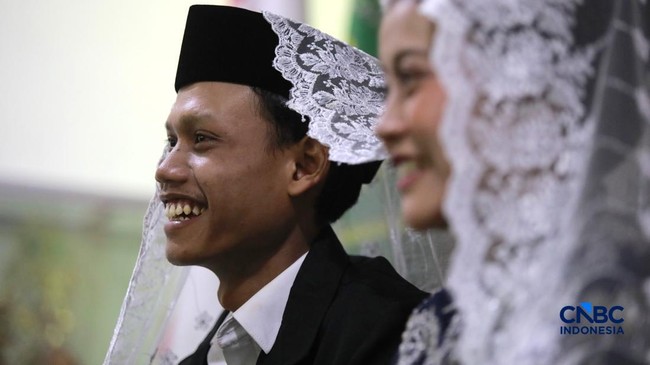
Jakarta, CNBC Indonesia - The phenomenon of young couples choosing to marry at the Office of Religious Affairs (KUA) is increasingly common. This choice is not solely about reducing costs, but also reflects a shift in the younger generation’s perspective on marriage. For many in Gen Z, a lavish party is no longer a priority. What matters more is life after the marriage contract, from setting up a household to buying a home and preparing for a honeymoon.
Abdul Hamid, a marriage officiant at the Setiabudi KUA, confirmed that the trend of marrying at the KUA has become more pronounced, especially after the Covid-19 pandemic. He noted that many young couples, predominantly from Gen Z, are choosing to marry at the KUA, though some millennials and those remarrying also opt for this simpler route. ‘It is almost true that many Gen Z now choose to marry only at the KUA. But there are also millennials. Then perhaps also those who are remarrying, they mostly marry at the KUA, they rarely hold a party,’ Hamid told CNBC Indonesia. He said the change has been noticeable in recent years, adding, ‘After Covid, the phenomenon of marrying at the KUA has become more common.’
According to Hamid, one of the main reasons Gen Z chooses to marry at the KUA is a lifestyle that favours practicality. This generation is accustomed to the ease of technology and instant services, so they tend to avoid the hassle of organising a large party. ‘One, perhaps Gen Z prefers things that are simple. Because their lives are now simple. In the past, everything was difficult, like to make a call we had to go to a phone booth. Or to chat, we had to SMS with a lot of patience. Now, Gen Z is trained in a life of simplicity, chatting, calling, everything is easy. Ordering food is easy, so this triggers the thought, “Ah, it’s better to keep the wedding simple,” because the core is the marriage contract,’ he explained.
Beyond the practical factor, Hamid believes economic considerations also play a role. The significant cost of a party makes many young couples more calculating. Funds that could be spent in a single day on a reception are now preferred for post-marriage needs. ‘The second reason might be economic, as the economy now seems rather difficult. So they choose to marry at the KUA to save money. For their future after marriage. Indeed, they prefer to use the money for after the wedding, like a honeymoon, starting a new business, or buying a house or other property,’ Hamid said.
Meanwhile, Nasrulloh, Head of the Tebet KUA, revealed that more young couples are marrying at the KUA, particularly this year. ‘Specifically for the Tebet KUA, previously the percentage was 20% marrying at the KUA and 80% outside. This year, it has risen to 40% at the KUA and 60% outside, the majority are Gen Z although there are some from other age groups,’ he stated. Nasrulloh noted a key factor driving this choice. ‘I’m not entirely sure, but one or two couples have said they’d rather save the money for the future than waste it on a party,’ he said.
A similar story came from Seruni Cantika, a Gen Z member who decided to marry at the KUA. For her, the decision was not due to a lack of funds, but because she felt the wedding money was better saved for married life. ‘The main reason is simplicity, and perhaps many now think like me: it’s better to use the money for life after the wedding. Because marriage is not the end, but the beginning of a journey,’ Seruni said. Her decision was also influenced by the experience of a close relative. She recalled seeing her cousin force a lavish party, leaving her parents in debt. That experience solidified her resolve not to hold a grand reception. ‘Initially, I thought about marrying at the KUA because I saw my cousin go all out for a luxurious party, but her parents ended up in debt. God forbid, after knowing that, I immediately committed, no party if it only causes headaches and debt. In this economy, right?’ she said.
Beyond the cost, Seruni also did not want to be burdened by the long list of party preparations. She said that even though her savings were sufficient, the complexity of dealing with vendors and event details convinced her to opt for a simple ceremony at the KUA. ‘Moreover, even if the savings were secure, meaning we had the funds and calculations for a party, I heard from my friends who have been through it, it’s a headache dealing with all the details. For me, who doesn’t want the hassle, it’s better to just go to the KUA,’ she stated. Choosing to marry at the KUA did not eliminate the celebratory element. Seruni still prepared a special moment in her own way. She hired a photographer to document the ceremony, used a makeup artist, and held a meal with her immediate family at a restaurant. ‘Luckily, my partner agreed. So I chose to hire a photographer willing to come to the KUA, I had my makeup done neatly, so after the ceremony at the marriage hall, I immediately took photos with the hired photographer. After all, we still need documentation,’ she said. With this simple concept, the total cost was far more economical than a typical reception. ‘I think it was around Rp6 million or Rp7 million at the time, because it was just a Sundanese restaurant, and the per-person cost wasn’t even Rp200,000. And the KUA was free, so I only paid for the makeup artist, clothes rental, and photographer. It was super cheap,’ Seruni revealed.
Another Gen Z couple, Ade and Intan, shared the same sentiment. The couple, who married at the Tanjung Priok KUA, said they chose to marry at the KUA because they wanted to avoid debt and focus on their future together.
Source: jawawa.id (https://jawawa.id/newsitem/gen-z-in-indonesia-opt-for-simple-kua-weddings-prioritising-future-over-lavish-parties-1784616771)
Originally published by CNBC Indonesia (https://www.cnbcindonesia.com/news/20260720180923-4-752339/bukan-pelit-terungkap-ini-alasan-gen-z-pilih-nikah-di-kua), translated from Indonesian