
Gema Bangsa: Factional Threshold Scheme to Ensure Votes are Not Lost
“This formula better guarantees the representation of the people’s voice. Thus, no votes are lost, as happened in the 2024 election, where 18 million votes from non-parliamentary parties were not converted into seats,” said Rofiq in a statement in Jakarta, Thursday.
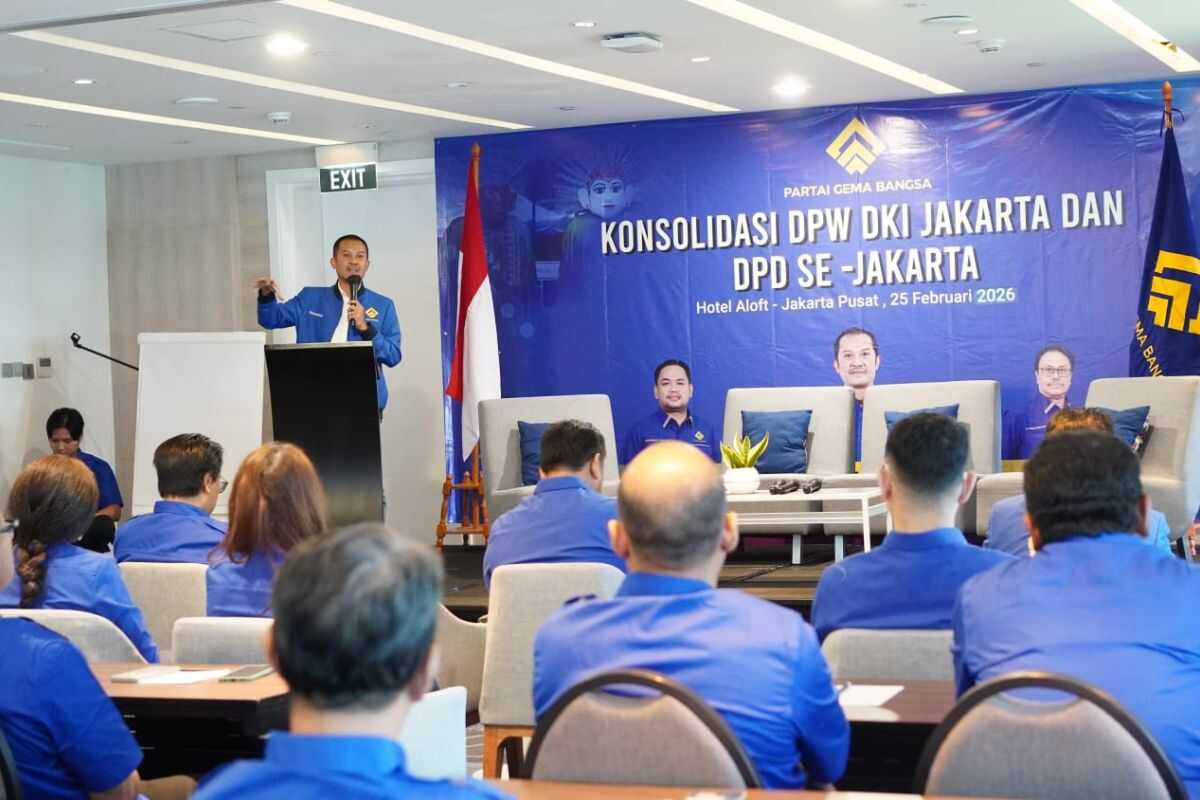
This was conveyed during the consolidation of the DKI Jakarta DPW and DPD, held in Jakarta.
Several parties in Senayan have proposed several options regarding the parliamentary threshold, some proposing a 2 percent threshold, maintaining 4 percent, or even 7 percent. The parliamentary threshold figure has become a debate along with the Revision of the Election Law. The DPR’s Baleg has included the Election Bill in the 2026 National Legislation Program (Prolegnas).
The revision of this rule follows the Constitutional Court’s decision No. 116/PUU-XXI/2023, which asked the lawmakers to amend the parliamentary threshold provision before the 2029 election.
Rofiq explained that the factional threshold scheme is able to maintain a balance between representation and institutional effectiveness.
“All votes are counted. Parliament is also effective because not all parties automatically form factions. In fact, I challenge, would parties in Senayan dare to agree on a factional threshold, for example, being able to form a faction if they meet 10 to 15 percent of the seats,” he said.
With this scheme, there will not be many factions in the DPR. Small parties also still have the opportunity to be represented without being limited by forming a joint faction.
This scheme is similar to what was applied in the DPR resulting from the 1999 and 2004 elections. At the DPRD level, the factional threshold approach is still in effect.
“So, just abolish the parliamentary threshold. Use a factional threshold that is more proportional and constitutional. Voters’ voices will not be lost, and political fragmentation in parliament can be controlled,” he said.
Meanwhile, in this consolidation, all DPW, DPD, and DPC administrators from DKI Jakarta were present. The core administrators of the Gema Bangsa DPP were also present.
The Chairman of the DPW, Charles Panji Dewanto, stated that they would immediately tidy up the organizational structure to the sub-district level.
Panji said that Generation Z mostly occupies positions in the structure of the Gema Bangsa DKI DPW to DPC. These young people are not just for show. They are fully involved in running the organization.
“In socialization, we choose issues that are of concern to young people. We will also involve critical groups such as students and academics to discuss real problems in DKI,” said Panji.