
GBCI Promotes Low-Carbon Buildings Through Green Material Integration
The national construction sector faces a significant challenge in reducing its carbon footprint amidst steadily increasing development rates. A low-carbon building approach is no longer deemed sufficient by focusing solely on product selection; instead, it demands comprehensive integration with design, policy standards, construction methods, and industrial readiness.
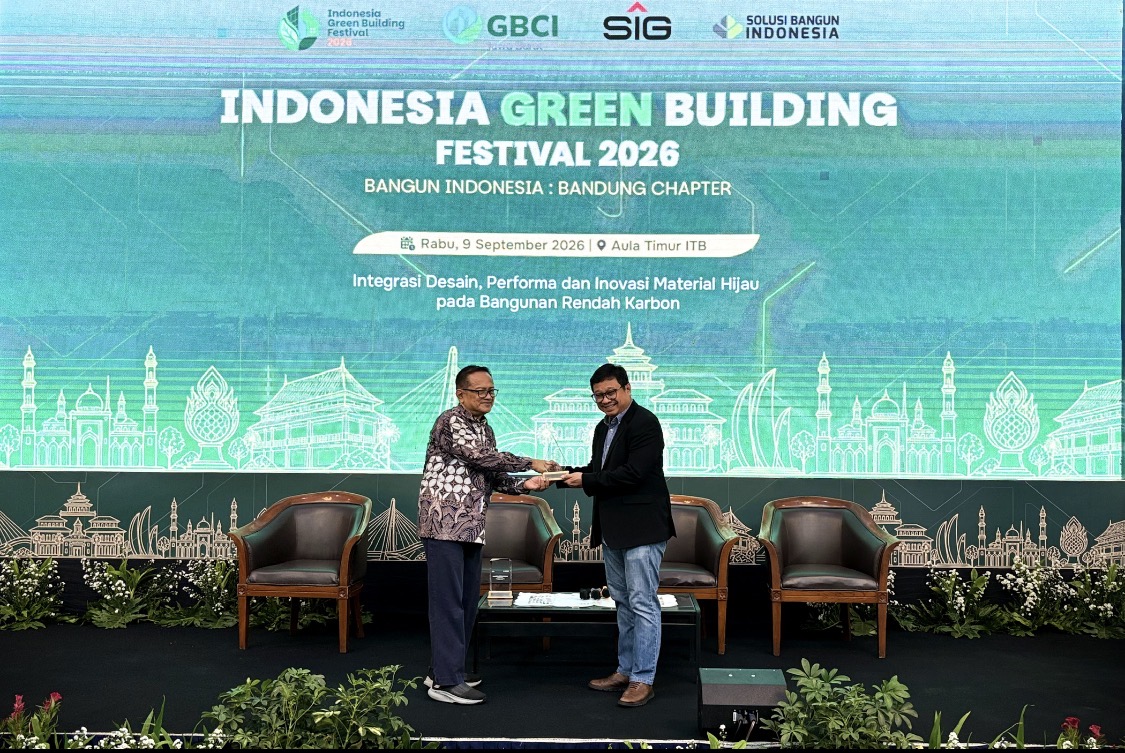
These cross-sectoral needs were highlighted during the ‘Bangun Indonesia: Bandung Chapter’ forum, part of the Indonesia Green Building Festival (IGSB) 2026 series. The event was held at the East Hall of the Bandung Institute of Technology (ITB) on Wednesday (9/9).
Under the theme ‘Integration of Design, Performance, and Green Material Innovation in Low-Carbon Buildings’, the activity was organised through a collaboration between GBCI and PT Semen Indonesia (Persero) Tbk (SIG).
The Bandung Chapter brought together government officials, academics, practitioners, urban planners, and industry players to discuss how various elements within the development ecosystem can move together towards a lower-carbon built environment.
Through this forum, GBCI aims to bring the discussion on low-carbon buildings closer to the actual needs and decisions within the construction sector, while providing a space for knowledge exchange between parties playing different roles in the development process.
“As development needs continue to grow, we must ensure that this growth is accompanied by efforts to reduce environmental impact. Material innovation is a vital component because material choices relate to the carbon footprint and building performance. However, materials cannot stand alone. We need connectivity between policy, design, performance, regional planning, market needs, and industrial readiness,” said Ir. Ignesjz Kemalawarta, MBA., GP., Chairperson of the Green Building Council Indonesia (GBCI).
According to Ignesjz, this connectivity requires a collaborative space that allows various parties to understand challenges and opportunities from different perspectives. In this context, GBCI performs its role as an independent, non-profit professional organisation promoting the implementation of sustainable construction practices in Indonesia.
“GBCI’s role is to bring together knowledge, standards, practices, and various stakeholders so that the green building agenda can be implemented in reality. Transformation requires not only new technology or products but also capacity building, shared understanding, and cross-sector collaboration,” Ignesjz continued.
Zki Kresno Edhie Hambali, President Director of Solusi Bangun Indonesia, stated that as a Corporate Founder of GBCI, Solusi Bangun Indonesia continues to strengthen its commitment to leading the green movement from the industrial side, to realise sustainable development which requires collaboration from all stakeholders in the construction ecosystem.
“For Solusi Bangun Indonesia, the principle of sustainability is not just a corporate goal, but also a primary foundation in conducting business and operations to provide products and solutions that can meet current and future development needs. Certainly, these efforts need to be driven comprehensively, from design, material selection, and construction processes to building operations, so that development needs can continue to be met with an increasingly lower carbon footprint,” said Rizki.
This discussion demonstrates that the direction towards low-carbon buildings is increasingly influenced by various simultaneous considerations. Policies can create direction and standards, project needs determine the scale and implementation challenges, while the market increasingly considers building quality and performance when making investment and space-use decisions.
Amidst the series of activities, GBCI also commemorated 17 years of the organisation’s journey in promoting sustainable construction practices in Indonesia.
Founded in 2009 as an independent, non-profit professional organisation, GBCI continues to contribute to the development of the green building ecosystem through knowledge, capacity building, standards and certification, as well as collaboration with various stakeholders.
This celebration serves as a momentum to reflect on that journey while strengthening GBCI’s commitment to making green buildings increasingly relevant and applicable to more parties in Indonesia.
Through the Indonesia Green Building Festival 2026, GBCI brings the ‘Bangun Indonesia’ spirit as an invitation to expand involvement in sustainable development. The Bandung Chapter serves as a space to bring together knowledge, experience, innovation, and the real needs of various sectors.
Source: jawawa.id (https://jawawa.id/newsitem/gbci-promotes-low-carbon-buildings-through-green-material-integration-1789368788)
Originally published by Media Indonesia (https://mediaindonesia.com/ekonomi/933153/gbci-dorong-bangunan-rendah-karbon-lewat-integrasi-material-hijau), translated from Indonesian