
Gaza's Resilience Against Hegemony
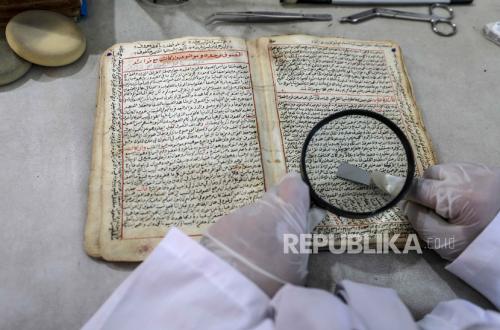
Amidst the bombings and gunfire devastating Gaza, Abdul Latif Hashim and Haneen Al-Amassi have chosen an unconventional path. They have been meticulously researching historical manuscripts, focusing on documentation, digitalisation, and conservation, as well as organising rescue efforts under emergency conditions.
A total of 25,000 manuscripts from the Mamluk and Ottoman eras have been successfully digitalised by the pair. These historians and cultural heritage researchers also established Gaza’s first specialised laboratory for the restoration of historical manuscripts.
In early September, UNESCO awarded the 2026 Jikji Memory of the World Prize to Abdul Latif and Haneen. This award recognises their efforts to preserve the world’s documentary heritage and ensure these documents remain accessible as a shared legacy for humanity. Abdul Latif and Haneen are the first individuals to receive this honour; previously, the award had always been granted to institutions, such as the National Library of Indonesia in 2024.
It is worth examining why, amidst a genocide that has claimed tens of thousands of Palestinian lives, these two figures have chosen to focus on preserving cultural heritage. At first glance, their efforts appear like a small slingstone facing Goliath. However, history records that such forms of resistance are not new to the Palestinian people.
Paleastinian poet Mossab Abu Toha documents this well in his book, Things you May Find Hidden in My Ear. When Palestinians are forcibly displaced from their homes, they keep their house keys as a symbol of their vow to return. When their cities are erased from maps and renamed by Israel, they immortalise those original names by naming their children after them. When a theatre was bombed in 2018, artists gathered to play instruments amidst the ruins. Mossab himself established a small library in his home after his university library was targeted by Israeli bombing.
Once again, amidst Israel’s immense military power and full support from the United States, these cultural efforts may seem small, like a single drop in the ocean. Yet, the Palestinian people seem never to tire of such endeavours.
Italian philosopher Antonio Gramsci helps us understand this Palestinian resilience. Gramsci argued that the supremacy of a group is achieved through two paths: domination, and intellectual and moral leadership—the latter known as hegemony, which is the attempt to win public opinion according to a set agenda. Israel employs both simultaneously.
They dominate through weaponry, while simultaneously exercising hegemony through political and cultural lobbying to gain moral legitimacy for their occupation and apartheid policies. It is common knowledge how powerful the Israeli lobby is within US politics, alongside the global ‘hasbara’ (pro-Israel propaganda) campaigns.
Palestinian cultural activists are acutely aware of this. Indeed, it can be said that this is where they find the fuel for their cultural resilience; they are attempting to dismantle Israel’s hegemony over global opinion. Through the cultural work of Abdul Latif and Haneen, these fighters are not merely engaging in cultural expression; they are nurturing the memory of Palestine while attempting to undermine Israeli hegemony.
In the past, such steps might have seemed insignificant. However, public support for Palestine is currently strengthening on the global cultural stage. The significant support for rapper Macklemore, who openly supports Palestine, and the criticism faced by Ed Sheeran for omitting Macklemore from his recent tour, serve as evidence that the pendulum is beginning to shift. Voices of the Palestinian liberation movement are moving beyond their echo chambers and reaching a wider audience. Even Israeli filmmakers have participated in producing the documentary Naza, which records the tracks of Israeli military atrocities in Gaza.
Unfortunately, this same echo is less audible in Indonesia. Voices supporting Palestine are not as loud as they were when the genocide first began. While support for Palestine has never waned, public attention or energy may be diverted by various domestic issues in Indonesia. In such conditions, the public may experience ‘news fatigue’—not because their care has faded, but because they feel overwhelmed.
In this situation, it is vital to draw upon the energy of Palestinian resilience. If anyone has the right to complain of exhaustion, it is them; yet, their activism never falters. Ultimately, the liberation of Palestine is a long-term project. Every cultural endeavour—whether performed by Palestinians or from abroad—will contribute positively to this long journey. By reflecting on the resilience of the Palestinian people, it is hoped that support from Indonesia will resonate once again.