
Gathering Coal and CPO Bosses, Here Is Rosan's Full Explanation on DSI
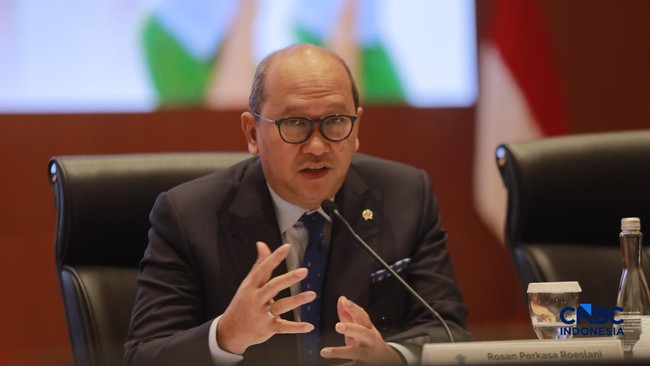
The Investment Management Agency (BPI) Daya Anagata Nusantara (Danantara) gathered business players and mining associations to provide an explanation regarding the working system of PT Danantara Sumberdaya Indonesia (DSI) on Monday (24/8/2026) at Wisma Danantara, Jakarta.
As is known, starting from 1 June 2026, PT DSI began monitoring export transactions for three strategic commodities, namely coal, crude palm oil (CPO), and ferro alloy.
Danantara CEO Rosan Roeslani emphasised that business players in these three commodities can still carry out their exports as usual.
Rosan explained that his party continues to respect long-term contracts between producers and buyers. The role of DSI here, according to him, is how to evaluate, monitor, and also ensure transparency in these transactions.
“As we all know, PT DSI has been in effect, has been running since 1 June (2026). By deed on 1 June, and in its role we certainly want this to be managed better, transparently, and also provide added value not only to our human resources, to our natural resources, but also to the Indonesian economy as a whole,” he said at the Wisma Danantara building, Jakarta, Monday (24/08/2026).
“Indeed, I understand that at the beginning many people wanted to know more about what DSI is, how its role works, how its responsibilities work, how it can provide added value, and most importantly, that this can provide the principle of benefit to all of us, especially to the economy in Indonesia,” he said.
“And indeed at the beginning, a comprehensive presentation will certainly be given by the board of directors, that at this initial stage there are only three national strategic commodities, which are in our focus, namely coal, palm oil or CPO, and also ferro alloy. Without us trying to change the existing commercial relationships that are running, and also exporters and buyers,” he said.
“So there is no need to doubt that you, ladies and gentlemen, can still carry out your exports directly, and we will remain under the sanctity of the contract, even for long-term contracts,” he stressed.
“But the nature of DSI at this time is more about evaluating, monitoring, and also ensuring that the most important thing is transparency of the transaction. That is the most important thing for us, so that everything runs well and properly,” he asserted.
Rosan explained that from the three commodities monitored through DSI, namely coal, CPO, and ferro alloy, the export value is around US$70 billion. In detail, the export value of coal is around US$30.35 billion, then CPO around US$22.87 billion, and ferro alloy around US$16.43 billion.
“And of course this requires improved governance of these three commodities because they have strategic significance for the economy in Indonesia,” he added.
“However, I want to emphasise that DSI is not intended to add a layer of bureaucracy, nor is it intended to replace the role of regulators. This must be underlined. All licensing, regulatory, and supervisory functions remain with the authorised ministries or agencies,” he said.
“All honoured guests, the role of DSI is to build a stronger verification point in the flow of data and export transactions, covering quantity, quality, goods classification, price, up to payment settlement and foreign exchange repatriation,” he explained.
“For Danantara Indonesia, this is important because the role of strategic assets is not enough to be oriented towards volume. Every transaction must have a reasonable basis, be traceable, and provide the greatest possible benefit for Indonesia. Therefore, its implementation will be carried out in stages, measurably, and based on readiness so that the flow of trade and existing commercial relationships are not disrupted,” he said.
According to him, Danantara also places great hopes on DSI. He then revealed the reasons. First, namely regarding how they can maintain data and process integrity so that DSI becomes a credible, professional, and open institution.
Second, maintaining business certainty with professional and efficient processes for exporters, buyers, banks, and other related agencies.
“And the most important thing is to deliver real value for Indonesia, not only through transparency, but also better information for policy-making and strengthening Indonesia’s position in the global market,” he said.
Therefore, according to him, this cannot be done by his party alone, but requires support from all parties, both ministries, agencies, and also business players.
“These things certainly cannot be done by DSI alone. We really need support from all relevant ministries and agencies, and for that I also express my highest gratitude and appreciation for the cooperation of all ministries and agencies that are very open, that provide access to us so that we can integrate all data so that the existing data and decision-making will become better and more open,” he said.
“And also most importantly, we as DSI always want to hear input from the business world, from associations, and also from you, ladies and gentlemen, so that the role of DSI becomes better, provides more added value to all of us. Because good governance must strengthen trust, not add uncertainty,” he said.
“As a closing word, that is what I can convey. Hopefully the launch of DSI can once again provide the principle of benefit to all of us, especially in the economic field. Thank you,” he concluded.