
Gateway to Opportunities: Where Innovation Serves People -- Hangzhou's Journey from Countryside to Robotics Labs
“Using e-commerce to help people earn more, that’s really interesting,” Klara said.
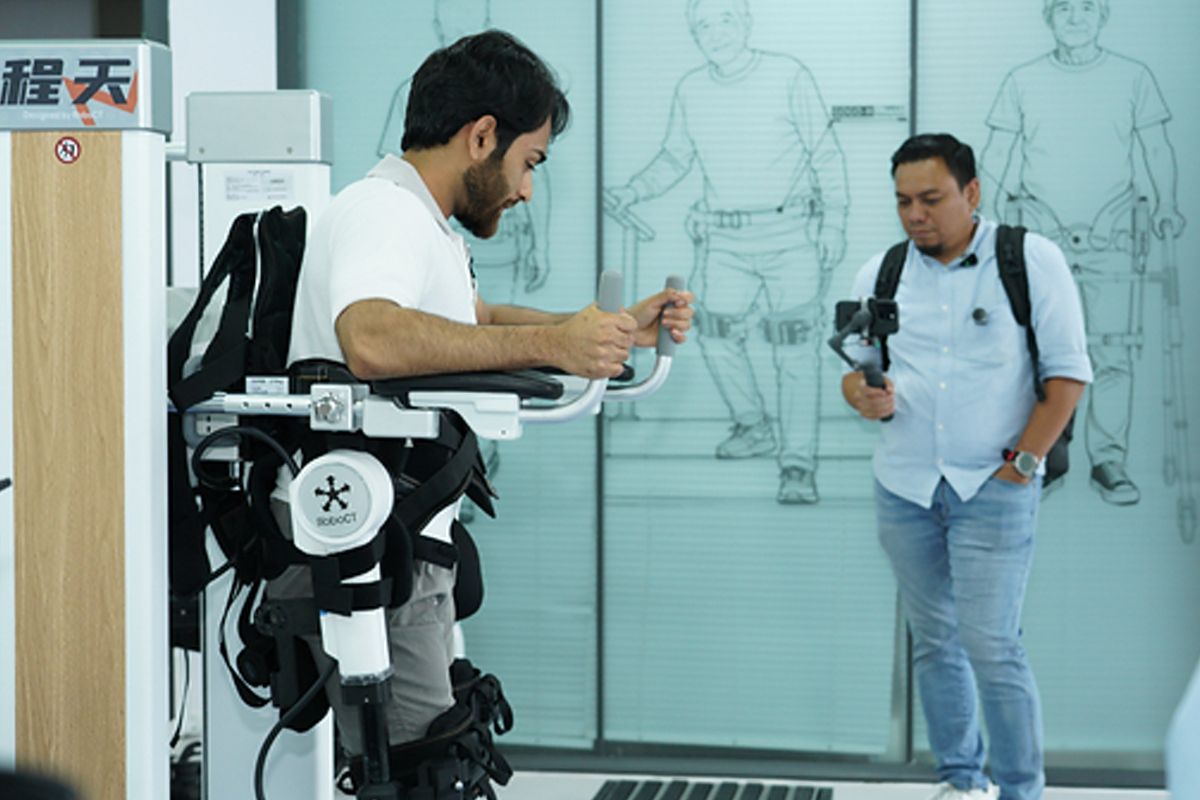
A few weeks later, in a Hangzhou tech company, Esmira Gasimova, a senior editor at Azerbaijan’s Public Television and Radio Broadcasting Company, strapped on an exoskeleton and took her first assisted steps. The machinery was light; the support was steady. Then tears filled her eyes. “In my country, many elderly and disabled people need technology like this,” she said, her voice trembling. “I truly want to bring this technology back to Azerbaijan.”
These two moments capture the essence of “Gateway to Opportunities, China’s Industry Stories,” an international communication program organized by the Hangzhou International Communication Center (HZICC). Through a month-long global recruitment process, overseas journalists and influencers formed two exploration delegations: “From Village to the World” (rural revitalization) and “Tech for Good.” They came with questions that resonate worldwide: Can businesses both profit and uplift communities? Can ecological restoration benefit farmers? Can technology genuinely leave the lab and reach people who need it most? They left with a series of rich and diverse narratives, each opening a doorway to understand how Hangzhou is writing new chapters of sustainable and inclusive development.
From Village to the World: Rural Revitalization Meets Global Curiosity
The rural revitalization delegation, composed of journalists and influencers from Turkey, Switzerland, Indonesia, South Korea, Pakistan, and France, spent four days traversing Hangzhou’s countryside, from bamboo-covered mountains to tea-scented valleys, from logistics hubs to museums preserving centuries of craft.
At Siwu Nature Park in Xiaoshan’s Yiqiao Town, Tunç Akkoç, founder and editor-in-chief of Turkish Harici Media, walked alongside scientists through the Park supported by Wanxiang Agriculture Group Co., Ltd. After nearly 100 biodiversity surveys, over 700 species of plants and animals have been detected returning to forests once ecologically imbalanced by the decline of the bamboo economy. Project director Liu Shenmin of the Siwu Nature Park explained how ecological restoration triggered a chain reaction, native species returned, organic tea was branded, over 200 nature education activities run annually, and hiking and cycling tourism flourished, boosting rural cultural industries.
Kim Seojun, a Korean YouTuber with 2 million followers, stood before an unrestored monoculture bamboo forest where bamboo had fallen over and few other plants grew on the ground, then walked to a nearby experimental restoration site with artificial “forest gaps,” where countless lush plants had already grown back. “I specially changed into hanfu today, planning to shoot a ‘Chinese fantasy’ style video in the bamboo forest,” he said with emotion, “But the meaning of ecological restoration moved me even more.”
Walking out of the bamboo forest, Tunç talked with two villagers, Shao Jianhua and Xu Hongfang, who work at the Siwu Nature Park. Shao pointed to his organic vegetable plot next to the bamboo forest: “This is my ‘territory.’ It’s good for the soil, and healthy for people too.” Xu added: “When the ecology improves, more children and young people come here to learn. I feel that what I am doing is truly meaningful.” Tunç said he saw how ecology can drive rural governance and hopes to return here in the future.
About 40 kilometers from Yiqiao Town, the model of Xiejing’an Transfar Agricultural Innovation Village caught the attention of Samuel Piotr Emch from Schweizer Radio und Fernsehen (SRF). As a journalist specializing in agriculture, he has been following many Chinese agri-tech companies, and Transfar’s model is one of his recent case studies. Built by Transfar Group from 2023, the first phase of the village officially began operation in 2024; this former “weak village” was selected as a national pilot site for “Beautiful and Harmonious Countryside.” Starting from the Xiejing’an Plant Science Center, Samuel visited breeding greenhouses, an intelligent seeding and germination workshop, a digital seedling factory, and a variety trial greenhouse.
Duan Gehong, general manager of Hangzhou Moyu Biotechnology Co., Ltd., leads a team of young scientists researching crop resistance to pests and diseases and improving breeding efficiency. “I was attracted by the plan here from the very beginning. The lab, the fields, and the research greenhouses are fully connected. We also received public-interest funding support,” she said, adding that these resources are especially important for startup teams that lack space, staff, and industry ecosystem support. Rong Song, deputy general manager of Zhejiang Transfar Rural Development Co., Ltd., outlined the broader vision: “Transfar Group has invested in many promising companies in areas such as gene editing and biological pesticides. Our goal is to build an ecosystem where every company that moves in can find support in technology, funding, and market channels.”
After leaving the research center, Manon Ruhlmann, French host at HZICC, tasted several new tomato varieties at a tomato picking base, before filming short videos to share the area’s development model. Kim Seojun visited the Agri-innovation Exchange Center booths, tasting local Xiaoshan chili sauce and immediately asking villagers how they develop the products. The place feels like a “connector” , linking laboratories with farmland, consumers with rural producers, and companies with local communities. Next year, the second phase of the Xiejing’an project is expected to be completed, potentially welcoming international companies and becoming a platform for global agricultural technology exchange.
In Fenglian Village, Tonglu, birthplace of YTO Express and the “3 Tong and 1 Da” delivery giants, Klara stepped into the agricultural livestream studio, held a live chicken, and mimicked the host’s selling style. She noted with surprise: “I can rec