
Garut Integrates Health Data from Posyandu and Community Health Centres
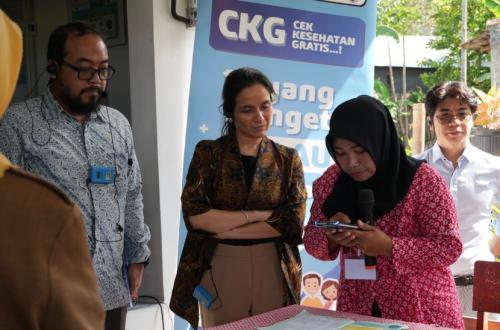
JAKARTA – Digital health data integration in Garut Regency, West Java, links service records from Posyandu community health posts with puskesmas management and district-level health planning. Data from facilities at different levels can be used to monitor programme performance and support local-government decision-making.
An international delegation, including independent assessors from Johns Hopkins University (JHU), Ornito, The SMERU Research Institute and the Ministry of Health, reviewed the system on Tuesday (3 November). They observed the Digitally Enabled District (DED), an initiative developed by the Summit Institute for Development (SUMMIT) in partnership with the Garut Regency Government through its Health Office.
DED is designed to integrate health-service records at Posyandu level with puskesmas service management and the use of data for district-level decisions. The system is intended to cover 54 of Garut’s 67 puskesmas, taking into account the characteristics and digital readiness of each area.
Smisha Agarwal, director of the Center for Global Digital Health Innovation at Johns Hopkins University, praised the system after seeing it in operation. She said the system implemented in Garut was more mature than those she had encountered in other countries.
“This [DED] is the most mature system and implementation we have seen across countries. You have managed to make something so complex look very easy,” Smisha said, according to a press release on Monday (9 November 2026).
During the field visit, the delegation went to four sites: Posyandu Dahlia 4 in Sukasono village, Maripari Community Health Centre, Karsa Husada Garut Institute and the Garut Regency Health Office. Each site demonstrated the digital system in a different area of health services and management.
At Posyandu Dahlia 4, the delegation observed the use of KuApps, a suite of applications comprising BidanKu, KaderKu and PerawatKu. The apps support the recording of maternal and child health services, anthropometric measurements of young children, and screenings for people of working age and older people, in line with the respective roles of health workers.
Staff can also use optical character recognition (OCR) to scan Maternal and Child Health (KIA) books and identity cards. Measurements are then recorded and validated using range-checking features before appearing on the Posyandu dashboard, helping staff monitor service coverage.
The system also supports antenatal checks and blood-pressure measurements for the early detection of hypertension. An offline feature allows staff to record data in areas with limited internet access; the data are synchronised when a connection becomes available.
DED uses the HL7 FHIR interoperability standard to support data exchange between systems, including integration with the Ministry of Health’s SATUSEHAT platform. The standard enables different systems to exchange health information in a structured format.
At Maripari Community Health Centre, the delegation reviewed a Local Area Monitoring (PWS) dashboard containing indicators for various health programmes. The data are used to monitor service coverage, identify gaps, and support workforce management and service planning.
The health centre also uses Dynamic Workers Support (DWS), a digital tool that records field activities, GPS-based locations and health-worker attendance. The information can be used to monitor staff duties, strengthen accountability for activities and support reporting on the use of Health Operational Assistance (BOK) funds.
At Karsa Husada Garut Institute, the delegation saw the Bunda Hebat HealthComm service, which provides initial consultations and health information through WhatsApp automation and a call centre. The service also sends reminders for antenatal and postnatal check-ups and immunisations.
The visit continued at the Garut Regency Health Office, where the delegation reviewed the district-level dashboard. It integrates Posyandu and puskesmas data to support performance monitoring and health-programme planning.
Discussions also covered DED’s long-term sustainability, including local-government funding commitments through the regional budget (APBD) and stronger data governance. The Health Office acts as the data custodian, while data are stored on domestic servers in accordance with the Personal Data Protection Law.
Source: jawawa.id (https://jawawa.id/newsitem/garut-integrates-health-data-from-posyandu-and-community-health-centres-1794221526)
Originally published by Republika (https://daerah.republika.co.id/berita/to8a8b416/garut-integrasikan-data-kesehatan-posyandu-dan-puskesmas), translated from Indonesian