
Garuda (GIAA) Revenue Grows 13.2% as It Pushes Business Transformation
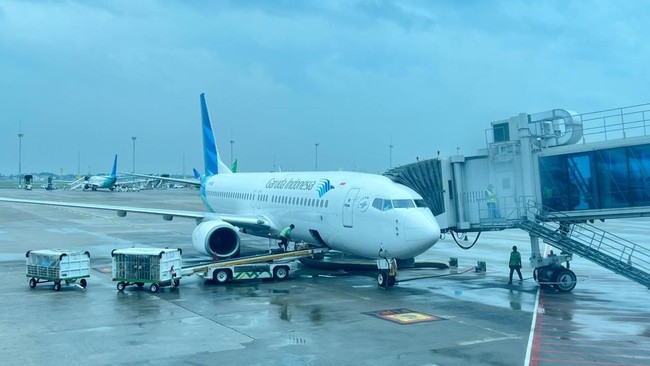
Jakarta, CNBC Indonesia — PT Garuda Indonesia (Persero) Tbk (GIAA) recorded consolidated revenue of US$2.71 billion in the first nine months of 2026. This represented year-on-year growth of 13.2%, or an increase of US$316.4 million compared with the same period last year.
The growth reflects progress in the company’s business transformation agenda, supported by higher revenue from scheduled flight services, a greater contribution from non-aviation businesses, and the recovery of capacity and operational reliability.
Scheduled flights remained the main driver of revenue growth, rising 12.6%, or US$233.2 million. Revenue from non-scheduled flights increased by 2.1%, or US$6.3 million.
Garuda Indonesia President Director Thomas Oentoro said performance through September 2026 offered a positive indication of the direction of the transformation, particularly efforts to strengthen productivity and optimise business potential across the group.
“Sustaining Garuda Indonesia’s growth requires a stronger aviation business foundation, alongside a greater contribution from the group’s entire business ecosystem. Rising non-aviation revenue reflects the potential to develop capabilities and synergies between business entities, which we continue to optimise as part of the transformation to strengthen business resilience and support a sustainable recovery in financial performance,” Thomas said in an official statement on Thursday (29 October 2026).
Thomas said maximising the potential of all business entities was also part of the transformation strategy, supported on an ongoing basis by shareholder Danantara, particularly in strengthening productivity and the effectiveness of asset use.
“With Danantara’s support, we remain focused on improving productivity, maximising the economic value of our assets and capabilities, and strengthening synergies between business entities. These measures are intended to ensure that each business line makes an increasingly optimal contribution to the group’s growth and performance resilience,” he added.
Outside aviation, revenue from non-aviation business lines rose by 31.3% to US$322.8 million, an annual increase of US$77 million. This points to the group’s growing potential to diversify its businesses and broaden its sources of revenue growth.
The results were achieved amid significant cost pressures across the industry, particularly higher jet fuel prices amid volatility in global energy markets and geopolitical developments in the Middle East. During the reporting period, the group’s fuel costs increased by 42.9% year on year, or US$309.8 million, contributing to a 15.7% rise in total operating expenses.
However, growth in operating expenses excluding fuel was contained at around 3.1%, below revenue growth of 13.2%. This reflects progress in cost control and improvements in the company’s operational efficiency.
During the same period, Garuda Indonesia Group recorded operating profit of US$97.2 million, while its consolidated loss for the period narrowed by 3.0% year on year to US$179.3 million. The results indicate that revenue growth and disciplined cost management are beginning to contribute to improved performance, although fuel costs remain a challenge to a sustained recovery in profitability.
As part of its transformation agenda, Garuda Indonesia Group is continuing to develop its non-aviation businesses as a source of growth and strengthen the contribution of all entities across its business ecosystem. The 31.3% increase in non-aviation revenue was supported in part by a 42.4% rise in aircraft maintenance revenue from external customers of GMF AeroAsia, as well as a 76.1% increase in travel agency service revenue.
These developments reflect growing commercial opportunities from the group’s business capabilities and strengthen efforts to diversify revenue alongside passenger aviation. In parallel, fleet recovery initiatives supported increased flight activity and operational reliability during the first nine months of 2026.
By September 2026, the group had 106 serviceable aircraft: 64 operated by Garuda Indonesia and 42 by Citilink. This was 24 more than the 82 aircraft available in the same period last year, as fleet reactivation and operational capacity optimisation continued with Danantara’s support.
The improved availability of aircraft helped lift group passenger traffic to 16.7 million, compared with 15.6 million in the first nine months of 2025. Garuda Indonesia carried around 7.7 million passengers, while Citilink carried around 8.9 million.
The group’s flight frequency also rose by 7.9% year on year to 117,868 flights, from 109,259 in the same period last year.
Operational reliability also improved, with the group’s on-time performance (OTP) reaching 92.01%, up 5.86 percentage points from 86.15% a year earlier.
These developments form part of the company’s operational transformation, particularly the restoration of service capacity and improvements in the consistency and quality of the customer travel experience.
Thomas stressed that fleet recovery must be accompanied by higher productivity and an optimised flight network so that capacity growth delivers more sustainable benefits.
“Restoring aircraft availability is an important part of our transformation. But adding capacity alone is not enough. Each aircraft must be operated more productively, every route must contribute to a more efficient flight network, and customers must experience tangible improvements in reliability and service quality. This is what we continue to pursue so that operational progress can create greater value for both the business and customers,” Thomas said.
Accelerating transformation towards sustainable profitability
Performance through the third quarter of 2026 provides a foundation for Garuda Indonesia Group to continue its transformation in a more focused manner. Revenue growth, an increasing contribution from non-aviation businesses, and the recovery of capacity and operational reliability have created positive momentum for strengthening the company’s business fundamentals.
Maintaining this momentum will nevertheless require disciplined cost management and higher productivity, particularly to ensure that increased business activity translates into more consistent improvements in financial performance.
In the next phase of its transformation, Garuda Indonesia Group will continue to prioritise greater fleet utilisation and productivity, more measured optimisation of its flight network, stronger contributions from businesses across the group, and more effective management of costs and assets.
These priorities are expected to strengthen the group’s competitiveness and financial resilience, while supporting a gradual and sustainable recovery in profitability. Garuda Indonesia’s transformation continues to show positive progress, and the challenge is to maintain that momentum consistently.
“Our focus going forward is to translate every operational improvement and business-strengthening measure into healthier financial performance, while delivering an even better travel experience for customers. Through these efforts, we aim to strengthen Garuda Indonesia’s competitiveness, build long-term business resilience and restore its position as the nation’s flag carrier, capable of competing globally while growing into a world-class company,” Thomas concluded.
Source: jawawa.id (https://jawawa.id/newsitem/garuda-giaa-revenue-grows-13-2-as-it-pushes-business-transformation-1793285426)
Originally published by CNBC Indonesia (https://www.cnbcindonesia.com/market/20261029210517-17-780768/dorong-transformasi-bisnis-pendapatan-garuda--giaa--tumbuh-132), translated from Indonesian