
Garlic Self-Sufficiency Pursued, Production Target Reaches 630,000 Tonnes
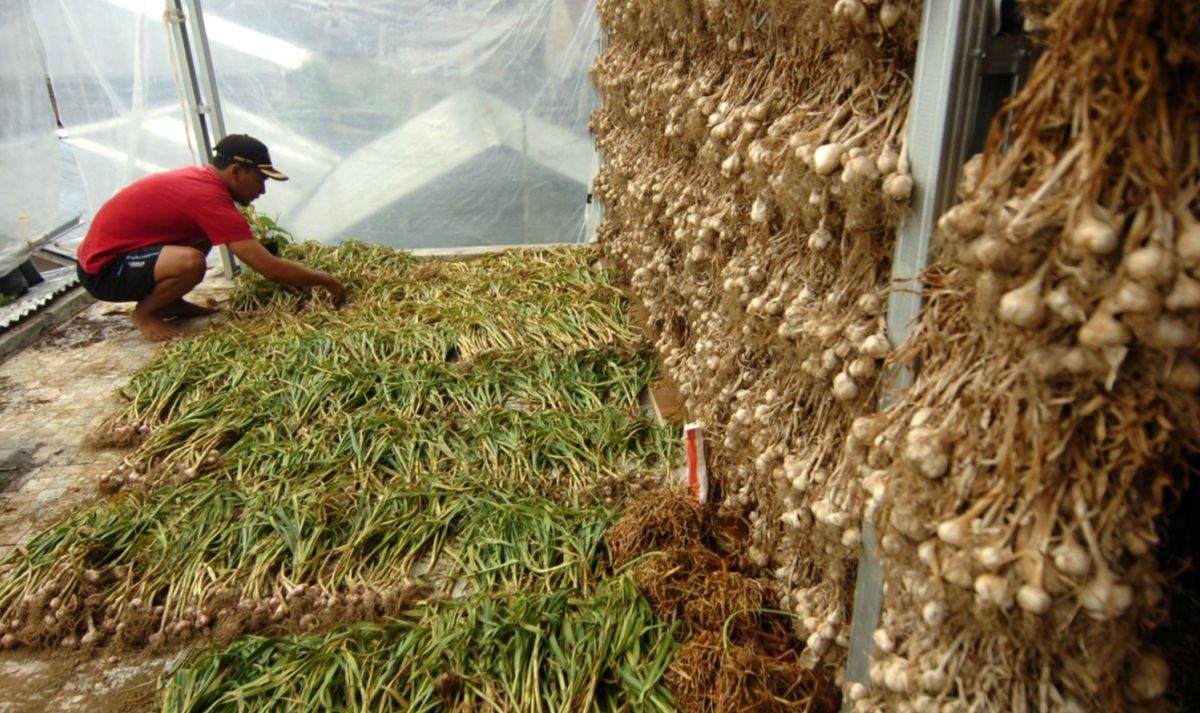
The government is once again pushing for garlic self-sufficiency by preparing various strategies to increase domestic production. Over the next three years, garlic production is targeted to meet national demand while simultaneously reducing dependence on imports.
This target is based on historical precedent; Indonesia once achieved garlic self-sufficiency in 1995, with production reaching 152,421 tonnes. However, domestic production has since steadily declined, with national production recorded at only 39,438 tonnes in 2023. Conversely, domestic garlic needs are still largely met through imports. In 2019, garlic imports reached 602,745 tonnes. While this figure has decreased, it remains at a high level, projected at 525,640 tonnes for 2025.
Several regions that previously served as garlic production centres, such as Temanggung in Central Java, East Lombok in West Nusa Tenggara, and Enrekang in South Sulawesi, are now receiving renewed attention in the effort to develop this commodity. The government has also begun categorising garlic as a strategic commodity that receives special budgetary support, including subsidies for production facilities, particularly fertilisers.
Muhammad Agung Sunusi, Director of Horticulture Seedlings at the Ministry of Agriculture, stated that Indonesia possesses significant land potential to revive garlic production. He shared this during a webinar titled “Subsidised Fertiliser Support for the Acceleration of Garlic Self-Sufficiency,” organised by Tabloid Sinar Tani in collaboration with PT Pupuk Indonesia in Jakarta on Wednesday (16/9).
Agung is optimistic that this land potential can serve as capital for Indonesia to regain garlic self-sufficiency. According to data from the Centre for Assembly and Modernisation of Agriculture (BRMP) of Agricultural Land Resources (SDLP), the potential land for garlic cultivation reaches 1.52 million hectares. This potential is spread across various regions: Sumatra (699,048 hectares), Java (327,081 hectares), Kalimantan (14,065 hectares), Sulawesi (247,232 hectares), Bali and Nusa Tenggara (180,454 hectares), and Maluku and Papua (55,577 hectares).
For 2026, the government has set garlic development on 5,000 hectares of land. Central Java has received the largest allocation with 2,240 hectares, followed by West Nusa Tenggara with 762 hectares, North Sumatra with 563 hectares, East Java with 358 hectares, and West Java with 245 hectares.
Despite the vast land potential, Agung acknowledged several challenges in achieving self-sufficiency. These include improving competitiveness in terms of bulb size and price, increasing local garlic consumption, and strengthening human resources, particularly among farmers. Consequently, the government is accelerating garlic production from the upstream to the downstream sectors with support from the State Budget (APBN).
“Given the high challenge of garlic imports, steps must be taken to reduce imports gradually. The government has created a scenario to achieve self-sufficiency in both garlic seeds and consumable garlic,” he said.
Under this scenario, in 2026, the area for garlic seed production is targeted to reach 5,000 hectares with a production of 20,000 tonnes of seeds. In 2027, the planting area is targeted to increase to 20,000 hectares with seed production reaching 80,000 tonnes. By 2028, the planting area is targeted to reach 80,000 hectares, with seed production of 120,000 tonnes and consumable garlic production of approximately 320,000 tonnes. Furthermore, by 2029, the planting area is targeted to reach 120,000 hectares, with seed production projected at 120,000 tonnes and consumable garlic production targeted at 630,000 tonnes.
To achieve these targets, the government is preparing strategies for both upstream and downstream sectors. In the upstream sector, the strategy focuses on research to increase productivity, including enlarging bulb size, accelerating dormancy, and developing high-productivity cultivation technologies. In the downstream sector, the government is preparing strategies involving promotion, expansion of market access, and the development of partnerships.
“Currently, we have also proposed the issuance of Government Purchase Price (HPP) regulations for wet bulb garlic at Rp 12,000/kg and the Government Reference Price for dry seed bulbs at Rp 46,000/kg,” he added.
Inti Pertiwi Nashwari, Head of the BRMP Horticulture Centre, revealed that national garlic development still faces several issues. These include limited suitable land, inadequate availability of high-quality seeds, low productivity and cultivation efficiency, and pest and disease attacks.
Additionally, garlic production costs remain relatively high. Farmers also face the risk of crop failure due to climate and weather conditions, while the competitiveness of domestic garlic faces pressure from imported products. Other constraints include post-harvest infrastructure and facilities that still need strengthening.
To address these issues, the BRMP Horticulture is preparing several production increase strategies. One of these is strengthening the seed system by assembling new superior varieties (VUB) that are adaptive to climate change and can be developed in medium altitudes. Rapid and mass seed technology, including through tissue culture, is also part of the strategy.
In 2026, the production of source seeds by BRMP Horticulture will be developed on 177 hectares with a target production of 593 tonnes of source seeds. Locations include North Sumatra (13 hectares), Jambi (5 hectares), South Sumatra (3 hectares), West Java (106 hectares), Central Java (20 hectares), East Java (5 hectares), and West Nusa Tenggara (25 hectares).
“We are also continuously seeking technology so that in the future, garlic can also be planted off-season. Additionally…”