
Gapasdap: Ketapang Queues Caused by Insufficient Port Capacity, Not Ship Shortage
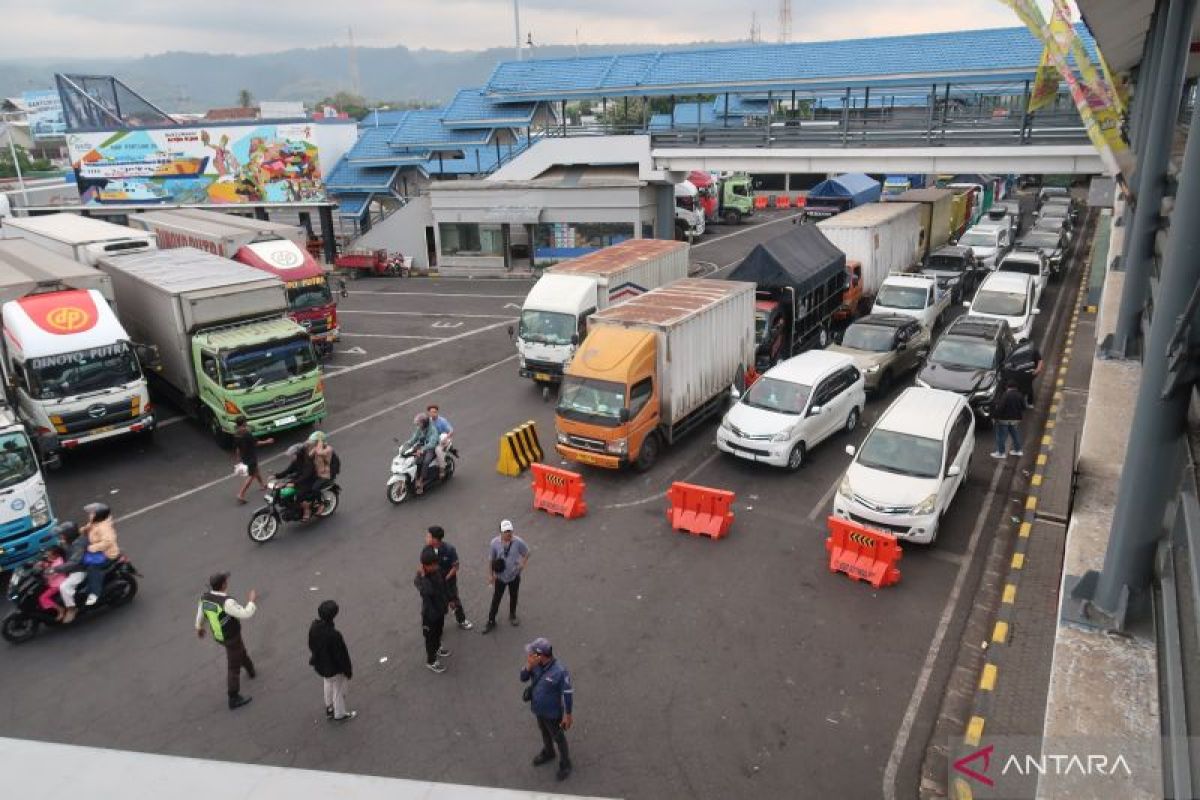
Banyuwangi (ANTARA) - The Association of National Entrepreneurs of River, Lake, and Ferry Transport (Gapasdap) has stated that the main cause of long queues at Ketapang Port, Banyuwangi, East Java, is not a shortage of vessels, but rather port infrastructure capacity failing to keep pace with the growth in vehicle numbers.
Gapasdap Chairman Khoiri Soetomo expressed concern regarding the increasing density of vehicle traffic on the Ketapang-Gilimanuk crossing route over recent days during the school holiday period. “This issue cannot be viewed merely as a seasonal problem that only appears during Eid or long holidays, but has become a structural issue that requires a swift and permanent solution,” he stated in Banyorkan, Saturday.
Khoiri revealed that for years, whenever vehicle queues occurred at the Bali Strait crossing, the proposed solutions always involved adding more ships, bringing in larger vessels, operating faster ships, or requesting operators to increase fleet investment. Ferry operators have met these demands, and vessel investment continues so that the fleet becomes more modern, larger, safer, and more numerous. However, port infrastructure development has not progressed at the same speed.
He noted that there are currently approximately 56 ships ready to serve the Ketapang-Gilimanuk route, but capacity and the number of piers remain limiting factors, forcing many ships to wait for their turn to berth and for schedules to operate. “As a result, ship waiting times increase, fleet productivity decreases, and vehicle queues on land grow longer,” said Khoiri.
According to Khoiri, this highly strategic crossing connecting Java and Bali, which serves as the logistics distribution gateway to Nusa Tenggara, still faces basic infrastructure limitations. Some piers currently in use are LCM-type piers, which are no longer ideal for serving modern passenger motor ships (KMP).
The Gapasdap Chairman expressed appreciation to the East Java Provincial Government, which has shown genuine concern for the development of ferry ports. The LCM pier on Banyuwangi Regency land was built with support from the East Java Provincial Government, as was the MB IV Pier. Meanwhile, the MB III and Bulusan Piers, located on ASDP land, were also built with support from the provincial government.
At the Bulusan Pier, there are plans for local government development to expand and build a connecting bridge between Bulusan Pier and the LCM and MB IV Piers. This would facilitate logistics vehicles by preventing them from having to enter and exit national roads, which causes congestion outside the port area. “However, Bulusan Pier can no longer be used as an additional pier because two of its berthing dolphins are damaged and one is in poor condition, meaning ships cannot berth safely,” said Khoiri.
Khoiri admitted he has repeatedly submitted letters, studies, and proposals to the Ministry of Transportation requesting the construction of new piers, rehabilitation of damaged facilities, construction of breakwaters, expansion of the port basin, and an immediate increase in port capacity. He noted that infrastructure development cannot be carried out just days before the holiday rush; it requires planning, budgeting, and implementation that must begin long before the need becomes a crisis.
“We hope the Indonesian House of Representatives (DPR RI) gives greater attention to the development of ferry ports as part of national strategic infrastructure,” said Khoiri. “We also request the attention of the President of the Republic of Indonesia to lead the acceleration of ferry port infrastructure development, so that national policy no longer focuses solely on increasing fleets, but also on developing infrastructure,” he added.
On another occasion, the Deputy President Director of PT ASDP Indonesia Ferry (Persero), Yossianis Marciano, revealed that this year (2026), ASDP will strive to improve facilities and infrastructure, including adding piers on both the Ketapang and Gilimanuk sides of the port. “We will also rearrange the ports, both at Ketapang and Gilimanuk, to ensure smoother operations in the future,” he said.