
Gajah Mungkur Reservoir in Wonogiri Dries Up, Revealing Hundreds of Ancient Graves
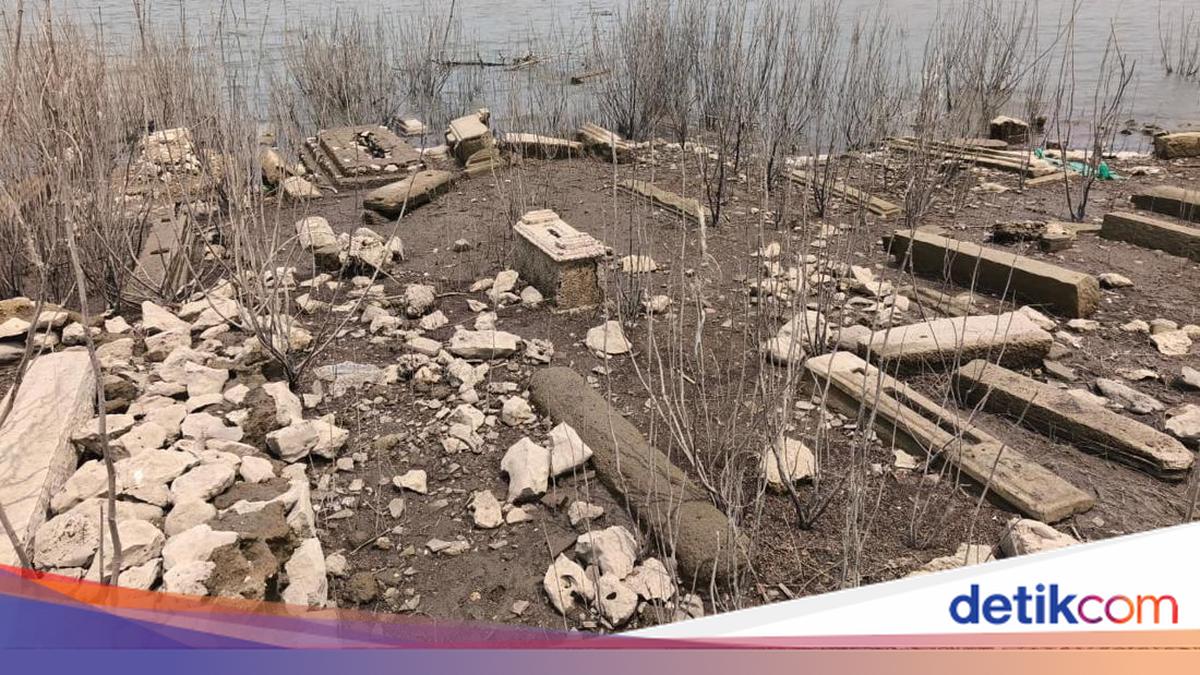
Water levels at Gajah Mungkur Reservoir (WGM) have fallen because of a prolonged dry spell, revealing an ancient cemetery complex. One of the best-known sites is the cemetery in Sentono hamlet, Wuryantoro, Wonogiri, Central Java.
“It started to become visible at the beginning of last month. The water has receded further, so now the entire cemetery can be seen,” said Mardi, a local resident, as quoted by detikJateng on Saturday (10 October 2026).
Hundreds of gravestones are visible at the Sentono hamlet cemetery, which was formerly in Ngungkingsari village. The cemetery appears to have once had a perimeter wall, as remnants resembling foundations remain at its western end.
Mardi said residents of Ngungkingsari village had relocated to Sumatra, but when the reservoir’s water level falls like this, some return to see their former home.
“A group came here some time ago. If I’m not mistaken, they used to live in Pondok hamlet, one of the hamlets that was submerged. They came to retrace their steps and visit their former village,” he said.
Separately, Wuryantoro community figure Suparso, 77, said the Sentono hamlet cemetery had once been quite large, covering roughly half the size of a football pitch.
“It was the hamlet cemetery, in Sentono village, within Ngungkingsari. It was quite large, perhaps half the size of a football pitch. The gravestones were made of hard, white stone and were simple, just elongated stones,” Suparso said.
Source: jawawa.id (https://jawawa.id/newsitem/gajah-mungkur-reservoir-in-wonogiri-dries-up-revealing-hundreds-of-ancient-graves-1791730284)
Originally published by detikcom (https://news.detik.com/berita/d-8702543/waduk-gajah-mungkur-di-wonogiri-mengering-ratusan-makam-kuno-bermunculan), translated from Indonesian