
Gajah Mungkur Floating Solar Plant Begins Construction, Could Meet 37% of Wonogiri's Electricity Needs
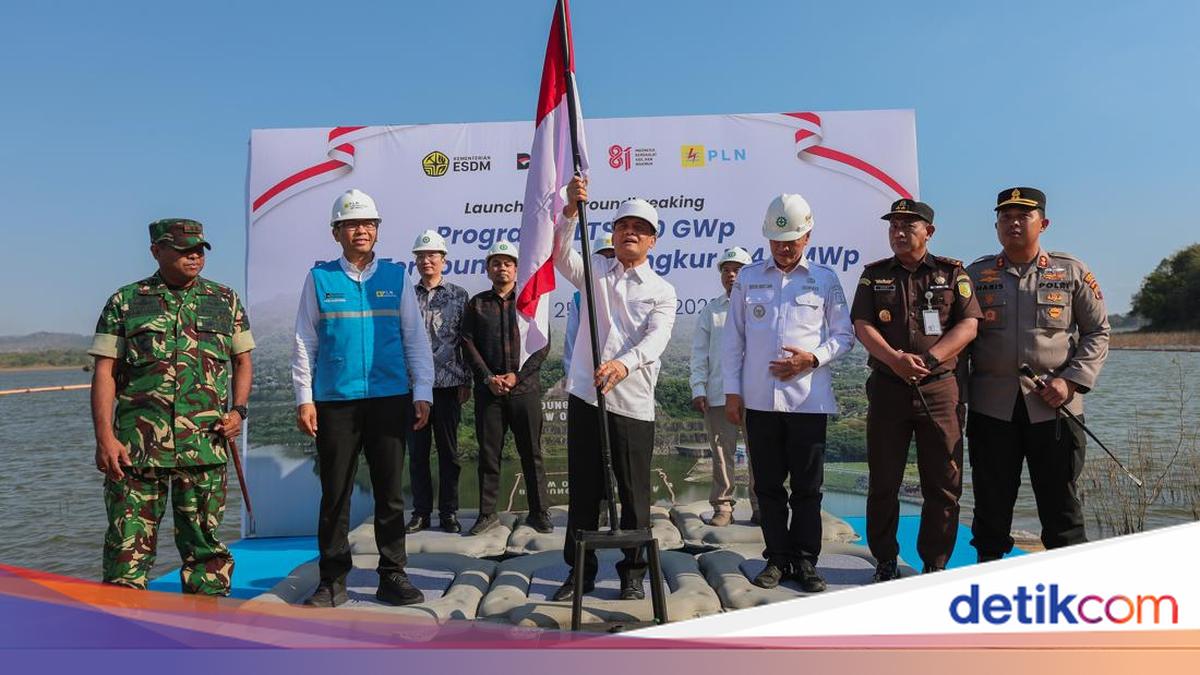
The groundbreaking for the Gajah Mungkur Floating Solar Power Plant was carried out simultaneously with the launch of the 100 GWp Solar Power Plant Programme led by President Prabowo Subianto from Bali on Tuesday (25/8). A total of 14 solar power plants with a combined capacity of 5.2 gigawatt peak (GWp) were launched at that time, one of which was the Gajah Mungkur Floating Solar Power Plant.
In Wonogiri, the event was attended directly by Central Java Governor Ahmad Luthfi, along with regional government officials, PT PLN, water resource managers, and the project developer. “Today we are carrying out the groundbreaking related to the solar power plant. In Central Java, this is one of the largest solar power plants in Wonogiri, with a capacity of 134 megawatt peak,” said Luthfi in his statement on Tuesday (25/8/2026).
Once operational, the Gajah Mungkur solar power plant is projected to generate approximately 218 GWh of electricity per year. This amount is equivalent to around 37 percent of Wonogiri Regency’s electricity needs in a single year. Luthfi stated that the investment for the construction of the Gajah Mungkur Floating Solar Power Plant reached approximately Rp1.6 trillion and is targeted to be operational by 2027.
According to Luthfi, the development of new renewable energy will become one of Central Java’s priorities to reduce dependence on fossil fuels. General Manager of PT PLN Central Java Distribution Unit, Bramantyo Anggun Pambudi, explained that electricity from the Gajah Mungkur solar power plant will be transmitted through a 150 kilovolt network to the Nguntoronadi Substation, located approximately 11.7 kilometres away.
Once connected to the Java-Madura-Bali interconnection network, the electricity will not only be used in the area surrounding the Gajah Mungkur Reservoir. “When the electricity has entered the interconnection network, it is not specifically for the surrounding area. It can also be distributed to all areas connected to the interconnection network,” said Bramantyo.
Meanwhile, Director of Gas Power Plant Operations at PT PLN Indonesia Power, Daniel Eliawardhana, said that preparations and technical aspects of the project are currently underway. “In terms of the time target, as conveyed by the Governor earlier, by the end of 2027 this can be operational at 134 megawatt peak,” he said.
In addition to Gajah Mungkur, solar power development in Central Java is also planned at the Kedung Ombo Reservoir with a capacity of approximately 100 MWac. Another project with a capacity of around 7.4 MW is also being prepared in Karimunjawa.
The construction of the Gajah Mungkur solar power plant is part of the 100 GWp Solar Power Plant Programme developed by the government nationally to strengthen energy security and independence. Prabowo emphasised that the government is serious about pursuing the construction of solar power plants. He is targeting the 100 GWp solar capacity to be built within three years.
According to Prabowo, the energy development is part of Indonesia’s efforts to strengthen energy independence. Minister of Energy and Mineral Resources, Bahlil Lahadalia, said the 100 GWp Solar Power Plant Programme nationally is estimated to require investment of around US$73 billion, or more than Rp1,140 trillion.
The programme is projected to create approximately 5.52 million jobs while generating energy subsidy efficiency of around Rp73.9 trillion per year.
Specifically for the Gajah Mungkur Floating Solar Power Plant, the panel area is planned to occupy less than 5 percent of the Gajah Mungkur Reservoir’s total area of approximately 5,600 hectares. The layout has been prepared taking into account changes in the reservoir’s water level while maintaining routes for community activities and fishermen.
During the construction phase, the project is also estimated to require around 150 to 250 support workers who can be recruited from the local community through contractors.